English translation
Load image
AI Article Decision Snapshot
Turn the lesson into workflow, model, budget, and security checks before choosing tools.
Use this quick snapshot before leaving the article. It keeps the next search tied to practical AI software, model/API, cost, privacy, and implementation questions.
Workflow fit
Identify the real job behind the article: coding, research, document review, support, analytics, content, or internal automation.
Model or tool decision
Decide whether the next step is a software shortlist, an AI tool comparison, an API platform choice, or a model benchmark.
Budget and usage signal
Estimate seats, API calls, prompt volume, retries, review time, and fallback work before assuming the workflow is cheap.
Security and privacy review
Check whether source code, customer data, private documents, prompts, logs, or embeddings will enter the AI workflow.

The core idea behind SVD applications is to preserve dominant structural components while discarding weak, noisy ones. Image compression, recommendation systems, and PCA can all be understood from this perspective.

I’ll plot the singular value decay curve. The number of dimensions to retain should not be decided by intuition alone.
In the previous article, we delved deeply into how to compute singular values and related concepts. Singular Value Decomposition (SVD) is a powerful mathematical tool with broad applications across many domains—especially in data analysis, signal processing, and machine learning. Next, we’ll focus on practical SVD applications, illustrating how it functions effectively in diverse real-world scenarios.
1. Dimensionality Reduction
1.1 Application Context

While reading this section, treat “dimensionality reduction → application context → example: image compression → sample code” as a verification checklist: first identify the object, the action, and the decision criteria; then revisit the concrete examples, code, or evaluation metrics for validation.
When dealing with high-dimensional data, dimensionality reduction is a common requirement. High-dimensional data not only consumes large storage space and incurs high computational cost, but also risks the so-called “curse of dimensionality.” SVD provides an effective approach to reduce dimensionality.
1.2 Example: Image Compression
Suppose we have a grayscale image whose pixel intensities can be represented as a matrix . We can apply SVD to decompose this matrix:
Here, , , and are matrices obtained via SVD, where is a diagonal matrix containing the singular values.
To compress the image, we retain only the top largest singular values (along with the corresponding columns of and rows of ), and construct an approximated matrix :
By choosing a relatively small , we achieve significant compression while preserving most of the essential visual information.
1.3 Sample Code
Below is a simple Python implementation using NumPy to perform image compression:
import numpy as np
import matplotlib.pyplot as plt

# Load image
image = plt.imread('image.jpg')  # Assume grayscale image
# Convert to matrix form
A = image[:, :, 0]

# Perform SVD
U, S, Vt = np.linalg.svd(A, full_matrices=False)

# Retain top k singular values
k = 50
A_k = np.dot(U[:, :k], np.dot(np.diag(S[:k]), Vt[:k, :]))

# Display original and compressed images
plt.subplot(1, 2, 1)
plt.title('Original Image')
plt.imshow(A, cmap='gray')

plt.subplot(1, 2, 2)
plt.title('Compressed Image')
plt.imshow(A_k, cmap='gray')
plt.show()
2. Recommendation Systems
2.1 Application Context
After finishing “Applications of SVD,” reflect on three questions:
- What problem does it solve?
- At which step is error most likely to occur?
- Can I reproduce it end-to-end with a small, self-contained example?
Recommendation systems play a critical role in e-commerce, social media, and content platforms. Leveraging SVD, we can reduce the dimensionality of user–item interaction matrices to uncover latent user preferences.
2.2 Example: Collaborative Filtering
In a simple recommendation scenario, user ratings for items can be organized into a rating matrix . Applying SVD yields an approximation:
Here, encodes latent user features, and encodes latent item features. By reconstructing a low-rank approximation of , we can predict missing ratings for unrated items.
2.3 Sample Code
A minimal Python implementation for collaborative filtering:
import numpy as np

# User–item rating matrix (example)
R = np.array([[5, 4, 0, 1],
              [4, 0, 0, 1],
              [1, 1, 0, 5],
              [1, 0, 5, 4]])

# Perform SVD
U, S, Vt = np.linalg.svd(R, full_matrices=False)

# Reconstruct rating matrix
k = 2  # Number of latent features
R_approx = np.dot(U[:, :k], np.dot(np.diag(S[:k]), Vt[:k, :]))

# Print reconstructed rating matrix
print("Reconstructed Rating Matrix:")
print(R_approx)
3. Noise Filtering and Signal Processing
3.1 Application Context
In signal processing, SVD is widely used for noise filtering and signal extraction. By applying SVD to a signal matrix, we can readily separate signal components from noise components—thereby suppressing noise and enhancing overall signal quality.
3.2 Example: Denoising
Suppose we have a time-series dataset contaminated with noise. We can arrange observations into a matrix—e.g., each row representing measurements at different time points. Performing SVD on this matrix and retaining only the top few singular values allows us to reconstruct a denoised version of the signal matrix.

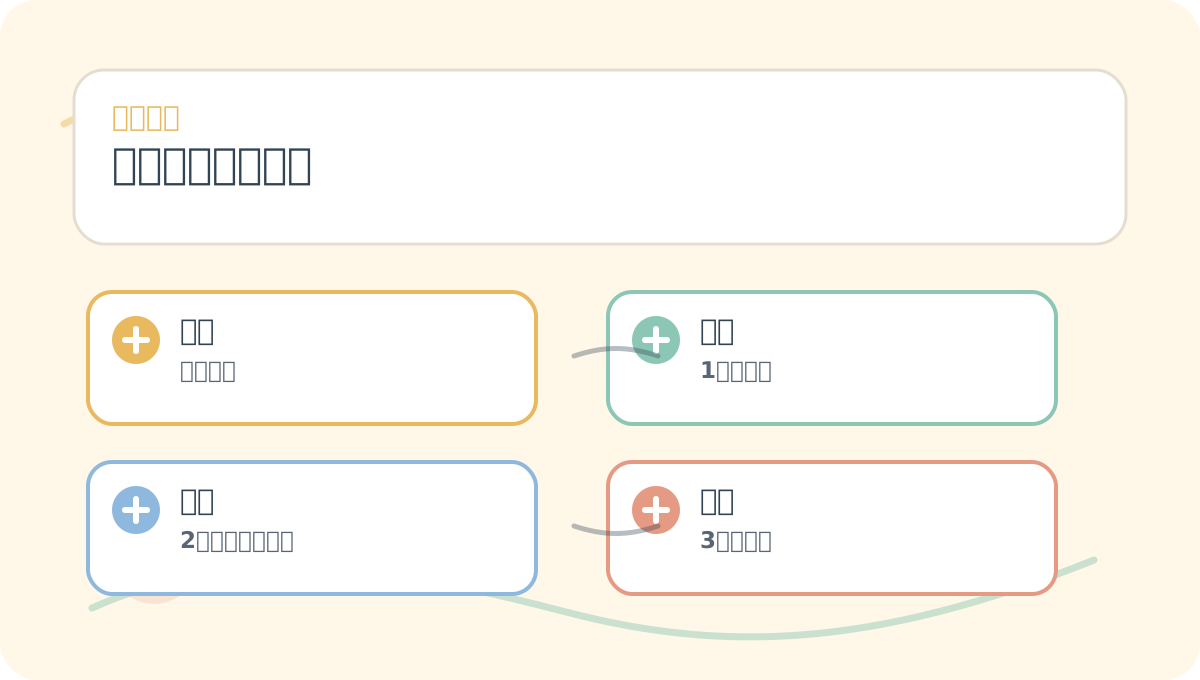
If you haven’t fully internalized “Applications of SVD” yet, use the four actions on this card to walk through the material again.

When reviewing “Applications of SVD,” there’s no need to launch a large-scale project right away. Start instead with one simple, illustrative example to verify whether the core logic is clear.
Summary
Singular Value Decomposition is a powerful and versatile tool, widely applied in dimensionality reduction, recommendation systems, and signal processing. By decomposing data via SVD, we not only extract its fundamental structural patterns but also achieve effective compression and noise suppression. As AI and machine learning continue to advance, a solid understanding of linear algebra—and especially its practical applications—will provide increasingly strong support for data processing and analysis.
In our next article, we’ll explore how linear algebra underpins machine learning—examining its pivotal role in model construction and optimization algorithms. Stay tuned!
Apply This Lesson
Turn this article into AI software, model, API, and security decisions.
English Article FAQ
Use this article as evidence before choosing AI tools
How should I use this AI Tutorials article?
Use it as the implementation or learning layer, then connect the idea to AI software buyer guides, tool comparisons, benchmarks, API choices, and security checks before making a production decision.
Is this English article different from the Chinese original?
The English edition is localized for global AI readers while preserving the original diagrams, screenshots, prompts, code examples, and source context from the Chinese article.
What should I read after Load image?
Continue with AI Software Buyer Guides, AI Tools Workbench, Best AI Coding Agents, AI Model Benchmarks, OpenAI vs Anthropic API, or LLM Security Tools depending on the decision you need to make.
Can this article alone choose an AI product or model?
No. Treat the article as evidence and context, then validate fit with pricing, privacy requirements, integration effort, benchmark results, workflow tests, and fallback planning.
Continue