English translation
Generate sample data
AI Article Decision Snapshot
Turn the lesson into workflow, model, budget, and security checks before choosing tools.
Use this quick snapshot before leaving the article. It keeps the next search tied to practical AI software, model/API, cost, privacy, and implementation questions.
Workflow fit
Identify the real job behind the article: coding, research, document review, support, analytics, content, or internal automation.
Model or tool decision
Decide whether the next step is a software shortlist, an AI tool comparison, an API platform choice, or a model benchmark.
Budget and usage signal
Estimate seats, API calls, prompt volume, retries, review time, and fallback work before assuming the workflow is cheap.
Security and privacy review
Check whether source code, customer data, private documents, prompts, logs, or embeddings will enter the AI workflow.

Machine learning training is commonly expressed in matrix form: a batch of samples is processed simultaneously to compute predictions, followed by parameter updates based on the prediction error.

I’ll align the shapes (X.shape, w.shape, and output shape) explicitly in code. Most training errors can be caught right here.
In the previous tutorial, we explored Singular Value Decomposition (SVD) and its critical role in data dimensionality reduction. This article continues our deep dive into applications of linear algebra in machine learning—helping you understand how to leverage linear algebra concepts and tools to enhance model performance and computational efficiency.
Review of Fundamental Linear Algebra Concepts
In machine learning, data is typically represented as matrices. We use matrices to encode features, samples, and model weights—making mastery of core linear algebra concepts essential. Key ideas include:
- Vectors: The basic unit of data—usually represented as a one-dimensional array (column vector) of numerical values.
- Matrices: Two-dimensional arrays composed of vectors, used to represent relationships among multiple samples and features.
- Transpose: An operation that swaps rows and columns of a matrix, denoted .
- Inner and Outer Products: The inner (dot) product measures similarity between two vectors; the outer product is frequently used when constructing matrices.
Linear Regression and Its Linear Algebra Foundation
Linear regression is one of the most fundamental machine learning models. Its goal is to fit a linear equation to known data points in order to predict outputs. The model is expressed as:
where is the target (output) vector, is the feature matrix, is the parameter (weight) vector, and is the error term.
During training, we solve for the optimal by minimizing a loss function—commonly the squared Euclidean norm of the residual:
Using linear algebra, this optimization yields the normal equation, providing a direct closed-form solution:
This matrix-based derivation enables efficient, analytical computation of regression parameters—bypassing iterative optimization entirely.
Principal Component Analysis (PCA)
Principal Component Analysis is a widely used dimensionality reduction technique that identifies the directions (principal components) along which data exhibits maximum variance. At its core, PCA relies heavily on linear algebra: it transforms high-dimensional data into a lower-dimensional space while preserving as much structural information as possible.
The standard PCA pipeline includes:
- Data Standardization: Compute the mean and standard deviation for each feature, then center and scale the data so each feature has zero mean and unit variance.
- Covariance Matrix Computation: Capture pairwise feature relationships via the covariance matrix: (assuming is already centered).
- Eigendecomposition: Decompose the covariance matrix to obtain eigenvalues (representing variance explained) and eigenvectors (defining principal component directions).
- Component Selection: Retain the top- eigenvectors corresponding to the largest eigenvalues to define a new -dimensional feature subspace.
Below is a minimal working implementation of PCA:
import numpy as np

# Generate sample data
data = np.array([[2.5, 2.4],
                 [0.5, 0.7],
                 [2.2, 2.9],
                 [1.9, 2.2],
                 [3.1, 3.0],
                 [2.3, 3.2],
                 [3.0, 3.0],
                 [2.0, 1.6],
                 [1.0, 1.1],
                 [1.5, 1.6]])

# Center the data
data_meaned = data - np.mean(data, axis=0)

# Compute covariance matrix
cov_mat = np.cov(data_meaned, rowvar=False)

# Eigendecomposition
eigenvalues, eigenvectors = np.linalg.eigh(cov_mat)

# Select top-k eigenvectors (here k = 1)
k = 1
top_k_eigenvectors = eigenvectors[:, -k:]

# Project data onto the new subspace
reduced_data = np.dot(data_meaned, top_k_eigenvectors)

print("Dimensionality-reduced data:")
print(reduced_data)
In this example, PCA reduces 2D data to 1D, extracting the dominant direction of variation. Such transformations reduce computational overhead and improve training efficiency—especially valuable when handling high-dimensional datasets.
Linear Algebra in Decision Trees
Although decision trees are not inherently linear models, linear algebra underpins several key aspects of their construction. Metrics like information gain and the Gini index, used for feature selection and node splitting, rely on statistical summaries—including means and variances—computed over subsets of data. These operations involve vectorized aggregations and matrix-like partitioning logic, making them conceptually grounded in linear algebra.
After reading Applications of Linear Algebra in Machine Learning, start with a small end-to-end example. Then assess which steps you can now implement independently.
By this point, organize Applications of Linear Algebra in Machine Learning into a reflection table: first articulate the central narrative, then validate it using a concrete mini-task and its outcome.

While reading, treat the sequence “Review of Linear Algebra Fundamentals → Linear Regression & Linear Algebra → Principal Component Analysis (PCA) → Linear Algebra in Decision Trees” as a verification thread: first clarify the concepts, actions, and expected outcomes, then revisit case studies, code snippets, or evaluation metrics to cross-check understanding.
Summary
This section clarified several practical applications of linear algebra in machine learning—particularly in linear regression and dimensionality reduction techniques like PCA. These methods provide both interpretability and computational efficiency, enabling robust data analysis and accurate prediction. In the next article, we’ll explore how linear algebra powers deep learning—stay tuned!
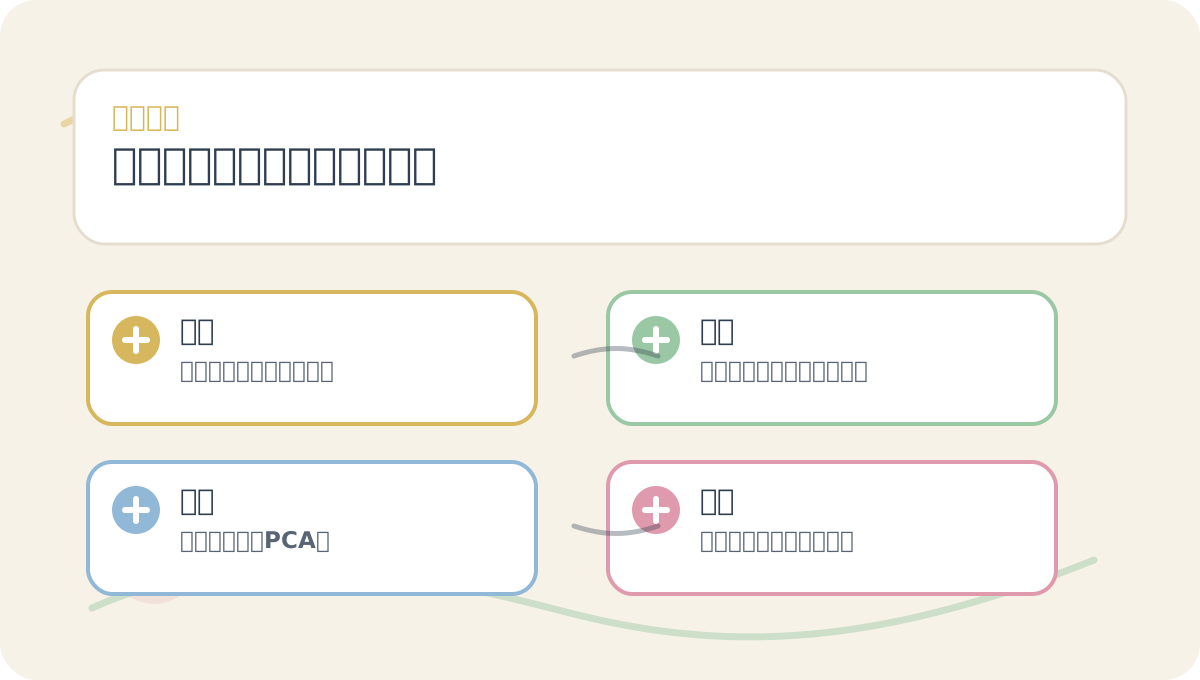
When reading Applications of Linear Algebra in Machine Learning, begin with the visuals: identify the tasks, core concepts, practice prompts, and judgment checkpoints shown in the figures—then return to the main text to fill in technical details. This approach helps you quickly map the content to real-world scenarios and assess its applicability.
Apply This Lesson
Turn this article into AI software, model, API, and security decisions.
English Article FAQ
Use this article as evidence before choosing AI tools
How should I use this AI Tutorials article?
Use it as the implementation or learning layer, then connect the idea to AI software buyer guides, tool comparisons, benchmarks, API choices, and security checks before making a production decision.
Is this English article different from the Chinese original?
The English edition is localized for global AI readers while preserving the original diagrams, screenshots, prompts, code examples, and source context from the Chinese article.
What should I read after Generate sample data?
Continue with AI Software Buyer Guides, AI Tools Workbench, Best AI Coding Agents, AI Model Benchmarks, OpenAI vs Anthropic API, or LLM Security Tools depending on the decision you need to make.
Can this article alone choose an AI product or model?
No. Treat the article as evidence and context, then validate fit with pricing, privacy requirements, integration effort, benchmark results, workflow tests, and fallback planning.
Continue