English translation
Assume we have historical stock price data
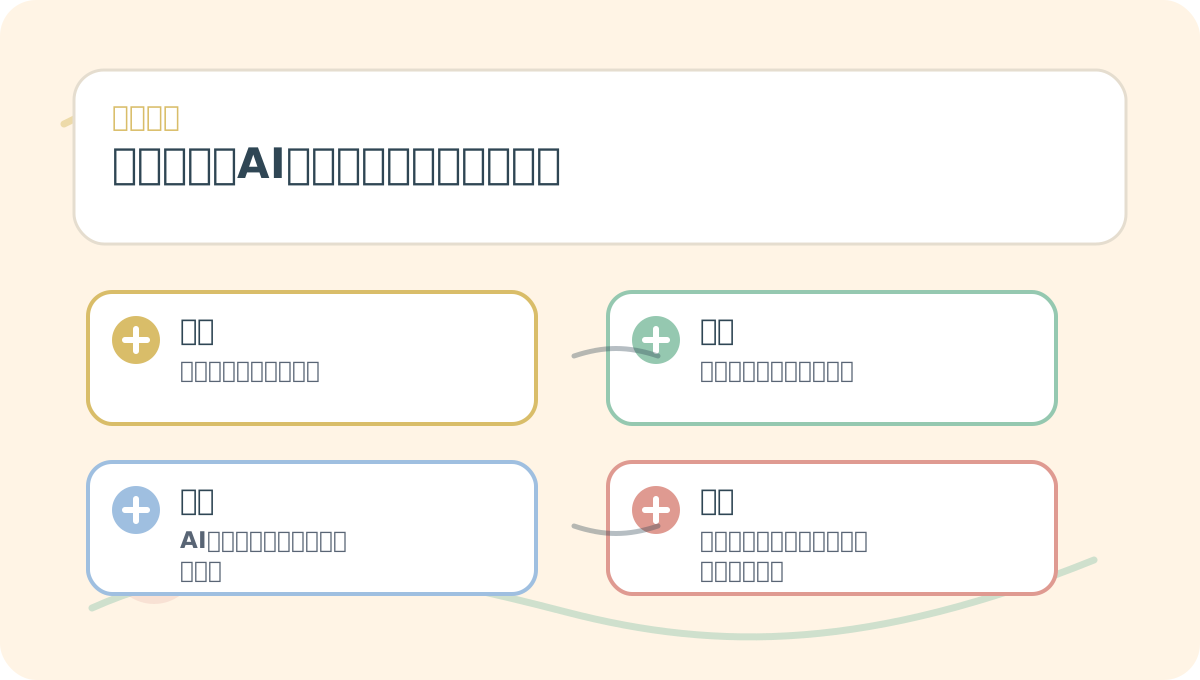
AI Article Decision Snapshot
Turn the lesson into workflow, model, budget, and security checks before choosing tools.
Use this quick snapshot before leaving the article. It keeps the next search tied to practical AI software, model/API, cost, privacy, and implementation questions.
Workflow fit
Identify the real job behind the article: coding, research, document review, support, analytics, content, or internal automation.
Model or tool decision
Decide whether the next step is a software shortlist, an AI tool comparison, an API platform choice, or a model benchmark.
Budget and usage signal
Estimate seats, API calls, prompt volume, retries, review time, and fallback work before assuming the workflow is cheap.
Security and privacy review
Check whether source code, customer data, private documents, prompts, logs, or embeddings will enter the AI workflow.

State-space models describe how a system evolves over time using matrices. They unify historical states, external inputs, and observed outputs within a single linear framework.

I distinguish clearly among state, input, and output. When these three are conflated, state-space models quickly lose interpretability.
In the previous article, we explored the importance of linear algebra in deep learning—particularly how it helps us understand and design neural networks. In this article, we focus on the application of linear algebra in state-space models, which is critical for many artificial intelligence tasks, especially in control systems and time-series forecasting.
What Is a State-Space Model?
A state-space model is a dynamic system model commonly used to describe how a system’s internal state changes over time. It leverages the framework of linear algebra to express relationships among the system’s inputs, outputs, and internal states via a set of equations. A linear state-space model takes the following canonical form:

While reading this article, treat the sequence “What is a state-space model? → Components of state-space models → Application case in AI: time-series forecasting → Example: implementing a state-space model” as a verification checklist: first clarify the topic, logical pathway, and validation points; then revisit concrete cases, code, or metrics for cross-checking.
Here:
- is the system’s state vector;
- is the input vector;
- is the output vector;
- are the state transition matrix, input matrix, output matrix, and direct transmission (feedthrough) matrix, respectively.
Components of a State-Space Model
- State variables: Variables that capture the internal condition of the system—for example, temperature or velocity.
- Input variables: External signals that influence the system’s state.
- Output variables: Quantities produced by the system—typically those of practical interest.
- State transition matrix : Governs how the state evolves from time to in the absence of inputs.
- Input matrix : Specifies how inputs drive changes in the state.
- Output matrix : Maps the current state to the observable output.
- Direct transmission matrix : Captures instantaneous (feedthrough) effects of inputs on outputs.
You don’t need to absorb every detail of Linear Algebra in AI: State-Space Models all at once. Start with a small, hands-on problem you can verify experimentally—then use the diagrams and main text to fill in conceptual gaps.
Application Case in AI: Time-Series Forecasting
State-space models are widely used in AI for modeling time-series data—for instance, forecasting stock prices in financial markets or predicting meteorological variables. These models excel at capturing the dynamic, time-varying behavior inherent in such data.
Example: Stock Price Forecasting Using a State-Space Model
Suppose we aim to forecast the future price of a stock. We can construct a state-space model as follows:
- Define state variables: Let the state vector include the current stock price, trading volume, and other price-influencing factors.
- Input variables: Incorporate macroeconomic indicators—such as interest rates or GDP growth rates—as elements of the input vector .
- Learn state-transition and output matrices: Estimate matrices from historical data.
Below is a simplified Python example demonstrating time-series forecasting using a state-space model:
import numpy as np
from pykalman import KalmanFilter

# Assume we have historical stock price data
observations = np.array([100, 102, 101, 105, 107]) # Historical prices

# Create a Kalman filter
kf = KalmanFilter(initial_state_mean=100, n_dim_obs=1)

# Define state transition matrix A and observation matrix C
kf.transition_matrices = np.array([[1]])
kf.observation_matrices = np.array([[1]])

# Fit the model to historical observations
kf = kf.em(observations, n_iter=10)
(state_means, state_covariances) = kf.smooth(observations)

print("Estimated state means:", state_means)
In this example, we use the pykalman library’s Kalman filter implementation—a classic state-space estimator—to smooth and infer latent states from sequential observations, enabling future price forecasts.
Advantages of State-Space Models
Key advantages of state-space models include:
- Dynamism: Suitable for online learning and real-time updates—ideal for non-stationary time series.
- Interpretability: Each component (e.g., ) has a clear physical or causal meaning, making system behavior transparent.
- Flexibility: Easily adaptable to diverse input–output configurations across application domains.
After studying Linear Algebra in AI: State-Space Models, try adapting it to your own scenario—pay close attention to whether inputs, internal processing, and outputs align coherently.
To apply Linear Algebra in AI: State-Space Models to your own task, begin by narrowing the scope—focus first on validating just one critical decision point.
Summary
This article introduced the fundamental concepts and structure of state-space models and demonstrated their application in time-series forecasting—including a concrete Python implementation for stock price prediction. Linear algebra provides powerful tools to effectively model and solve complex problems arising in dynamic systems.
In the next article, we will continue exploring additional applications of linear algebra in AI—stay tuned!
Apply This Lesson
Turn this article into AI software, model, API, and security decisions.
English Article FAQ
Use this article as evidence before choosing AI tools
How should I use this AI Tutorials article?
Use it as the implementation or learning layer, then connect the idea to AI software buyer guides, tool comparisons, benchmarks, API choices, and security checks before making a production decision.
Is this English article different from the Chinese original?
The English edition is localized for global AI readers while preserving the original diagrams, screenshots, prompts, code examples, and source context from the Chinese article.
What should I read after Assume we have historical stock price data?
Continue with AI Software Buyer Guides, AI Tools Workbench, Best AI Coding Agents, AI Model Benchmarks, OpenAI vs Anthropic API, or LLM Security Tools depending on the decision you need to make.
Can this article alone choose an AI product or model?
No. Treat the article as evidence and context, then validate fit with pricing, privacy requirements, integration effort, benchmark results, workflow tests, and fallback planning.
Continue