English translation
Activation function
AI Article Decision Snapshot
Turn the lesson into workflow, model, budget, and security checks before choosing tools.
Use this quick snapshot before leaving the article. It keeps the next search tied to practical AI software, model/API, cost, privacy, and implementation questions.
Workflow fit
Identify the real job behind the article: coding, research, document review, support, analytics, content, or internal automation.
Model or tool decision
Decide whether the next step is a software shortlist, an AI tool comparison, an API platform choice, or a model benchmark.
Budget and usage signal
Estimate seats, API calls, prompt volume, retries, review time, and fallback work before assuming the workflow is cheap.
Security and privacy review
Check whether source code, customer data, private documents, prompts, logs, or embeddings will enter the AI workflow.

At its core, neural network computation still consists largely of matrix multiplications. Understanding tensor shapes, weights, and gradients transforms deep learning from mere library invocation into genuine comprehension.

I record tensor shapes layer by layer. As the number of layers increases, systematically documenting shapes is far more reliable than ad-hoc guessing.
In the previous article, we explored the applications of linear algebra in machine learning—particularly emphasizing its importance in data preprocessing and model construction. Today, we delve deeper into the role of linear algebra in deep learning, especially how it helps us understand and optimize neural networks.
Linear Algebra and Neural Networks
The fundamental building block of deep learning is the neural network—and neural networks can be expressed entirely using operations on matrices and vectors. A simple feedforward neural network learns complex functional relationships through linear transformations (e.g., matrix multiplication) followed by nonlinear activation functions (e.g., ReLU, Sigmoid).

While reading this article, treat “Linear Algebra & Neural Networks → Linear Transformation → Nonlinear Activation → Backpropagation” as a checklist: first align the objects, steps, and evidence; then revisit concrete examples, code, or metrics for verification.
Linear Transformations
In a typical deep neural network, input data—usually represented as a feature vector—passes through multiple hidden layers. Each layer can be expressed as a linear transformation (matrix multiplication) plus a bias term:
where is the input to the next layer, is the weight matrix, is the input to the current layer, and is the bias vector.
For example, consider a network with 3 neurons in the input layer and 2 neurons in the hidden layer. This can be written as:
This operation clearly reveals the relationship between inputs and weights.
Nonlinear Activation
After computing the linear transformation, a nonlinear activation function is typically applied to enhance the model’s expressive power. This step is formalized as:
Here, denotes an activation function—such as ReLU or Sigmoid.
Backpropagation
Training neural networks in deep learning commonly relies on the backpropagation algorithm to optimize weights and biases. Backpropagation computes gradients of the loss function with respect to each weight and bias—requiring extensive matrix and vector operations rooted in linear algebra, calculus (especially derivatives), and the chain rule.
For instance, given a loss function , the gradient with respect to the weight matrix is computed via the chain rule:
Each term above can be expressed and computed using matrix and vector operations.
Case Study
Consider a simple deep learning example: classifying handwritten digits (e.g., the MNIST dataset) using a three-layer neural network. Below is a basic Python implementation using NumPy.
import numpy as np

# Activation function
def sigmoid(z):
    return 1 / (1 + np.exp(-z))

# Forward pass
def forward(X, W1, b1, W2, b2):
    z1 = np.dot(X, W1) + b1
    a1 = sigmoid(z1)
    z2 = np.dot(a1, W2) + b2
    output = sigmoid(z2)
    return output

# Example input
np.random.seed(0)
X = np.random.rand(5, 3)  # 5 samples, 3 features each
W1 = np.random.rand(3, 4)  # Layer 1 weights: 3 → 4
b1 = np.random.rand(4)      # Layer 1 bias
W2 = np.random.rand(4, 1)  # Layer 2 weights: 4 → 1
b2 = np.random.rand(1)      # Layer 2 bias

output = forward(X, W1, b1, W2, b2)
print("Network output:\n", output)
In this example, we first generate random input data , then perform forward propagation using predefined weights and biases to obtain the network’s output. By iteratively adjusting , , , and , we can train the model to better classify handwritten digits.
When reviewing “The Role of Linear Algebra in Deep Learning,” place key concepts, procedural steps, and observable outcomes side-by-side on a single page for efficient revision.
When practicing “The Role of Linear Algebra in Deep Learning,” write input conditions, processing actions, and observable outcomes together—making future review straightforward.
Summary
Linear algebra plays a pivotal role in deep learning, primarily manifested in three ways:
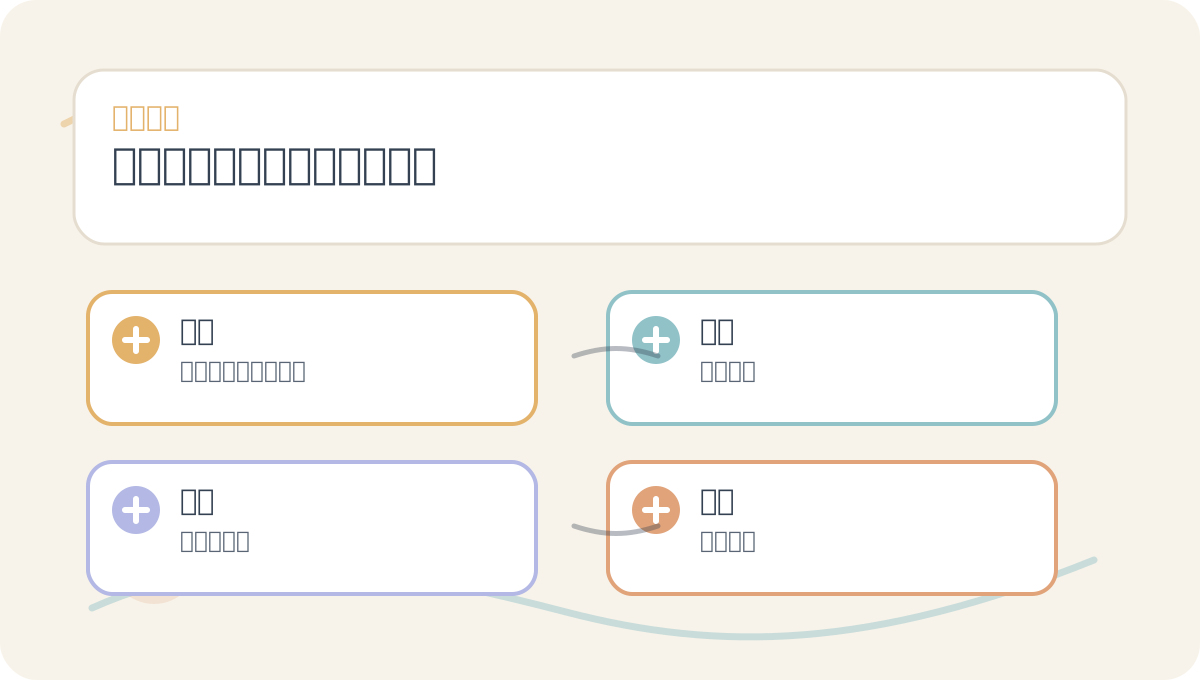
Before reading “The Role of Linear Algebra in Deep Learning,” use the accompanying diagram to confirm the central narrative; after reading, verify which steps you can execute directly—and identify where further study is needed.
- Data Representation: Inputs, weights, and outputs are naturally represented as vectors and matrices.
- Computational Efficiency: Matrix multiplication drastically reduces manual computational complexity, enabling scalable network architectures.
- Backpropagation: Efficient gradient computation via matrix operations underpins effective optimization of neural network performance.
Linear algebra provides not only essential mathematical tools—but also profound insight into the inner workings of complex deep learning models. In the next article, we will explore the application of linear algebra in state-space models, highlighting its critical role in dynamic systems.
Apply This Lesson
Turn this article into AI software, model, API, and security decisions.
English Article FAQ
Use this article as evidence before choosing AI tools
How should I use this AI Tutorials article?
Use it as the implementation or learning layer, then connect the idea to AI software buyer guides, tool comparisons, benchmarks, API choices, and security checks before making a production decision.
Is this English article different from the Chinese original?
The English edition is localized for global AI readers while preserving the original diagrams, screenshots, prompts, code examples, and source context from the Chinese article.
What should I read after Activation function?
Continue with AI Software Buyer Guides, AI Tools Workbench, Best AI Coding Agents, AI Model Benchmarks, OpenAI vs Anthropic API, or LLM Security Tools depending on the decision you need to make.
Can this article alone choose an AI product or model?
No. Treat the article as evidence and context, then validate fit with pricing, privacy requirements, integration effort, benchmark results, workflow tests, and fallback planning.
Continue