English translation
Calculus Fundamentals: Definition and Why It Matters for AI
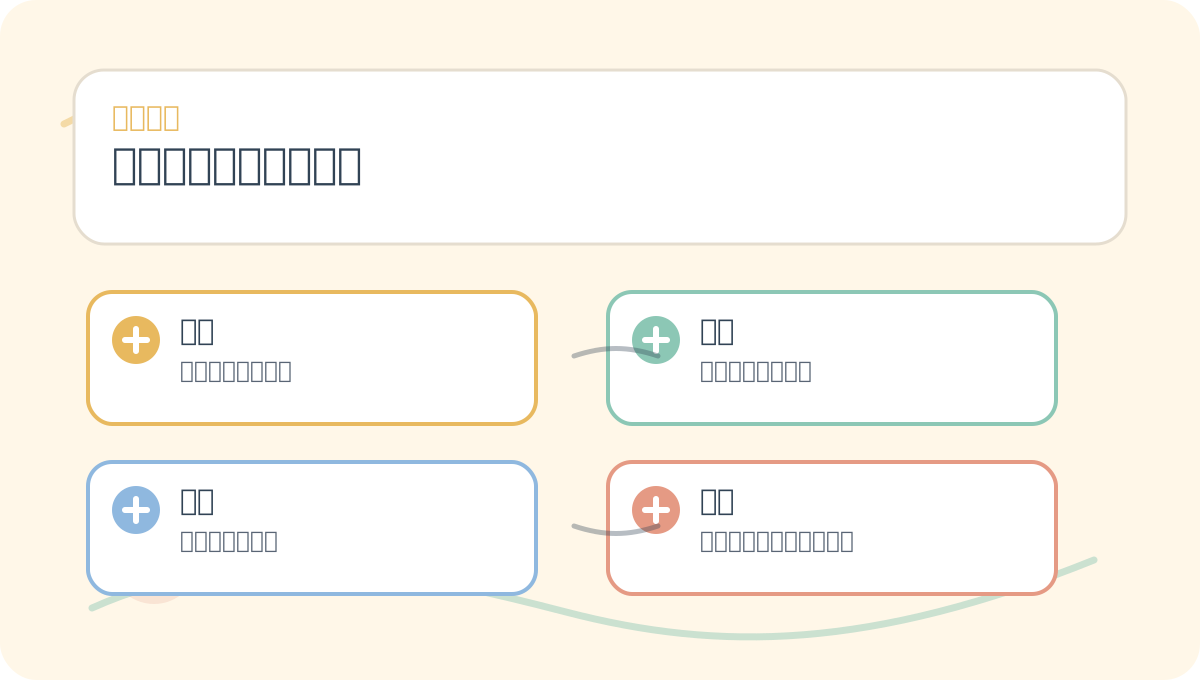
AI Article Decision Snapshot
Turn the lesson into workflow, model, budget, and security checks before choosing tools.
Use this quick snapshot before leaving the article. It keeps the next search tied to practical AI software, model/API, cost, privacy, and implementation questions.
Workflow fit
Identify the real job behind the article: coding, research, document review, support, analytics, content, or internal automation.
Model or tool decision
Decide whether the next step is a software shortlist, an AI tool comparison, an API platform choice, or a model benchmark.
Budget and usage signal
Estimate seats, API calls, prompt volume, retries, review time, and fallback work before assuming the workflow is cheap.
Security and privacy review
Check whether source code, customer data, private documents, prompts, logs, or embeddings will enter the AI workflow.

At its core, calculus is not about complicated notation—it’s about describing continuous change. Derivatives capture instantaneous change, while integrals capture cumulative effect. These two ideas thread through model training and optimization later on.

I first ask: Is the problem asking about an instantaneous rate of change—or about the total quantity over an interval? The phrasing determines which tool to use.

In AI, calculus often operates behind the scenes during training. Start by building intuition around four key words—functions, derivatives, integrals, and optimization—so that when you encounter gradient descent, you’re not just memorizing formulas.
Calculus is a foundational branch of mathematics focused on relationships among continuously changing quantities. Its core ideas are embodied in the concepts of derivatives and integrals. Far more than just a mathematical tool, calculus plays a vital role across science, engineering, economics, medicine, and many other disciplines. A solid understanding of calculus is essential for learning and applying artificial intelligence (AI). Below, we introduce some basic definitions and explore why calculus matters.
Fundamental Definitions of Calculus
Calculus consists of two major parts: differentiation and integration.

When practicing “Definition and Importance of Calculus”, write the input conditions, processing steps, and observable outcomes together—this makes future review easier.

When reviewing “Definition and Importance of Calculus”, place key concepts, procedural steps, and observable outcomes on the same page for efficient re-examination.
After reading “Definition and Importance of Calculus”, reflect on three questions:
-
What problem does it solve?
-
Which step is most error-prone?
-
Can I walk through a small example end-to-end?
-
Differentiation (Derivatives): Differentiation studies how a function changes—specifically, its rate of change. When we want to understand how a function behaves at a single point, we use derivatives. Mathematically, the derivative of a function at point is defined as
This represents the slope—or instantaneous rate of change—of at .
-
Integration (Integrals): Integration is essentially the inverse operation of differentiation. It computes the accumulated quantity of a function over an interval. The definite integral is defined as
and geometrically represents the signed “area” under the curve of over the interval .
Intuitive Understanding of Calculus
To build intuition, consider a simple physical example:
Suppose we analyze the motion of an object whose position (displacement) is described by a function , where denotes time. Differentiating yields the object’s instantaneous velocity:
i.e., the rate at which position changes at time . Conversely, integrating velocity over a time interval gives the net displacement during that period:
Why Calculus Matters
Calculus is indispensable across many domains:
-
Modeling: In scientific research, calculus enables precise mathematical modeling of real-world phenomena—from kinematics in physics to supply-and-demand dynamics in economics.
-
Optimization: Calculus provides tools to locate maxima and minima of functions—a cornerstone of machine learning, where minimizing a loss function is central to model training.
-
Probability and Statistics: In statistics, integrals compute probabilities from probability density functions (PDFs), while derivatives help derive expectations, variances, and other moments.
Case Study: Application in Physics
Consider classical free-fall motion: an object’s height over time follows the quadratic function
where is gravitational acceleration. Differentiating yields instantaneous velocity:
Integrating over any time interval recovers the corresponding displacement.
Summary
Calculus is a powerful framework for modeling and analyzing continuous change—and its influence spans science, engineering, economics, and beyond. In the next section, we’ll dive into concrete applications of calculus in artificial intelligence (AI), revealing its critical role in machine learning, data analysis, and real-world problem solving. Through these insights, we hope to spark deeper curiosity and practical fluency in calculus—laying a robust foundation for your AI journey.
Apply This Lesson
Turn this article into AI software, model, API, and security decisions.
English Article FAQ
Use this article as evidence before choosing AI tools
How should I use this AI Tutorials article?
Use it as the implementation or learning layer, then connect the idea to AI software buyer guides, tool comparisons, benchmarks, API choices, and security checks before making a production decision.
Is this English article different from the Chinese original?
The English edition is localized for global AI readers while preserving the original diagrams, screenshots, prompts, code examples, and source context from the Chinese article.
What should I read after Calculus Fundamentals: Definition and Why It Matters for AI?
Continue with AI Software Buyer Guides, AI Tools Workbench, Best AI Coding Agents, AI Model Benchmarks, OpenAI vs Anthropic API, or LLM Security Tools depending on the decision you need to make.
Can this article alone choose an AI product or model?
No. Treat the article as evidence and context, then validate fit with pricing, privacy requirements, integration effort, benchmark results, workflow tests, and fallback planning.
Continue