English translation
Generate sample data
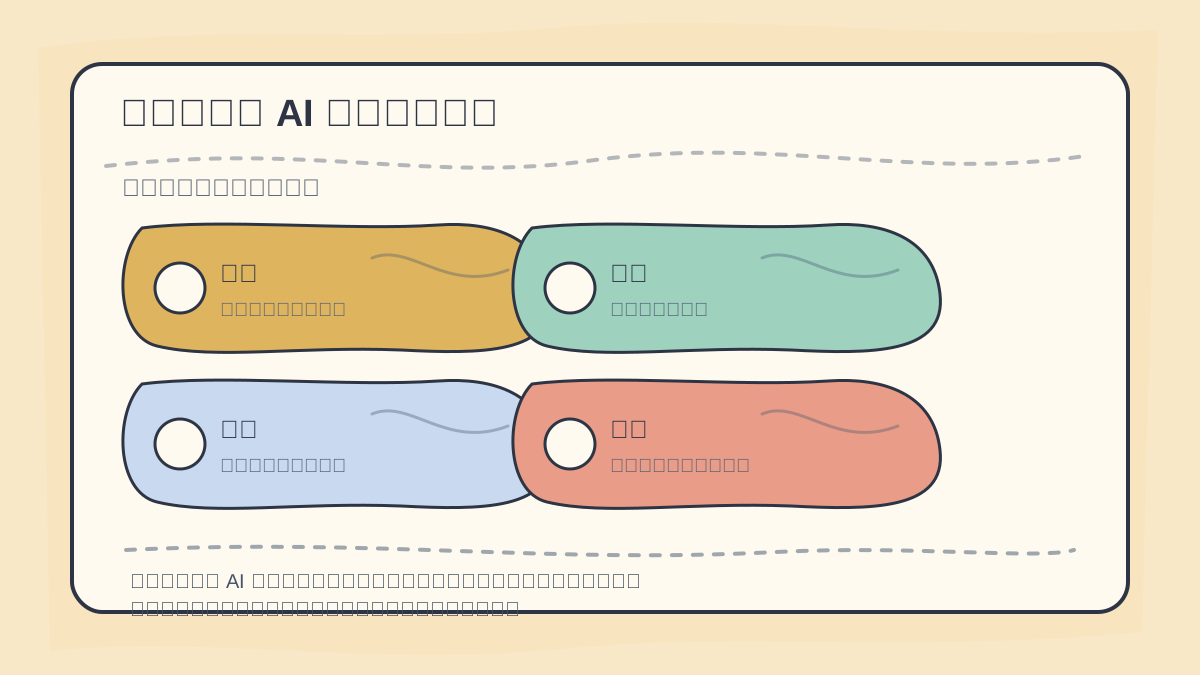
AI Article Decision Snapshot
Turn the lesson into workflow, model, budget, and security checks before choosing tools.
Use this quick snapshot before leaving the article. It keeps the next search tied to practical AI software, model/API, cost, privacy, and implementation questions.
Workflow fit
Identify the real job behind the article: coding, research, document review, support, analytics, content, or internal automation.
Model or tool decision
Decide whether the next step is a software shortlist, an AI tool comparison, an API platform choice, or a model benchmark.
Budget and usage signal
Estimate seats, API calls, prompt volume, retries, review time, and fallback work before assuming the workflow is cheap.
Security and privacy review
Check whether source code, customer data, private documents, prompts, logs, or embeddings will enter the AI workflow.

The most frequent use of calculus in AI is optimization. A model first computes its loss, then uses gradients to determine how and in which direction to adjust its parameters—ultimately reducing prediction error step by step.

We’ll ground the formulas directly in the training workflow: Where does the loss come from? With respect to which variables do we compute gradients? And—critically—do evaluation metrics actually improve after parameter updates?
In the previous section, we firmly established the definition and significance of calculus. Now, let’s dive deeper into its applications in artificial intelligence (AI), helping us better appreciate its central role in modern technology.
Calculus and Machine Learning
Calculus permeates machine learning—especially in optimization. Algorithms such as linear regression, logistic regression, and neural networks all rely on optimizing a loss function: a mathematical expression that quantifies the discrepancy between model predictions and true labels. Our goal is typically to minimize this loss to enhance predictive performance.
When reading about calculus in AI, focus on three key elements:
- How the loss function changes,
- What direction the gradient points to, and
- How parameters are updated accordingly.
Grasping this chain transforms training from a “black box” into an interpretable, principled process.
For example, in linear regression, our objective is to minimize the mean squared error (MSE) loss function:
where is the true label, is the model’s prediction, and represents the model parameters.
Gradient Descent
To solve this optimization problem, we commonly apply gradient descent—a calculus-based iterative algorithm. Its core idea is to compute the gradient of the loss function and update parameters in the opposite direction of that gradient. This requires differentiating the loss with respect to the parameters.
Parameter updates follow this rule:
where is the learning rate and denotes the gradient of with respect to .
Code Example
Below is a simple Python implementation demonstrating how gradient descent optimizes parameters for a linear regression model:
import numpy as np

# Generate sample data
X = np.array([[1, 1], [1, 2], [2, 2], [2, 3]])
y = np.array([1, 2, 2, 3])

# Initialize parameters
w = np.random.rand(2)
learning_rate = 0.01

# Define loss function
def loss(X, y, w):
    return np.mean((y - X.dot(w)) ** 2)

# Define gradient function
def gradient(X, y, w):
    return -2 * X.T.dot(y - X.dot(w)) / len(y)

# Run gradient descent
for _ in range(1000):
    w -= learning_rate * gradient(X, y, w)

print(f'Optimized parameters: {w}')
Here, calculus—specifically gradient computation—drives parameter updates to minimize the loss function.
Calculus in Deep Learning
In deep learning, calculus plays an even more prominent role. Training neural networks likewise hinges on computing gradients of the loss function. To do so efficiently across many layers, we employ backpropagation—a derivative computation method grounded in the chain rule.
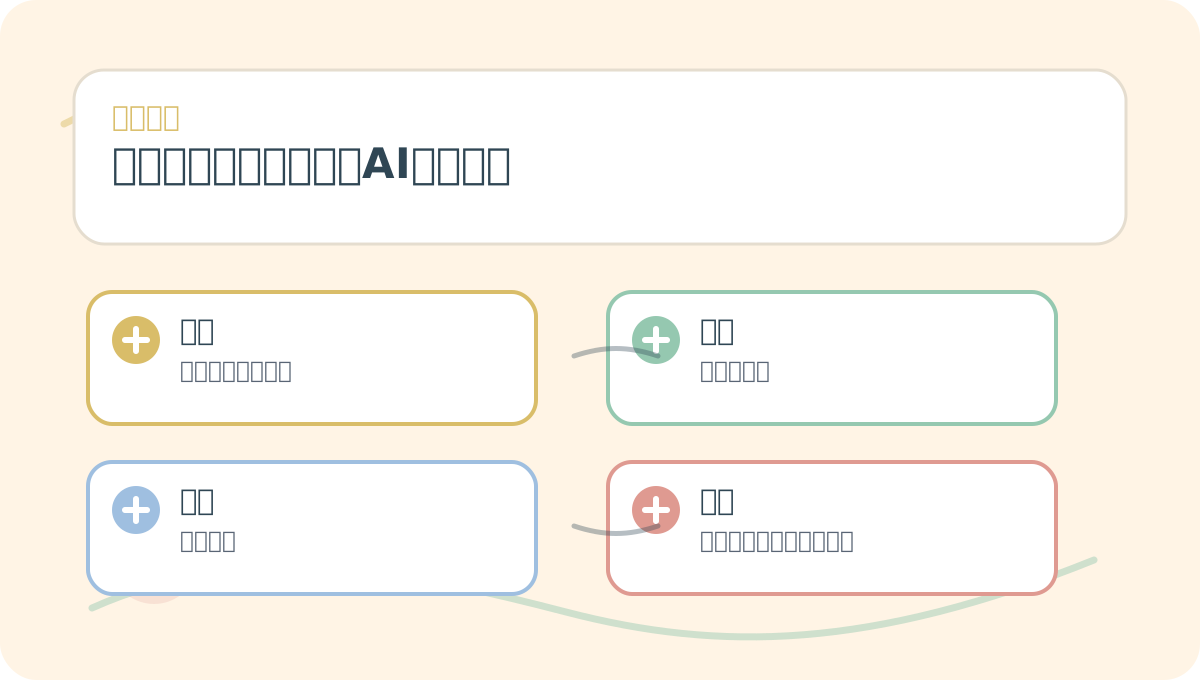
You don’t need to absorb every detail of “Calculus Overview: Applications in AI” all at once. Start with one small, hands-on problem you can verify experimentally—then use the diagrams and text to fill in conceptual gaps.
Backpropagation
At its heart, backpropagation propagates the loss backward through the network by multiplying successive layer derivatives—yielding gradients for each layer’s parameters. Suppose the loss is , the final output is , an intermediate activation is , and the parameters of layer are . Parameter updates follow:
Computing requires repeated application of the chain rule—a process we’ll explore in detail later.
After completing “Calculus Overview: Applications in AI”, try adapting it to your own scenario. Pay special attention to whether inputs, internal computations, and outputs align coherently.
To apply “Calculus Overview: Applications in AI” to your own task, begin by narrowing the scope—focus on validating just one critical decision point.
Summary
Calculus underpins nearly every facet of AI—it provides the foundational tools for optimization and learning. From defining loss functions to computing gradients, calculus enables systematic error reduction and performance improvement. In upcoming sections, we’ll outline the course structure and concrete learning objectives to help you master these concepts effectively.
By understanding calculus’s pivotal role in AI, you’ll be equipped to apply these ideas flexibly—advancing both your learning journey and real-world AI development.
Apply This Lesson
Turn this article into AI software, model, API, and security decisions.
English Article FAQ
Use this article as evidence before choosing AI tools
How should I use this AI Tutorials article?
Use it as the implementation or learning layer, then connect the idea to AI software buyer guides, tool comparisons, benchmarks, API choices, and security checks before making a production decision.
Is this English article different from the Chinese original?
The English edition is localized for global AI readers while preserving the original diagrams, screenshots, prompts, code examples, and source context from the Chinese article.
What should I read after Generate sample data?
Continue with AI Software Buyer Guides, AI Tools Workbench, Best AI Coding Agents, AI Model Benchmarks, OpenAI vs Anthropic API, or LLM Security Tools depending on the decision you need to make.
Can this article alone choose an AI product or model?
No. Treat the article as evidence and context, then validate fit with pricing, privacy requirements, integration effort, benchmark results, workflow tests, and fallback planning.
Continue