English translation
10. Fundamentals of Integration: Core Concepts
AI Article Decision Snapshot
Turn the lesson into workflow, model, budget, and security checks before choosing tools.
Use this quick snapshot before leaving the article. It keeps the next search tied to practical AI software, model/API, cost, privacy, and implementation questions.
Workflow fit
Identify the real job behind the article: coding, research, document review, support, analytics, content, or internal automation.
Model or tool decision
Decide whether the next step is a software shortlist, an AI tool comparison, an API platform choice, or a model benchmark.
Budget and usage signal
Estimate seats, API calls, prompt volume, retries, review time, and fallback work before assuming the workflow is cheap.
Security and privacy review
Check whether source code, customer data, private documents, prompts, logs, or embeddings will enter the AI workflow.

Integration can be understood as accumulation. Without limits, we seek an antiderivative; with upper and lower limits, we compute the cumulative effect over a given interval.

I’ll begin by distinguishing between indefinite and definite integrals: one yields a family of functions; the other yields a specific numerical value.
In the previous article, we explored applications of derivatives and differentials—particularly tangents and rates of change. Now, we turn to the foundational concepts of integration to help you systematically grasp this essential mathematical tool. Integration is one of the two pillars of calculus, intrinsically linked to differentiation—in fact, integration is essentially the inverse process of differentiation.
1. Definition of Integration
In mathematics, integration falls into two primary categories: indefinite integration and definite integration. Indefinite integration seeks an antiderivative of a function, whereas definite integration computes the “total accumulation” over a specified interval.

When learning the fundamental concepts of integration, start by considering three key perspectives: area under a curve, cumulative quantity, and the inverse operation of differentiation. The precise meaning of “integration” may shift depending on context.
1.1 Indefinite Integral
An indefinite integral typically involves finding a function satisfying a given condition. For example, given a function , we seek a function such that:
We then call an antiderivative (or indefinite integral) of , denoted by:
1.2 Definite Integral
A definite integral computes the “area” enclosed by a function over a specified interval. Its formal definition is:
This represents the net signed area bounded by and the -axis over the interval . While elementary geometry treats area as nonnegative, in calculus the definite integral yields a signed value—positive where the curve lies above the -axis, negative where it lies below.
2. Relationship Between Integration and Differentiation
Integration and differentiation are deeply interconnected—a relationship captured precisely by the Fundamental Theorem of Calculus. In essence, this theorem bridges indefinite and definite integration, showing how definite integrals can be evaluated using antiderivatives.
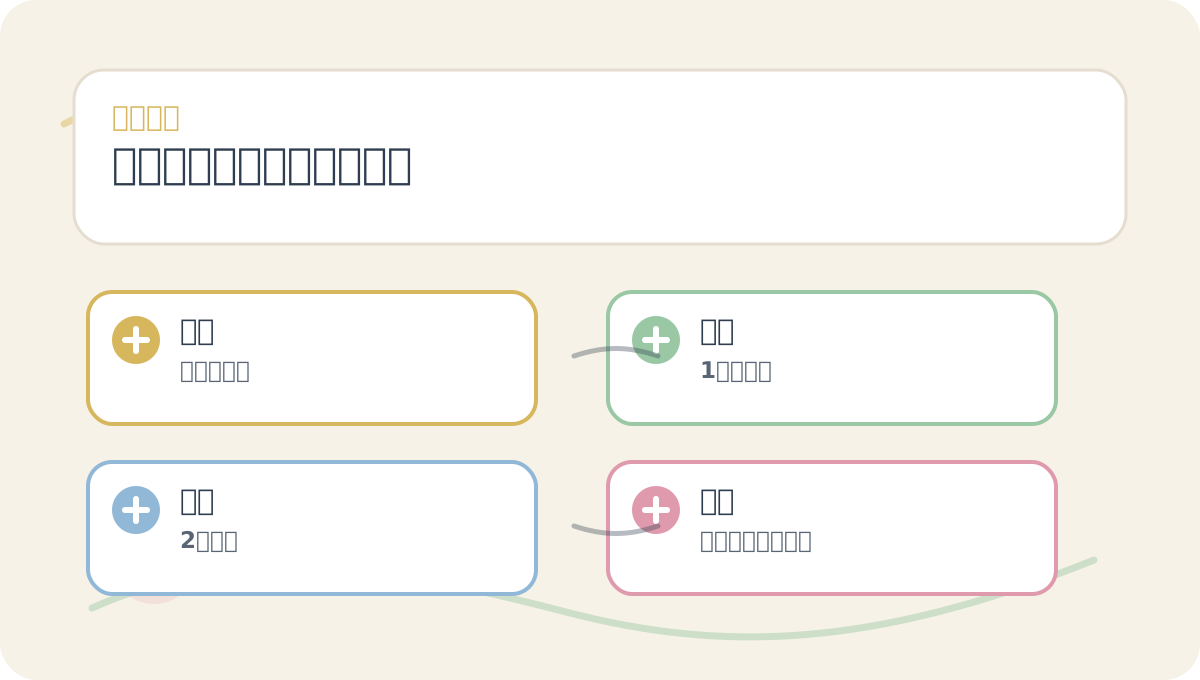
Before diving into the main text of “Foundations of Integration: Core Concepts”, quickly scan the accompanying visuals: What question does the diagram pose? Which concepts must be clearly distinguished? At which step should you actively work through an example? And finally—by what criteria will you assess your understanding?
The first part of the Fundamental Theorem states: if is an antiderivative of , then:
This means we can evaluate a definite integral by first finding an antiderivative , then computing the difference at the upper and lower limits.
3. Geometric Interpretation of Integration
Geometrically, integration corresponds to computing the signed area beneath a curve. Visual representations greatly enhance intuitive understanding. Consider, for instance, the graph of over the interval :
- The curve starts at the origin and rises gradually as increases.
- Over , the curve and the -axis enclose a region.
The signed area of this region equals the definite integral .
4. Worked Example
Let’s illustrate the core ideas and applications of integration with a concrete example.
Suppose we wish to compute the definite integral of over :
-
Find the indefinite integral:
-
Apply the Fundamental Theorem:
Thus, the definite integral of over equals —representing the net signed area between the curve and the -axis on that interval.
After completing “Foundations of Integration: Core Concepts”, try adapting the framework to a scenario of your own—pay close attention to whether inputs, processing steps, and outputs align coherently.
To apply “Foundations of Integration: Core Concepts” to your own task, begin by narrowing the scope—focus first on validating just one critical decision point.
5. Summary
This article introduced the foundational concepts of integration—including definitions of indefinite and definite integrals, their interrelationship via the Fundamental Theorem of Calculus, and their geometric and practical interpretations. Through visual aids and computational examples, we deepened our understanding of integration’s central role across mathematics, science, and engineering.
In upcoming articles, we’ll explore practical techniques for computing indefinite integrals—equipping calculus beginners with accessible tools and strategies. We hope this foundation serves you well!
Apply This Lesson
Turn this article into AI software, model, API, and security decisions.
English Article FAQ
Use this article as evidence before choosing AI tools
How should I use this AI Tutorials article?
Use it as the implementation or learning layer, then connect the idea to AI software buyer guides, tool comparisons, benchmarks, API choices, and security checks before making a production decision.
Is this English article different from the Chinese original?
The English edition is localized for global AI readers while preserving the original diagrams, screenshots, prompts, code examples, and source context from the Chinese article.
What should I read after 10. Fundamentals of Integration: Core Concepts?
Continue with AI Software Buyer Guides, AI Tools Workbench, Best AI Coding Agents, AI Model Benchmarks, OpenAI vs Anthropic API, or LLM Security Tools depending on the decision you need to make.
Can this article alone choose an AI product or model?
No. Treat the article as evidence and context, then validate fit with pricing, privacy requirements, integration effort, benchmark results, workflow tests, and fallback planning.
Continue