English translation
Calculus for AI Beginners: Basic Integration Rules and Substitution Method
AI Article Decision Snapshot
Turn the lesson into workflow, model, budget, and security checks before choosing tools.
Use this quick snapshot before leaving the article. It keeps the next search tied to practical AI software, model/API, cost, privacy, and implementation questions.
Workflow fit
Identify the real job behind the article: coding, research, document review, support, analytics, content, or internal automation.
Model or tool decision
Decide whether the next step is a software shortlist, an AI tool comparison, an API platform choice, or a model benchmark.
Budget and usage signal
Estimate seats, API calls, prompt volume, retries, review time, and fallback work before assuming the workflow is cheap.
Security and privacy review
Check whether source code, customer data, private documents, prompts, logs, or embeddings will enter the AI workflow.

Substitution is essentially the reverse application of the chain rule. The key is complete substitution—not only replacing the function, but also properly transforming the differential term.

I’ll verify that all variables are consistent. If an expression mixes both and , it usually indicates the substitution hasn’t been fully carried out.
In the previous article, we explored methods for computing indefinite integrals. In this one, we delve deeper into the foundations of integration—specifically, fundamental integration rules and the method of substitution. These concepts are essential for understanding definite integrals and their applications later on.
Fundamental Integration Rules
Let’s first review several important fundamental integration rules. These allow us to compute indefinite integrals quickly and efficiently.

When applying fundamental integration rules and substitution, first identify the inner function, check for derivative relationships, and select a suitable substitution variable—then revert back to the original variable.
-
Constant Multiple Rule: If is a constant, then
Example:
-
Sum Rule: For two integrable functions and ,
Example:
-
Power Rule: For , the indefinite integral is
Example:
With these basic rules, we can rapidly evaluate indefinite integrals of simple functions—and combine them flexibly to tackle more complex problems.
The Method of Substitution
The method of substitution (also known as change of variables) is a powerful technique for simplifying integrals. Its core idea is to transform a complicated integral into a familiar, easier-to-integrate form via an appropriate change of variable.
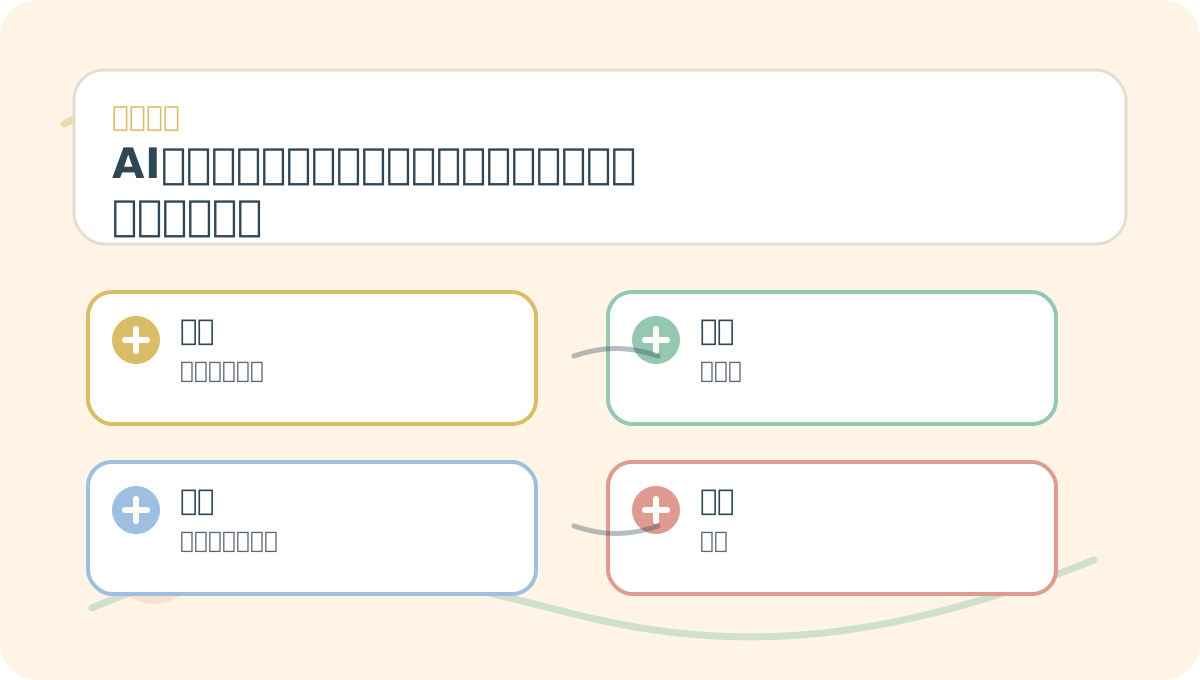
This tutorial—Essential Calculus for AI Beginners: Foundations of Integration — Fundamental Rules and Substitution—can be read through the lens of “Scenario, Concept, Action, Result.” First align these four elements; then revisit the parameters, code, or workflow in the main text.
Steps for Substitution:
-
Choose the substitution variable: Identify a suitable variable that simplifies the integrand. A common choice is a function embedded within a composite expression. For instance, if the integrand has the form , let .
-
Compute the differential: During substitution, compute using the relation .
-
Substitute and integrate: Replace all expressions in terms of with those in terms of , and rewrite the integral using .
-
Back-substitute: Finally, replace with its expression in terms of to obtain the result in the original variable.
Example
Consider the indefinite integral:
We apply substitution: let , so .
The integral becomes:
We know:
Reverting to :
Using substitution, we reduced a seemingly complex integral to a standard, easily solvable form.

By now, you can organize Essential Calculus for AI Beginners: Foundations of Integration — Fundamental Rules and Substitution into a recap table: clarify the central thread first, then test it with a small task.

After reading Essential Calculus for AI Beginners: Foundations of Integration — Fundamental Rules and Substitution, try walking through a small example step-by-step—and assess which steps you can now perform independently.
Summary
In this tutorial, we introduced fundamental integration rules and the method of substitution—building essential groundwork for upcoming topics on definite integrals and their applications. Fundamental rules provide foundational computational tools, while substitution extends our ability to handle more intricate integrands.
In the next article, we’ll explore the definition and properties of definite integrals—stay tuned!
Apply This Lesson
Turn this article into AI software, model, API, and security decisions.
English Article FAQ
Use this article as evidence before choosing AI tools
How should I use this AI Tutorials article?
Use it as the implementation or learning layer, then connect the idea to AI software buyer guides, tool comparisons, benchmarks, API choices, and security checks before making a production decision.
Is this English article different from the Chinese original?
The English edition is localized for global AI readers while preserving the original diagrams, screenshots, prompts, code examples, and source context from the Chinese article.
What should I read after Calculus for AI Beginners: Basic Integration Rules and Substitution Method?
Continue with AI Software Buyer Guides, AI Tools Workbench, Best AI Coding Agents, AI Model Benchmarks, OpenAI vs Anthropic API, or LLM Security Tools depending on the decision you need to make.
Can this article alone choose an AI product or model?
No. Treat the article as evidence and context, then validate fit with pricing, privacy requirements, integration effort, benchmark results, workflow tests, and fallback planning.
Continue