English translation
Calculus Overview: Course Structure and Learning Objectives
AI Article Decision Snapshot
Turn the lesson into workflow, model, budget, and security checks before choosing tools.
Use this quick snapshot before leaving the article. It keeps the next search tied to practical AI software, model/API, cost, privacy, and implementation questions.
Workflow fit
Identify the real job behind the article: coding, research, document review, support, analytics, content, or internal automation.
Model or tool decision
Decide whether the next step is a software shortlist, an AI tool comparison, an API platform choice, or a model benchmark.
Budget and usage signal
Estimate seats, API calls, prompt volume, retries, review time, and fallback work before assuming the workflow is cheap.
Security and privacy review
Check whether source code, customer data, private documents, prompts, logs, or embeddings will enter the AI workflow.

This content is best approached problem-first: first understand how functions change, then learn how to compute rates of change, followed by how to accumulate totals, and finally advance to multivariable and dynamic processes.

Before each lesson, clarify both the entry point—the core problem—and the final success criteria.
In the previous article, we explored the role of calculus in artificial intelligence (AI), from optimization algorithms in machine learning to the training process of neural networks—highlighting calculus’s indispensable contribution. In this article, we detail the course structure and learning objectives for calculus, laying a solid foundation for subsequent topics. Our ultimate goal is to equip you with confidence in applying calculus tools to AI-related problems—and to prepare you for upcoming sections, such as “Functions and Limits.”
Course Structure
This tutorial unfolds calculus concepts step-by-step, organized into the following modules:

When reading the Calculus Overview, align functions, limits, derivatives, and optimization along a single conceptual thread. Understanding what problem each step solves ensures formulas remain meaningful—not isolated abstractions.
-
Foundational Concepts of Calculus
- Basic definitions of differentiation and integration
- Introduction to limits
-
Functions and Limits
- Concept and representation of functions
- Analysis of different function types
- Properties and computation of limits
-
Single-Variable Calculus
- Definition and geometric interpretation of derivatives
- Common derivative rules and formulas
- Applications of differentiation: tangent lines and optimization problems
-
Foundations of Integration
- Definite and indefinite integrals
- Fundamental integration formulas
- Geometric interpretations and applications of integration (e.g., computing area, volume)
-
Multivariable Calculus
- Analysis of functions with multiple variables
- Partial derivatives and gradients
- Definition and applications of multiple integrals
-
Applications of Calculus in AI
- Gradient descent in optimization algorithms
- Calculus in neural network training
Learning Objectives
Upon completing this tutorial series, you should be able to:
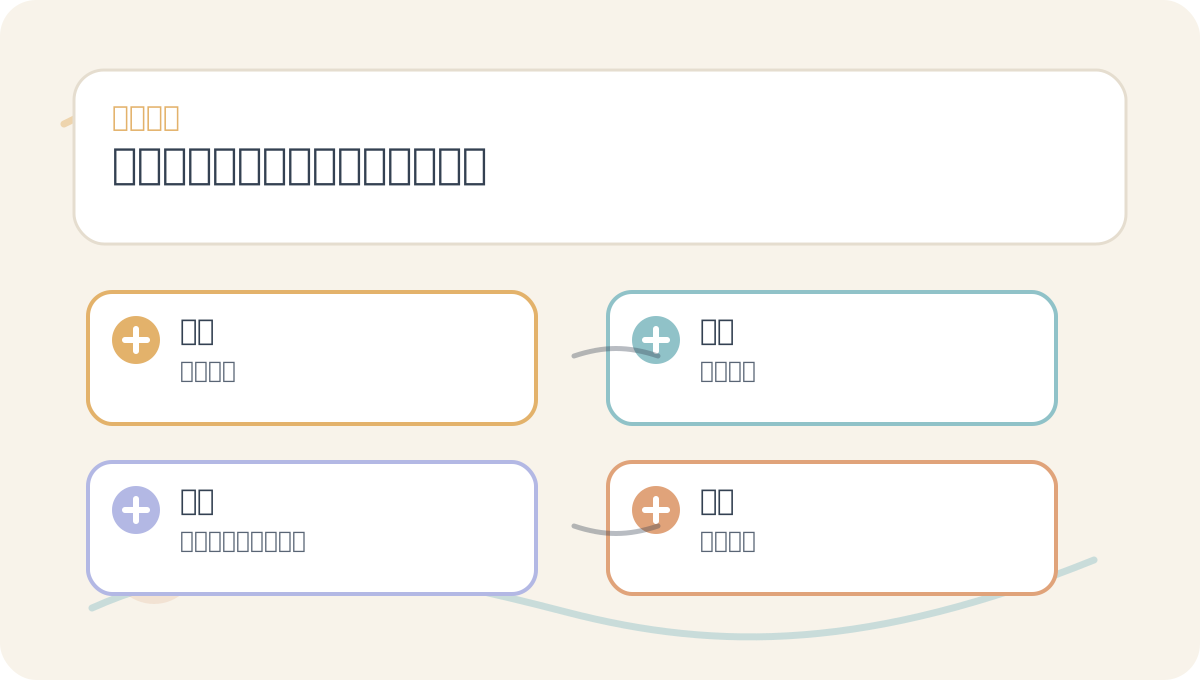
While reading “Calculus Overview: Course Structure and Learning Objectives,” treat the accompanying diagrams as roadmap cards: first grasp the overall sequence; then examine why each step matters; finally verify boundary conditions and assumptions.
-
Understand Core Concepts: Master foundational ideas—including derivatives, integrals, and limits—and appreciate their significance in mathematical analysis.
-
Represent and Analyze Functions: Identify and express various function types, interpret their graphs and properties, and build a robust foundation for advanced topics.
-
Analyze and Apply Differentiation: Compute derivatives and apply them to real-world problems—especially optimization—enhancing your ability to develop and refine AI algorithms.
-
Master Integration Techniques: Compute definite and indefinite integrals confidently, use integration to determine areas and volumes, and apply these skills to practical scenarios like data analysis.
-
Grasp Multivariable Calculus: Understand calculus for functions of several variables, master partial derivatives and gradients, and prepare for high-dimensional data analysis in machine learning.
-
Apply Calculus to AI: Recognize how calculus underpins key AI algorithms—such as computing update rules in gradient descent—and leverage it effectively in ML and deep learning contexts.
Case Study: An Optimization Problem
To illustrate calculus in action, consider this simple optimization example: Find the maximum value of the function .

When revisiting “Calculus Overview: Course Structure and Learning Objectives,” avoid tackling large projects upfront. Instead, validate the main conceptual thread using one straightforward example.
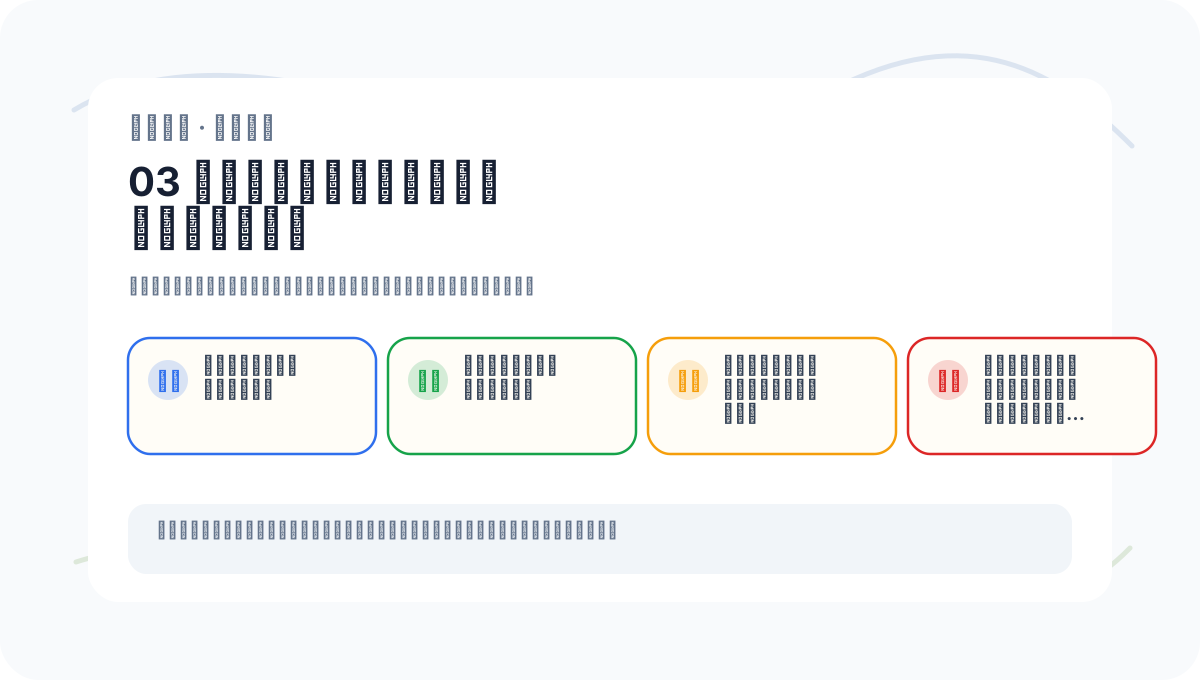
If “Calculus Overview: Course Structure and Learning Objectives” hasn’t yet fully clicked, retrace the four actions outlined on this card.
Solution Steps
-
Differentiate: First, compute the derivative of the function:
-
Set Derivative to Zero: Solve to locate critical points:
-
Second-Derivative Test: Compute the second derivative to classify the critical point:
Since , the function attains a local maximum at . -
Evaluate Maximum Value:
Thus, the function achieves its maximum value of at . This example demonstrates how calculus directly supports finding optimal solutions—a cornerstone capability in AI and data science.
In the next installment, we’ll dive into the “Functions and Limits” section, exploring function definitions and key properties to further strengthen your calculus foundation. Stay tuned for more!
Apply This Lesson
Turn this article into AI software, model, API, and security decisions.
English Article FAQ
Use this article as evidence before choosing AI tools
How should I use this AI Tutorials article?
Use it as the implementation or learning layer, then connect the idea to AI software buyer guides, tool comparisons, benchmarks, API choices, and security checks before making a production decision.
Is this English article different from the Chinese original?
The English edition is localized for global AI readers while preserving the original diagrams, screenshots, prompts, code examples, and source context from the Chinese article.
What should I read after Calculus Overview: Course Structure and Learning Objectives?
Continue with AI Software Buyer Guides, AI Tools Workbench, Best AI Coding Agents, AI Model Benchmarks, OpenAI vs Anthropic API, or LLM Security Tools depending on the decision you need to make.
Can this article alone choose an AI product or model?
No. Treat the article as evidence and context, then validate fit with pricing, privacy requirements, integration effort, benchmark results, workflow tests, and fallback planning.
Continue