English translation
15 Practical Applications of the Central Limit Theorem
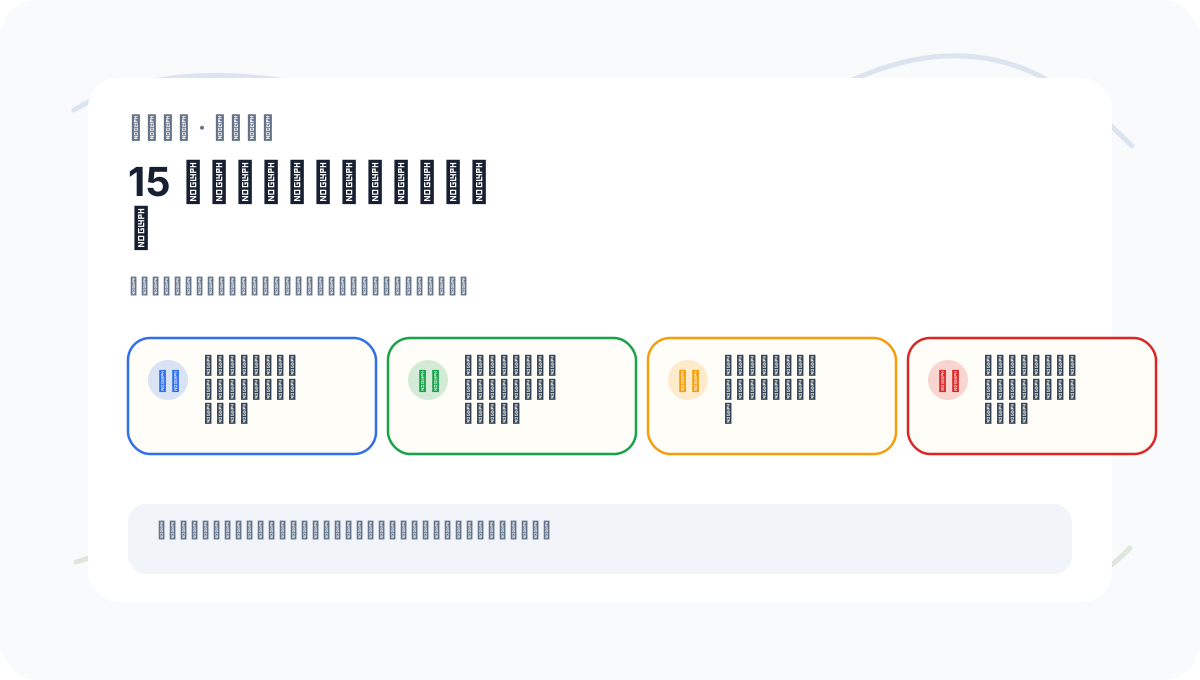
AI Article Decision Snapshot
Turn the lesson into workflow, model, budget, and security checks before choosing tools.
Use this quick snapshot before leaving the article. It keeps the next search tied to practical AI software, model/API, cost, privacy, and implementation questions.
Workflow fit
Identify the real job behind the article: coding, research, document review, support, analytics, content, or internal automation.
Model or tool decision
Decide whether the next step is a software shortlist, an AI tool comparison, an API platform choice, or a model benchmark.
Budget and usage signal
Estimate seats, API calls, prompt volume, retries, review time, and fallback work before assuming the workflow is cheap.
Security and privacy review
Check whether source code, customer data, private documents, prompts, logs, or embeddings will enter the AI workflow.

The Central Limit Theorem (CLT) explains why sample means from many distributions tend to approximate a normal distribution. It forms the theoretical foundation for confidence intervals, A/B testing, and error analysis.

I verify whether the sample size is sufficiently large and whether observations are approximately independent. When these conditions are not met, the normal approximation weakens.
In the previous article, we explored the Law of Large Numbers and learned how increasing sample size improves estimation accuracy. Now, we turn our focus to the Central Limit Theorem and its practical applications. The CLT is a cornerstone theorem in probability theory, widely applied across real-world problems and AI domains.
What Is the Central Limit Theorem?
The Central Limit Theorem states that, as the sample size grows large, the sampling distribution of the mean of independent random variables—drawn from any underlying distribution—converges to a normal (bell-shaped) distribution, regardless of the shape of the original distribution. This theorem underpins numerous statistical methods and machine learning algorithms.

Before applying the CLT, first check: (1) Are samples independent and identically distributed (i.i.d.)? (2) Is the sample size sufficiently large? (3) Are the mean and variance well-defined? Only then proceed with the normal approximation.
More formally, suppose we have a sequence of i.i.d. random variables , each with mean and variance . Then, for large , the sampling distribution of the sample mean approximates a normal distribution:
Here, denotes the normal distribution with mean and variance .
Practical Applications of the Central Limit Theorem

When revisiting “Applications of the Central Limit Theorem”, you need not tackle a large project all at once. Start with a simple, concrete example to verify whether the core logic is clear.
If you haven’t yet fully internalized “Applications of the Central Limit Theorem”, walk through the four actions on this card step by step.
1. Confidence Interval Estimation
You don’t need to absorb every detail of “Applications of the Central Limit Theorem” in one sitting. Begin with a small, hands-on problem you can verify yourself—then use the diagram and main text to fill in conceptual gaps.
In statistics, the CLT is routinely used to construct confidence intervals. To estimate an unknown population mean , we use the sample mean and—leveraging the CLT—derive a confidence interval around it.
Suppose we draw independent observations from a population and compute the sample mean and sample standard deviation . Using the CLT, the confidence interval for is:
where is the critical value from the standard normal distribution corresponding to the desired confidence level .
Example: Confidence Interval for Average Height
Suppose we wish to estimate the average height of adults in a city. We randomly select 100 adults and measure their heights, obtaining a sample mean of 170 cm and a sample standard deviation of 10 cm. At a 95% confidence level, the confidence interval is computed as follows:
- , ,
- For 95% confidence,
So the confidence interval is:
Thus, the 95% confidence interval is : we are 95% confident that the true average adult height in this city lies within this range.
2. Applications in Machine Learning
The CLT also plays a foundational role in many machine learning algorithms. During model evaluation—for instance, in cross-validation—we compute performance metrics (e.g., accuracy, recall) across folds, then take their mean and standard deviation. The CLT allows us to infer the reliability of overall model performance.
Example: Model Performance Evaluation
Suppose we perform 10-fold cross-validation and obtain the following accuracy scores per fold:
[0.85, 0.88, 0.82, 0.90, 0.87, 0.86, 0.84, 0.89, 0.83, 0.91]
We compute the mean and standard deviation:
import numpy as np

accuracies = [0.85, 0.88, 0.82, 0.90, 0.87, 0.86, 0.84, 0.89, 0.83, 0.91]
mean_acc = np.mean(accuracies)
std_dev = np.std(accuracies)

print(f"Mean Accuracy: {mean_acc:.2f}")
print(f"Standard Deviation: {std_dev:.2f}")
Output:
Mean Accuracy: 0.86
Standard Deviation: 0.03
By the CLT, we can construct a confidence interval for the true model accuracy (assuming sufficient effective sample size):
Hence, the 95% confidence interval for model accuracy is approximately .
3. A/B Testing
A/B testing is a common statistical method in product optimization and user experience research. The CLT enables us to assess whether observed differences between two variants (e.g., conversion rates in Group A vs. Group B) are statistically significant—by comparing their sample means and standard errors.
Summary
The Central Limit Theorem provides a powerful tool for simplifying complex random phenomena into tractable normal approximations. It is indispensable in statistical inference, machine learning, experimental design, and beyond. By applying the CLT, we gain greater confidence in scientific decision-making and data-driven analysis.
In the next article, we will delve into Bayesian theory—and its cornerstone, Bayes’ Theorem—to understand how prior knowledge and observed data jointly update our beliefs. This will further strengthen our ability to reason rigorously about uncertainty.
Apply This Lesson
Turn this article into AI software, model, API, and security decisions.
English Article FAQ
Use this article as evidence before choosing AI tools
How should I use this AI Tutorials article?
Use it as the implementation or learning layer, then connect the idea to AI software buyer guides, tool comparisons, benchmarks, API choices, and security checks before making a production decision.
Is this English article different from the Chinese original?
The English edition is localized for global AI readers while preserving the original diagrams, screenshots, prompts, code examples, and source context from the Chinese article.
What should I read after 15 Practical Applications of the Central Limit Theorem?
Continue with AI Software Buyer Guides, AI Tools Workbench, Best AI Coding Agents, AI Model Benchmarks, OpenAI vs Anthropic API, or LLM Security Tools depending on the decision you need to make.
Can this article alone choose an AI product or model?
No. Treat the article as evidence and context, then validate fit with pricing, privacy requirements, integration effort, benchmark results, workflow tests, and fallback planning.
Continue