English translation
20. Probability for AI Beginners: Summarizing Model Evaluation & Selection + Further Learning Resources
AI Article Decision Snapshot
Turn the lesson into workflow, model, budget, and security checks before choosing tools.
Use this quick snapshot before leaving the article. It keeps the next search tied to practical AI software, model/API, cost, privacy, and implementation questions.
Workflow fit
Identify the real job behind the article: coding, research, document review, support, analytics, content, or internal automation.
Model or tool decision
Decide whether the next step is a software shortlist, an AI tool comparison, an API platform choice, or a model benchmark.
Budget and usage signal
Estimate seats, API calls, prompt volume, retries, review time, and fallback work before assuming the workflow is cheap.
Security and privacy review
Check whether source code, customer data, private documents, prompts, logs, or embeddings will enter the AI workflow.

Model selection shouldn’t simply chase the highest score. To identify a robust, production-ready solution, you must compare baselines, validation strategies, error-prone samples, and real-world deployment constraints.

I will maintain a model selection log: metrics, data versions, misclassified samples, and final rationale—all traceable and auditable for retrospective analysis.
In the previous article, we explored key applied case studies in model evaluation and selection. By analyzing how different models perform on specific datasets, we gained deeper insight into selecting appropriate models to meet concrete requirements. This article synthesizes those core insights and provides curated resources for further learning—designed to spark more rigorous, probability-informed thinking at the intersection of AI and statistics.

Having read this article, organize “AI-Ready Probability for Beginners Series: Summary & Further Learning Resources on Model Evaluation and Selection” into a concise retrospective table: first clarify the central narrative, then validate it with a small, concrete task.

After reading “AI-Ready Probability for Beginners Series: Summary & Further Learning Resources on Model Evaluation and Selection”, pick a small example and walk through the full evaluation and selection workflow end-to-end—then assess which steps you can now execute independently.
Core Conclusions
- The Contextual Nature of Model Selection: Requirements vary significantly across industries and use cases. Therefore, model selection must be grounded in real-world business objectives. For instance, in financial risk control, precision often matters more than recall—so models explicitly optimized for precision should be prioritized.

When retrospecting model evaluation and selection, systematically document: applicable metrics per scenario, data splitting strategies, cost-sensitive error trade-offs, comparative modeling approaches, and recommended follow-up learning resources.
-
The Importance of Multiple Evaluation Metrics: Beyond accuracy, effective model assessment requires a thoughtful combination of metrics—including F1-score, ROC curves, and AUC. Each reveals distinct aspects of model behavior (e.g., class balance sensitivity, threshold robustness), enabling more holistic, context-aware decisions.
-
Balancing Overfitting and Underfitting: Overfitting and underfitting are persistent challenges during training. Cross-validation offers a principled, data-efficient way to estimate generalization performance—helping select models that are both accurate and robust.
-
Data Quality and Preprocessing Are Foundational: No model architecture compensates for poor data. Thoughtful preprocessing—such as imputation of missing values, feature scaling, or outlier handling—can dramatically improve downstream model performance, regardless of algorithm choice.
-
Interpretability Matters in Practice: Especially in high-stakes domains involving human judgment (e.g., healthcare, lending, legal tech), model interpretability is not optional—it’s essential. Models like decision trees or linear regression, which offer transparent reasoning paths, often foster greater user trust and regulatory compliance.
Further Learning Resources
To deepen your understanding of probability theory—and its practical role in model evaluation and selection—here are highly recommended books and online courses:
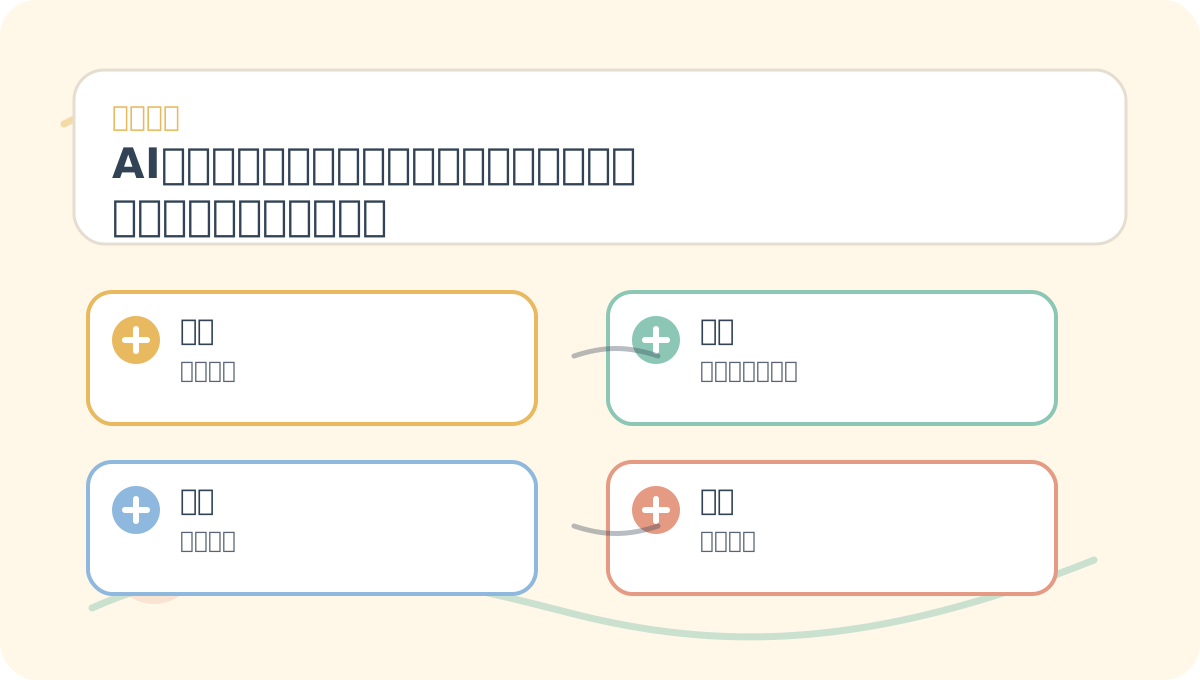
After finishing “AI-Ready Probability for Beginners Series: Summary & Further Learning Resources on Model Evaluation and Selection”, reflect on three questions:
- What problem does this solve?
- At which step is error most likely—and why?
- Can I implement the entire workflow successfully on a small, self-contained example?
Recommended Books
-
Pattern Recognition and Machine Learning by Christopher Bishop
A rigorous introduction to probabilistic foundations of machine learning—ideal for readers with some mathematical maturity seeking depth. -
The Elements of Statistical Learning by Trevor Hastie, Robert Tibshirani, and Jerome Friedman
A canonical reference covering model selection, regularization, cross-validation, and ensemble methods—with clear statistical intuition and practical guidance. -
Machine Learning: A Probabilistic Perspective by Kevin P. Murphy
Uniquely bridges theory and practice by framing nearly all ML concepts—from classification to deep learning—through a unified probabilistic lens.
Online Courses
-
Coursera: Probabilistic Graphical Models (Stanford University)
A comprehensive, mathematically grounded treatment of Bayesian networks, Markov random fields, and inference algorithms—directly relevant to uncertainty-aware AI systems. -
edX: Data Science MicroMasters Program (MIT)
A rigorous, multi-course credential program covering statistical modeling, machine learning, and evaluation methodology—including bias-variance trade-offs and resampling techniques. -
Kaggle Learn: Intro to Machine Learning
A hands-on, beginner-friendly curriculum using Python and real datasets—perfect for building intuition about train/validation/test splits, metric interpretation, and iterative model improvement.
Closing Remarks
By completing this series, you now possess a working understanding of how probability theory underpins sound AI practice—especially in evaluating and selecting models that generalize well, align with domain goals, and remain trustworthy in production. In upcoming installments, we’ll explore curated book and course recommendations in greater academic depth—helping you chart a sustainable, long-term learning path. Stay tuned for the next chapter!
Apply This Lesson
Turn this article into AI software, model, API, and security decisions.
English Article FAQ
Use this article as evidence before choosing AI tools
How should I use this AI Tutorials article?
Use it as the implementation or learning layer, then connect the idea to AI software buyer guides, tool comparisons, benchmarks, API choices, and security checks before making a production decision.
Is this English article different from the Chinese original?
The English edition is localized for global AI readers while preserving the original diagrams, screenshots, prompts, code examples, and source context from the Chinese article.
What should I read after 20. Probability for AI Beginners: Summarizing Model Evaluation & Selection + Further Learning Resources?
Continue with AI Software Buyer Guides, AI Tools Workbench, Best AI Coding Agents, AI Model Benchmarks, OpenAI vs Anthropic API, or LLM Security Tools depending on the decision you need to make.
Can this article alone choose an AI product or model?
No. Treat the article as evidence and context, then validate fit with pricing, privacy requirements, integration effort, benchmark results, workflow tests, and fallback planning.
Continue