English translation
Simulate coin flips
AI Article Decision Snapshot
Turn the lesson into workflow, model, budget, and security checks before choosing tools.
Use this quick snapshot before leaving the article. It keeps the next search tied to practical AI software, model/API, cost, privacy, and implementation questions.
Workflow fit
Identify the real job behind the article: coding, research, document review, support, analytics, content, or internal automation.
Model or tool decision
Decide whether the next step is a software shortlist, an AI tool comparison, an API platform choice, or a model benchmark.
Budget and usage signal
Estimate seats, API calls, prompt volume, retries, review time, and fallback work before assuming the workflow is cheap.
Security and privacy review
Check whether source code, customer data, private documents, prompts, logs, or embeddings will enter the AI workflow.

Don’t stop learning probability theory at rote memorization of formulas. The most effective approach is to validate your intuition with small simulations—and then interpret the results back in the context of real-world problems.

For every concept, I provide a runnable minimal example. Only when you can simulate it yourself does it become truly transferable to your projects.
In this tutorial, our goal is to summarize the key concepts we’ve covered so far—and to offer curated resources and practical recommendations for deepening your understanding of probability theory and its applications in artificial intelligence.

When reviewing AI-Ready Probability Theory for Beginners — Conclusions and Further Learning Recommendations, place key concepts, procedural steps, and observable outcomes on the same page for efficient re-examination.

When practicing AI-Ready Probability Theory for Beginners — Conclusions and Further Learning Recommendations, write down input conditions, processing actions, and observable outcomes together—making future review quick and systematic.
Key Takeaways
- Foundations of Probability: We learned that probability is a numerical measure of how likely an event is to occur—providing an essential framework for reasoning under uncertainty. Common approaches to computing probability include frequentist probability and subjective probability.

When planning your next steps in probability theory, prioritize these topics: random variables, common probability distributions, Bayesian updating, sampling methods, confidence intervals, and model uncertainty.
-
Conditional Probability and Independence: By studying conditional probability—e.g., computing —we gained insight into how events relate given specific information. We also defined independent events, satisfying .
-
Bayes’ Theorem: This pivotal formula connects conditional probabilities:
It underpins numerous machine learning techniques—for instance, Bayesian classifiers, where decisions rely directly on Bayes’ theorem.
-
Random Variables and Distributions: We explored both discrete and continuous random variables, and studied widely used probability distributions—including the binomial, normal (Gaussian), and Poisson distributions. These serve as mathematical models for diverse real-world phenomena.
-
Expectation and Variance: We developed intuition for expectation and variance . These summary statistics are indispensable in algorithm optimization, risk analysis, and uncertainty quantification.
-
Law of Large Numbers and Central Limit Theorem:
- The Law of Large Numbers states that as sample size grows, the sample average converges toward the theoretical expectation.
- The Central Limit Theorem tells us that, regardless of the underlying distribution, the sampling distribution of the mean tends toward a normal distribution for large samples—forming the statistical bedrock of many ML prediction methods.
Further Learning Recommendations
Books
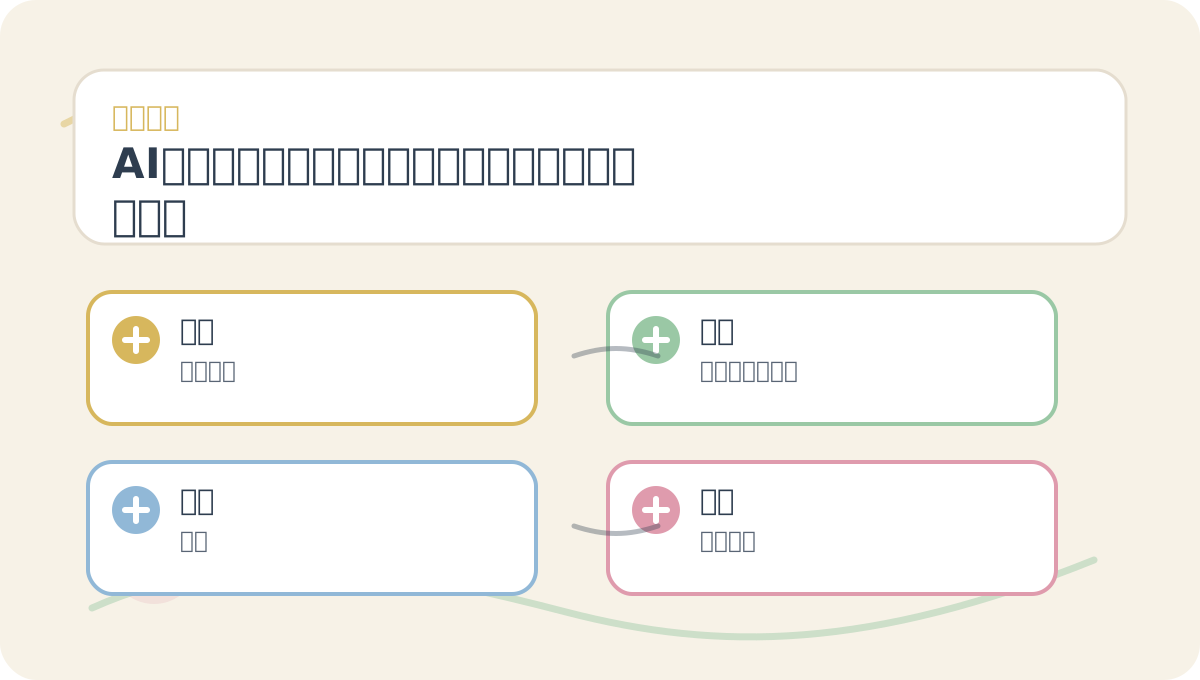
Before reading AI-Ready Probability Theory for Beginners — Conclusions and Further Learning Recommendations, first align the questions, keywords, actions, and success criteria shown in this diagram with the text—this makes reading more efficient. After finishing, try explaining the material again using your own project as context.
-
An Introduction to Probability Theory and Its Applications (William Feller): A classic, rigorous textbook ideal for building deep theoretical foundations.
-
The Elements of Statistical Learning (Trevor Hastie et al.): Bridges statistics and machine learning, with rich discussion of probabilistic modeling in practice.
-
Bayesian Reasoning and Machine Learning (David Barber): A comprehensive, application-oriented guide focused specifically on Bayesian methods and inference.
-
Head First Statistics (Dawn Griffiths): An accessible, visual, and intuition-first introduction—perfect for beginners navigating core statistical and probabilistic ideas.
Online Courses
-
Coursera Probability Courses: Offered by Stanford University and other top institutions—typically feature real-world case studies and hands-on coding exercises.
-
edX Introductory Data Science Courses: Cover foundational probability and statistics with emphasis on data analysis and ML readiness.
-
Kaggle Learning Paths: Include structured, interactive modules on probability and statistics tailored for machine learning practitioners.
Practical Case Study
Applying probability theory through concrete examples and datasets is essential. For instance, simulate a coin-flip experiment using Python and numpy:
import numpy as np

# Simulate coin flips
n_trials = 10000
results = np.random.binomial(1, 0.5, n_trials)  # 0.5 = probability of heads
heads = np.sum(results)
tails = n_trials - heads

print(f"Heads: {heads}, Tails: {tails}")
Running this code lets you observe empirically how head/tail frequencies stabilize with increasing trials—reinforcing abstract concepts through tangible experience.
Summary
This tutorial recaps core probability concepts covered throughout the series—and points you toward high-value resources and learning pathways for continued growth. In practice, probability theory will empower you to understand, design, evaluate, and trust AI systems more deeply. We encourage you to keep bridging theory and practice: build, simulate, reflect, and iterate—your intuition and expertise will grow with every experiment.
Apply This Lesson
Turn this article into AI software, model, API, and security decisions.
English Article FAQ
Use this article as evidence before choosing AI tools
How should I use this AI Tutorials article?
Use it as the implementation or learning layer, then connect the idea to AI software buyer guides, tool comparisons, benchmarks, API choices, and security checks before making a production decision.
Is this English article different from the Chinese original?
The English edition is localized for global AI readers while preserving the original diagrams, screenshots, prompts, code examples, and source context from the Chinese article.
What should I read after Simulate coin flips?
Continue with AI Software Buyer Guides, AI Tools Workbench, Best AI Coding Agents, AI Model Benchmarks, OpenAI vs Anthropic API, or LLM Security Tools depending on the decision you need to make.
Can this article alone choose an AI product or model?
No. Treat the article as evidence and context, then validate fit with pricing, privacy requirements, integration effort, benchmark results, workflow tests, and fallback planning.
Continue