English translation
Set seed for reproducibility
AI Article Decision Snapshot
Turn the lesson into workflow, model, budget, and security checks before choosing tools.
Use this quick snapshot before leaving the article. It keeps the next search tied to practical AI software, model/API, cost, privacy, and implementation questions.
Workflow fit
Identify the real job behind the article: coding, research, document review, support, analytics, content, or internal automation.
Model or tool decision
Decide whether the next step is a software shortlist, an AI tool comparison, an API platform choice, or a model benchmark.
Budget and usage signal
Estimate seats, API calls, prompt volume, retries, review time, and fallback work before assuming the workflow is cheap.
Security and privacy review
Check whether source code, customer data, private documents, prompts, logs, or embeddings will enter the AI workflow.

Conditional probability is not merely ordinary probability with an extra symbol—it redefines the scope of discussion given that a particular event has occurred.

First ask: Does condition B alter the sample space? If it does, the denominator can no longer be the original total count.
Building upon our understanding of events and sample spaces, we now delve into two pivotal concepts in probability theory: conditional probability and independence. These ideas play indispensable roles in machine learning and data science—mastering them is therefore essential for deeper study and practical application.
Conditional Probability
Definition

When learning conditional probability and independence, always begin by asking whether the new condition changes how we assess events. If the condition alters the probability, the events cannot simply be treated as mutually unaffected.
Conditional probability refers to the probability of one event occurring given that another event has already occurred. Mathematically, for events and , the conditional probability denotes the probability that event occurs under the condition that event has occurred.
Formula
The formula for computing conditional probability is:
where is the joint probability that both events and occur, and is the probability that event occurs.
Example
Consider a simple example: drawing a single card from a standard 52-card deck. Suppose we want to compute the conditional probability of drawing a red card (event ), given that the drawn card is a heart (event ).
- Event : Drawing a red card.
- Event : Drawing a heart.
In a standard deck, red cards consist of hearts (13 cards) and diamonds (13 cards). Since all hearts are red, , and . Therefore:
This result indicates that, given the card drawn is a heart, the probability it is red is 1 (i.e., certain).
Code Example
We can simulate this scenario using Python:
import numpy as np

# Set seed for reproducibility
np.random.seed(42)

# Define suits
cards = ['♠', '♣', '♦', '♥']
total_cards = 52
red_cards = ['♦', '♥']

# Draw one card
drawn_card = np.random.choice(cards, p=[1/4]*4)
is_red = 1 if drawn_card in red_cards else 0

print(f"Drawn card: {drawn_card}, Is red: {bool(is_red)}")
Independence
Definition
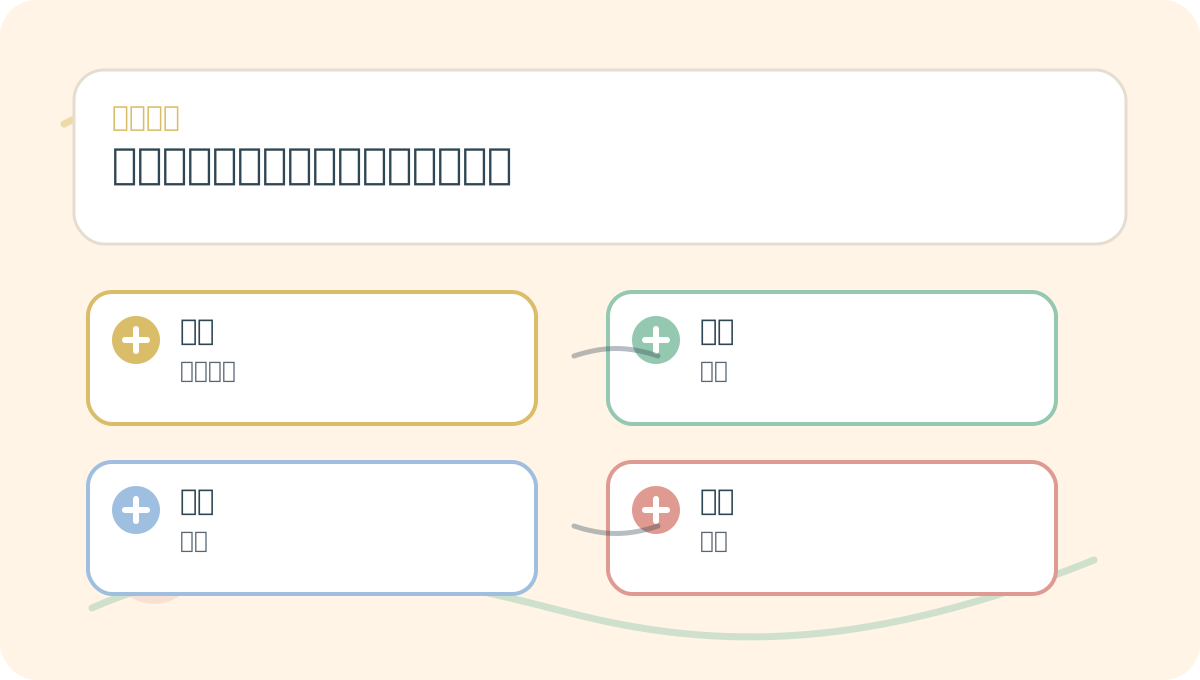
The article “Foundational Concepts in Probability: Conditional Probability and Independence” can be read through four lenses: scenario, concept, action, and outcome. First align these four elements; then revisit the parameters, code, or workflows described in the main text.
Two events are independent if the occurrence of one provides no information about the occurrence of the other. Formally, events and are independent if and only if:
Example
Suppose we have two completely independent experiments:
- Flipping a fair coin: event = “getting heads”.
- Rolling a fair six-sided die: event = “rolling a 4”.
We know:
- Probability of heads: .
- Probability of rolling a 4: .
Then the joint probability —i.e., getting heads and rolling a 4—is:
Code Example
Here’s a simple Python simulation illustrating independence:
import numpy as np

# Sampling functions for coin flip and die roll
def flip_coin():
    return np.random.choice(['Heads', 'Tails'], p=[0.5, 0.5])

def roll_die():
    return np.random.randint(1, 7)  # integers 1 through 6

# Run many trials
trials = 10000
independent_events = [(flip_coin(), roll_die()) for _ in range(trials)]

# Count occurrences of (Heads, 4)
count = sum(1 for outcome in independent_events if outcome[0] == 'Heads' and outcome[1] == 4)
probability = count / trials

print(f"After {trials} trials, the empirical probability of 'Heads' and '4' occurring together is approximately: {probability:.4f}")

If you haven’t fully internalized “Foundational Concepts in Probability: Conditional Probability and Independence”, revisit this card and walk through its four key actions step-by-step.

When reviewing “Foundational Concepts in Probability: Conditional Probability and Independence”, avoid jumping straight into large-scale projects. Instead, first verify conceptual clarity using a single, straightforward example.
Summary
After practicing the definitions, formulas, and computations related to conditional probability and independence, you should now possess a deeper, more intuitive grasp of these core probabilistic concepts. They are not only theoretically fundamental but also frequently encountered in real-world applications across data science and artificial intelligence. Next, we will explore random variables and their distributions in greater depth.
Apply This Lesson
Turn this article into AI software, model, API, and security decisions.
English Article FAQ
Use this article as evidence before choosing AI tools
How should I use this AI Tutorials article?
Use it as the implementation or learning layer, then connect the idea to AI software buyer guides, tool comparisons, benchmarks, API choices, and security checks before making a production decision.
Is this English article different from the Chinese original?
The English edition is localized for global AI readers while preserving the original diagrams, screenshots, prompts, code examples, and source context from the Chinese article.
What should I read after Set seed for reproducibility?
Continue with AI Software Buyer Guides, AI Tools Workbench, Best AI Coding Agents, AI Model Benchmarks, OpenAI vs Anthropic API, or LLM Security Tools depending on the decision you need to make.
Can this article alone choose an AI product or model?
No. Treat the article as evidence and context, then validate fit with pricing, privacy requirements, integration effort, benchmark results, workflow tests, and fallback planning.
Continue