English translation
Example: Analyzing user check-in behavior with Python
AI Article Decision Snapshot
Turn the lesson into workflow, model, budget, and security checks before choosing tools.
Use this quick snapshot before leaving the article. It keeps the next search tied to practical AI software, model/API, cost, privacy, and implementation questions.
Workflow fit
Identify the real job behind the article: coding, research, document review, support, analytics, content, or internal automation.
Model or tool decision
Decide whether the next step is a software shortlist, an AI tool comparison, an API platform choice, or a model benchmark.
Budget and usage signal
Estimate seats, API calls, prompt volume, retries, review time, and fallback work before assuming the workflow is cheap.
Security and privacy review
Check whether source code, customer data, private documents, prompts, logs, or embeddings will enter the AI workflow.
Continuous improvement for AI products cannot rely on ad-hoc firefighting. To achieve stable, incremental progress—rather than reinventing the wheel with every release—teams must institutionalize mechanisms for handling failure cases, user feedback, performance metrics, and version management.
Establish a consistent cadence: review high-frequency failure cases weekly, refresh evaluation datasets monthly, and conduct gradual rollouts (e.g., canary or phased releases) before major updates. When mechanisms are stable, product quality becomes stable too.
In the previous article, we covered Methods for Analyzing User Behavior, laying the groundwork for product launch and operations. Once user behavior is well understood, the next step is leveraging that data to drive continuous product improvement. This article introduces best practices for continuous improvement during product launch and operations—illustrated with real-world examples.
What Is Continuous Improvement?
Continuous Improvement is a systematic process aimed at enhancing the performance of products, services, or workflows through iterative, incremental changes and optimizations. It commonly follows the PDCA cycle: Plan → Do → Check → Act.
After reading AI Product Manager Tutorial: Best Practices for Continuous Improvement in Product Launch and Operations, start by walking through the full workflow using a small, concrete example—then assess which steps you can already execute independently.
By this point, you should be able to distill AI Product Manager Tutorial: Best Practices for Continuous Improvement in Product Launch and Operations into a concise retrospective summary sheet: first clarify the core narrative, then validate it against a small task.
1. Plan
Before launch, define clear goals and KPIs—such as user growth rate, daily active users (DAU), or customer satisfaction scores—that align directly with the product’s core value proposition and broader business strategy.
Example: Company A Launches a Health Management App
Company A sets a goal to increase DAU. Specifically, they aim to boost DAU by 20% within three months post-launch. Using user behavior analysis, they identify key user journeys and pain points inside the app.
2. Do
Once goals and strategies are defined, execution begins. During this phase, product managers must closely monitor user feedback and behavioral signals.
Continuing the Example:
During rollout, Company A introduces a new feature: “Exercise Logging via Daily Check-ins.” Behavioral analysis reveals many users struggle to complete check-ins. In response, the product team redesigns the interface and adds intuitive, step-by-step guidance.
# Example: Analyzing user check-in behavior with Python
import pandas as pd

# Assume we have check-in log data
data = {'user_id': [1, 2, 3, 4],
        'check_in_status': [1, 0, 1, 1]}
df = pd.DataFrame(data)

# Count users who missed check-ins
missed_checkins = df[df['check_in_status'] == 0].count()['user_id']
print(f'Number of users who missed check-ins: {missed_checkins}')
3. Check
After implementation, the team measures actual outcomes against targets. Techniques like A/B testing help quantify the impact of changes objectively.
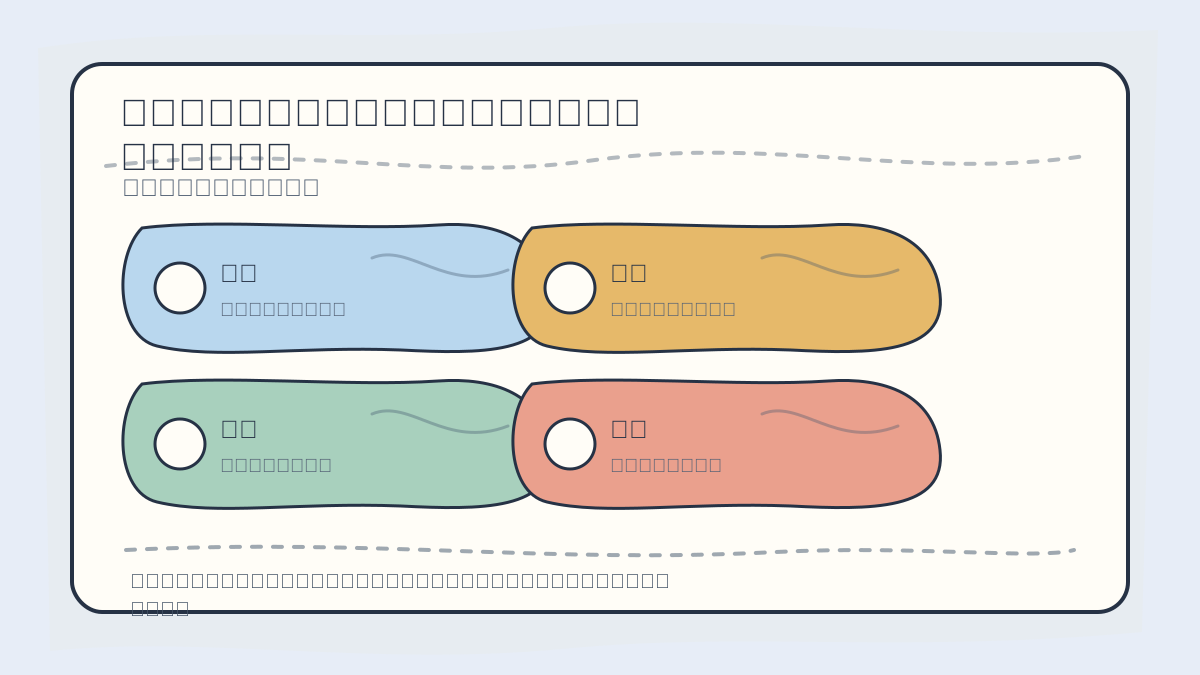
When conducting continuous improvement, always assess:
- Core metrics
- User feedback
- Release cadence
- Experiment infrastructure
- Issue prioritization framework
- Retrospective documentation
A/B Testing Example:
After deploying the new interface, Company A splits users into two groups:
- Group A: Uses the new interface
- Group B: Continues using the old interface
By comparing DAU and check-in completion rates between groups, they determine whether the new interface delivers measurable improvement.
# Example: Comparing A/B test results
import numpy as np

# Simulated check-in completion data
A_group = np.array([1, 1, 1, 0, 1])  # New interface group
B_group = np.array([0, 0, 1, 0, 1])  # Old interface group

# Calculate completion rates
completion_A = np.mean(A_group) * 100
completion_B = np.mean(B_group) * 100

print(f'Check-in completion rate (New UI): {completion_A}%')
print(f'Check-in completion rate (Old UI): {completion_B}%')
4. Act
Based on insights from the Check phase, product managers take decisive action. If the change proves effective, it may be rolled out broadly. If results fall short, root causes must be diagnosed—and the next iteration of the plan refined accordingly.
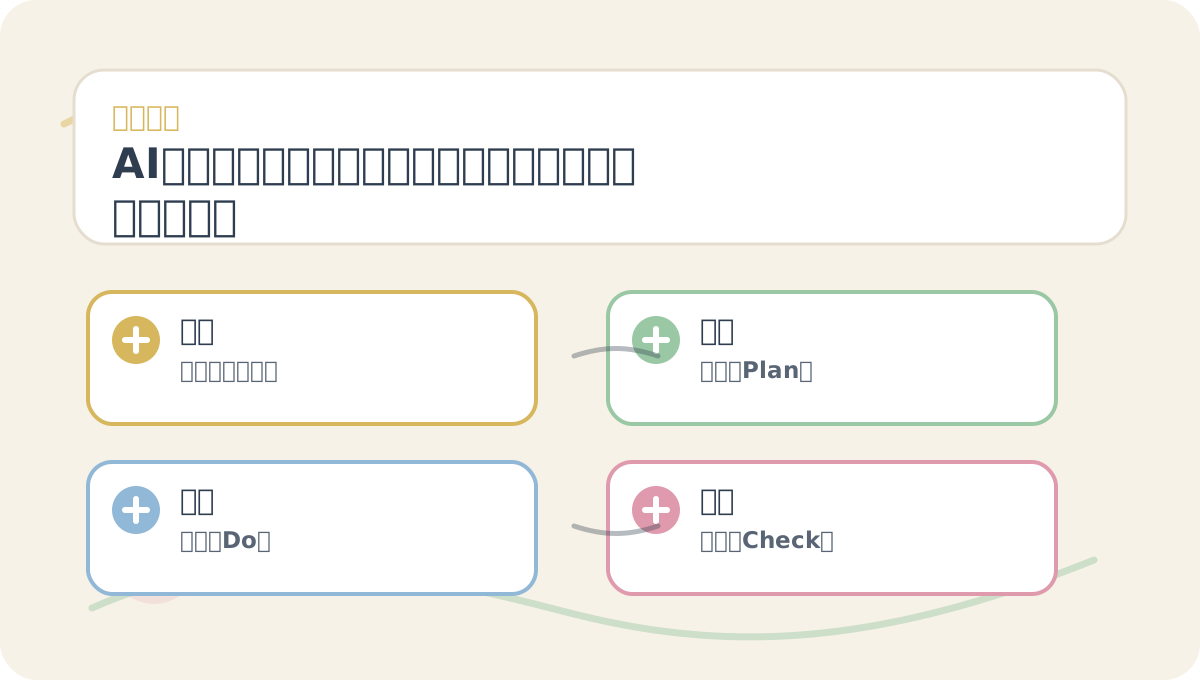
While reading AI Product Manager Tutorial: Best Practices for Continuous Improvement in Product Launch and Operations, first map each element in the diagram—problems, keywords, actions, and acceptance criteria—to the corresponding text. This makes reading more efficient. After finishing, try re-explaining the entire tutorial using your own project as context.
Summary & Recommendations
- Data-Driven Decisions: Continuous improvement must rest on rigorous, reliable data analysis—especially insights derived from user behavior analytics.
- Agile Responsiveness: Markets and user needs evolve rapidly; product managers must act swiftly and flexibly to adapt strategy and execution.
- User Feedback Loops: Proactively collect qualitative and quantitative feedback—via surveys, interviews, usability tests, and in-app prompts—to ensure decisions reflect real user needs and experiences.
Continuous improvement is not a one-time effort—it’s an ongoing discipline. In the next article, we’ll explore how to translate continuous improvement insights into concrete product iterations and new feature design. Stay tuned.
Apply This Lesson
Turn this article into AI software, model, API, and security decisions.
English Article FAQ
Use this article as evidence before choosing AI tools
How should I use this AI Tutorials article?
Use it as the implementation or learning layer, then connect the idea to AI software buyer guides, tool comparisons, benchmarks, API choices, and security checks before making a production decision.
Is this English article different from the Chinese original?
The English edition is localized for global AI readers while preserving the original diagrams, screenshots, prompts, code examples, and source context from the Chinese article.
What should I read after Example: Analyzing user check-in behavior with Python?
Continue with AI Software Buyer Guides, AI Tools Workbench, Best AI Coding Agents, AI Model Benchmarks, OpenAI vs Anthropic API, or LLM Security Tools depending on the decision you need to make.
Can this article alone choose an AI product or model?
No. Treat the article as evidence and context, then validate fit with pricing, privacy requirements, integration effort, benchmark results, workflow tests, and fallback planning.
Continue