English translation
19. User Behavior Analysis Methods for AI Product Launch and Operations
AI Article Decision Snapshot
Turn the lesson into workflow, model, budget, and security checks before choosing tools.
Use this quick snapshot before leaving the article. It keeps the next search tied to practical AI software, model/API, cost, privacy, and implementation questions.
Workflow fit
Identify the real job behind the article: coding, research, document review, support, analytics, content, or internal automation.
Model or tool decision
Decide whether the next step is a software shortlist, an AI tool comparison, an API platform choice, or a model benchmark.
Budget and usage signal
Estimate seats, API calls, prompt volume, retries, review time, and fallback work before assuming the workflow is cheap.
Security and privacy review
Check whether source code, customer data, private documents, prompts, logs, or embeddings will enter the AI workflow.
User behavior reveals many issues that users cannot articulate clearly in verbal feedback. For example, frequent copying of outputs, repeated retries, or rapid exits may all indicate that a feature is not yet truly usable.
When analyzing behavior, always interpret it in the context of task objectives. A long dwell time isn’t necessarily positive—it could mean users are stuck. Similarly, high retry rates aren’t inherently good—they may signal unstable output.
Understanding user behavior is one of the key success factors during product launch and operations. This tutorial dives deeply into multiple user behavior analysis methods—providing data-driven support for product iteration while also delivering robust foundations for continuous improvement. These analytical approaches lay the groundwork for the best practices covered next.
Theoretical Foundations
User behavior analysis refers to collecting and analyzing various data points generated as users interact with a product, in order to understand their needs, habits, and pain points. These insights empower product managers to formulate more precise operational strategies and prioritize feature iterations effectively.
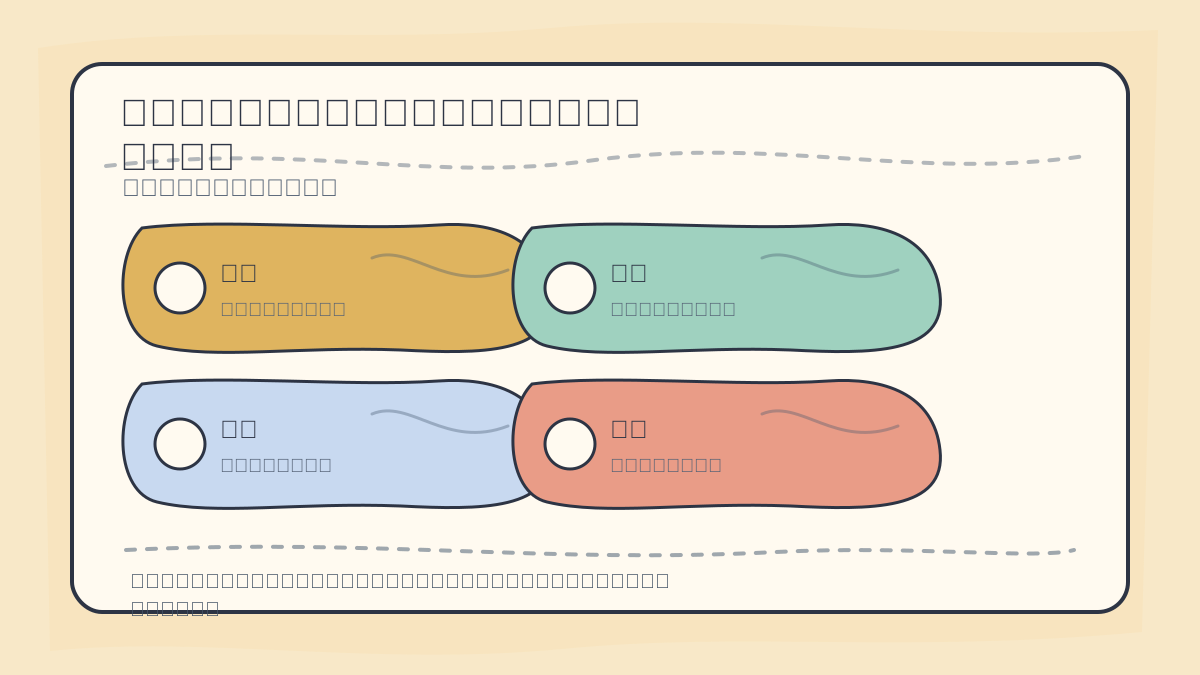
When analyzing user behavior, start by examining:
- Critical user journeys
- Event instrumentation (tracking)
- Retention and conversion metrics
- Segment-level differences
- Anomalous behaviors
- Actionable improvement opportunities
Data Collection Methods
- User Interviews
- Conduct direct conversations with users to gather qualitative feedback and uncover unmet needs. This method is especially valuable for early-stage products—or those lacking sufficient usage data.
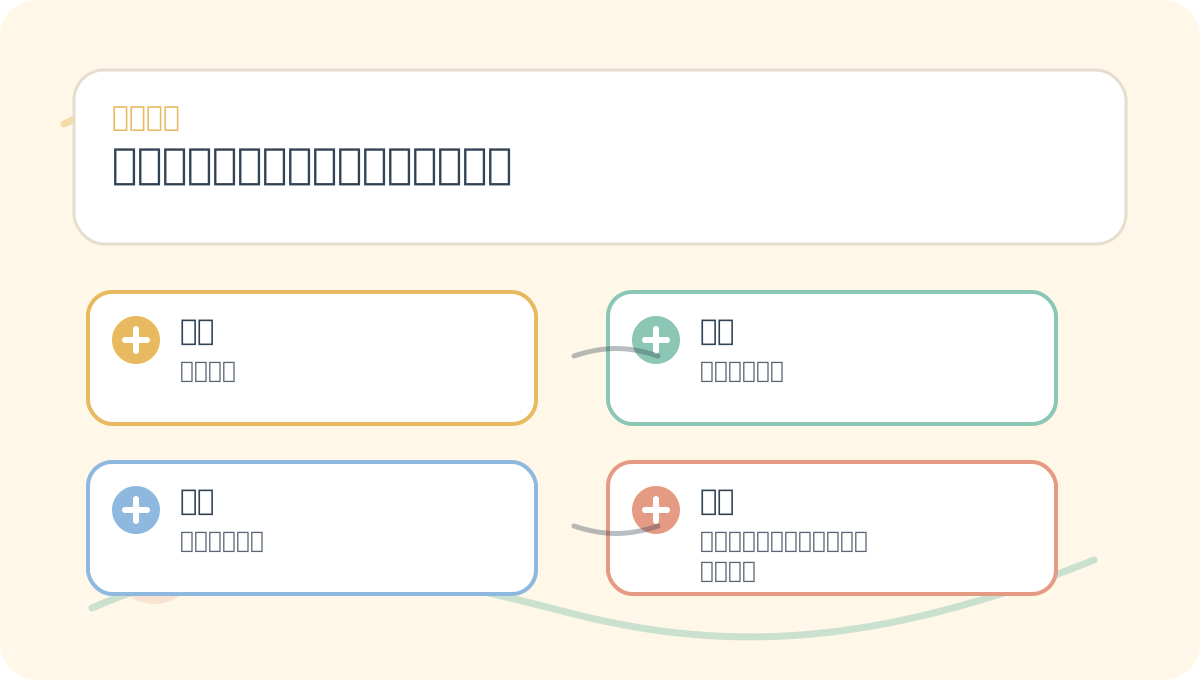
After reading User Behavior Analysis for Product Launch and Operations, revisit three questions:
- What problem does this solve?
- At which step is error most likely to occur?
- Can you walk through a small, concrete example end-to-end?
-
Surveys
- Deploy structured questionnaires to collect quantifiable feedback. Survey tools like Google Forms or SurveyMonkey help identify behavioral patterns through statistical analysis.
-
Behavioral Tracking
- Use analytics platforms (e.g., Google Analytics, Mixpanel, or Amplitude) to instrument and track user interactions across your product. Key metrics such as conversion rate and retention rate can then be derived and monitored.
-
Heatmap Analysis
- Leverage heatmap tools (e.g., Hotjar or Crazy Egg) to visualize where users click and scroll on web pages—revealing which content areas attract the most attention.
Key User Behavior Metrics
When conducting user behavior analysis, pay close attention to these core metrics:
-
Active Users (DAU/WAU/MAU)
- The number of users engaging with the product within a given time window (daily, weekly, or monthly). Analyzing active users helps gauge overall product appeal and engagement.
-
User Retention Rate
- The percentage of users who continue using the product over a defined period. For instance, Week 1 retention is calculated as:
-
Conversion Rate
- The proportion of users who complete a critical action (e.g., sign-up, purchase). It is computed as:
Case Study: User Behavior Analysis for an E-commerce Platform
Consider a typical e-commerce platform. After launch, user behavior analysis can proceed as follows:
1. Data Collection
Use Google Analytics to track user behavior, including event tracking for “Add to Cart” and “Purchase” button clicks. Simultaneously, deploy Hotjar to generate heatmaps and identify the most-clicked page regions.
2. Analysis Results
Suppose analysis reveals that 68% of users leave the site after browsing only 3–5 products—suggesting confusion or decision fatigue during product selection.
3. Action Plan
To address this, the product manager decides to:
- Simplify and optimize product categorization to help users locate desired items faster.
- Introduce a personalized recommendation engine, surfacing items based on users’ historical browsing behavior.
4. Measuring Improvement
After implementing these changes, re-evaluate conversion and retention metrics to assess whether meaningful improvements have occurred.
If User Behavior Analysis for Product Launch and Operations hasn’t yet been fully internalized, revisit the four actions outlined on this card to reinforce understanding.
When reviewing User Behavior Analysis for Product Launch and Operations, avoid launching large-scale initiatives upfront. Instead, begin with a single, simple example to verify whether the core logic is clear and actionable.
Conclusion
Effective user behavior analysis enables product teams not only to gain deep, empathetic insight into user needs—but also to make data-informed decisions about product iteration and operational strategy. This strengthens product appeal and competitiveness, laying a solid foundation for sustained improvement.
In the next chapter, we’ll explore Best Practices for Continuous Improvement in Product Launch and Operations. There, we’ll demonstrate how to translate behavioral insights—derived from the methods covered here—into concrete, impactful product optimizations. We hope these techniques help you cultivate richer user understanding—and ultimately drive your product’s success!
Apply This Lesson
Turn this article into AI software, model, API, and security decisions.
English Article FAQ
Use this article as evidence before choosing AI tools
How should I use this AI Tutorials article?
Use it as the implementation or learning layer, then connect the idea to AI software buyer guides, tool comparisons, benchmarks, API choices, and security checks before making a production decision.
Is this English article different from the Chinese original?
The English edition is localized for global AI readers while preserving the original diagrams, screenshots, prompts, code examples, and source context from the Chinese article.
What should I read after 19. User Behavior Analysis Methods for AI Product Launch and Operations?
Continue with AI Software Buyer Guides, AI Tools Workbench, Best AI Coding Agents, AI Model Benchmarks, OpenAI vs Anthropic API, or LLM Security Tools depending on the decision you need to make.
Can this article alone choose an AI product or model?
No. Treat the article as evidence and context, then validate fit with pricing, privacy requirements, integration effort, benchmark results, workflow tests, and fallback planning.
Continue