English translation
Example: Loading user behavior data
AI Article Decision Snapshot
Turn the lesson into workflow, model, budget, and security checks before choosing tools.
Use this quick snapshot before leaving the article. It keeps the next search tied to practical AI software, model/API, cost, privacy, and implementation questions.
Workflow fit
Identify the real job behind the article: coding, research, document review, support, analytics, content, or internal automation.
Model or tool decision
Decide whether the next step is a software shortlist, an AI tool comparison, an API platform choice, or a model benchmark.
Budget and usage signal
Estimate seats, API calls, prompt volume, retries, review time, and fallback work before assuming the workflow is cheap.
Security and privacy review
Check whether source code, customer data, private documents, prompts, logs, or embeddings will enter the AI workflow.
Traditional products are typically delivered around pages, workflows, and rules; AI products require ongoing operations—including continuous monitoring of model performance, data quality, and user trust. Launching is not the end—it’s the beginning of long-term oversight.
When writing a PRD, consider adding a dedicated section titled “Model Performance & Risks”: What are the target metrics? How are erroneous outputs handled? Do users understand the system’s capabilities—and its limits?
In today’s rapidly evolving technological landscape, Artificial Intelligence (AI) products have become central to many organizations’ strategic initiatives. These products differ significantly from traditional ones in both development and management—placing unique challenges and responsibilities on AI product managers. This article explores the key distinctions between AI and traditional product management, offering insights into how to effectively develop and manage AI-driven products.
Core Differences Between AI and Traditional Product Management
1. Data-Driven Decision-Making
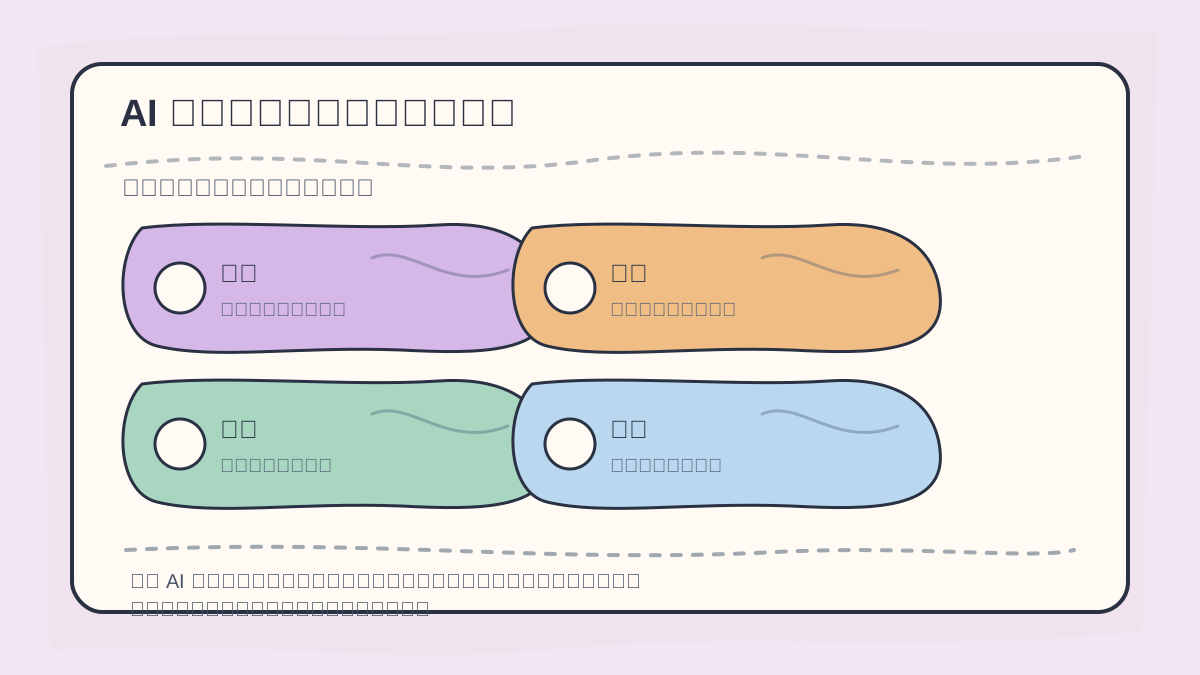
When comparing AI and traditional products, focus on four dimensions: output uncertainty, data dependency, continuous evaluation, and safety boundaries. Product managers must integrate these variables into daily decision-making.
In traditional product management, decisions are typically guided by market research, user feedback, and sales analytics. In contrast, AI product management relies heavily on data—especially real-time and historical big data.
For example, when building a recommendation system, a traditional product manager might base decisions on insights from a small-scale user survey. An AI product manager, however, must leverage algorithms to analyze tens of thousands of user behavioral records—enabling far more precise, personalized recommendations.
import pandas as pd

# Example: Loading user behavior data
user_data = pd.read_csv('user_behavior.csv')
recommendations = model.predict(user_data)
2. Uncertainty and Iterative Development
Traditional product management often follows rigid development cycles (e.g., the waterfall model), where requirements are largely fixed before development begins. In contrast, AI product development faces high levels of uncertainty—requiring frequent iterations to refine algorithms and models.
For instance, during the development of a speech recognition system, early versions may perform poorly under specific environmental conditions. The product manager must therefore continuously tune algorithms, collect and analyze new data, and retrain models to improve accuracy. This iterative rhythm demands exceptional adaptability and flexibility from AI product managers.
3. Cross-Disciplinary Collaboration
Traditional product management involves collaboration across functional teams—such as engineering, design, and marketing. AI product management adds another critical layer: close coordination with data scientists and machine learning engineers, to extract actionable insights from data and translate them into tangible product features.
For example, when developing an image recognition application, the AI product manager must not only prioritize UI/UX but also grasp technical aspects like model training pipelines and feature engineering—ensuring the product meets diverse user needs.
4. Balancing Algorithmic Optimization and User Experience
AI products rely on complex algorithms to generate desired outputs—a factor that directly impacts performance and response time. While traditional product management emphasizes interface usability, AI product managers must strike a careful balance between algorithmic performance and user experience.
Consider a real-time chatbot application: the AI product manager may need to weigh response speed against answer intelligence. In some cases, delivering a fast—but slightly less accurate—reply delivers better UX than making users wait for a highly sophisticated yet delayed response.
5. Ethics and Accountability
AI product managers must proactively address ethical considerations and bias mitigation. Although traditional product management also prioritizes privacy and security, AI introduces heightened ethical stakes—including model transparency, explainability, and fairness.
Take facial recognition technology as an example: the AI product manager must understand relevant legal frameworks and ethical guidelines governing personal data use—ensuring compliance and responsible deployment. They must also actively identify and mitigate algorithmic bias to guarantee equitable treatment across all user groups.
Having read this article, consolidate “AI Product Management Fundamentals: How AI Differs from Traditional Product Management” into a retrospective checklist: first clarify the core narrative, then validate it using a small, concrete task.
After reading “AI Product Management Fundamentals: How AI Differs from Traditional Product Management”, select a small, realistic use case and walk through the full process end-to-end. Then assess which steps you can already execute independently.
Summary
AI product management differs significantly from traditional product management—not only in its reliance on data-driven decisions and tolerance for uncertainty, but also in its demand for cross-disciplinary collaboration, nuanced trade-offs between algorithmic sophistication and user experience, and heightened accountability for ethics and fairness. Understanding these distinctions equips AI product managers to build and scale AI products more effectively—and lays the groundwork for our next article: a deep dive into successful AI product case studies.
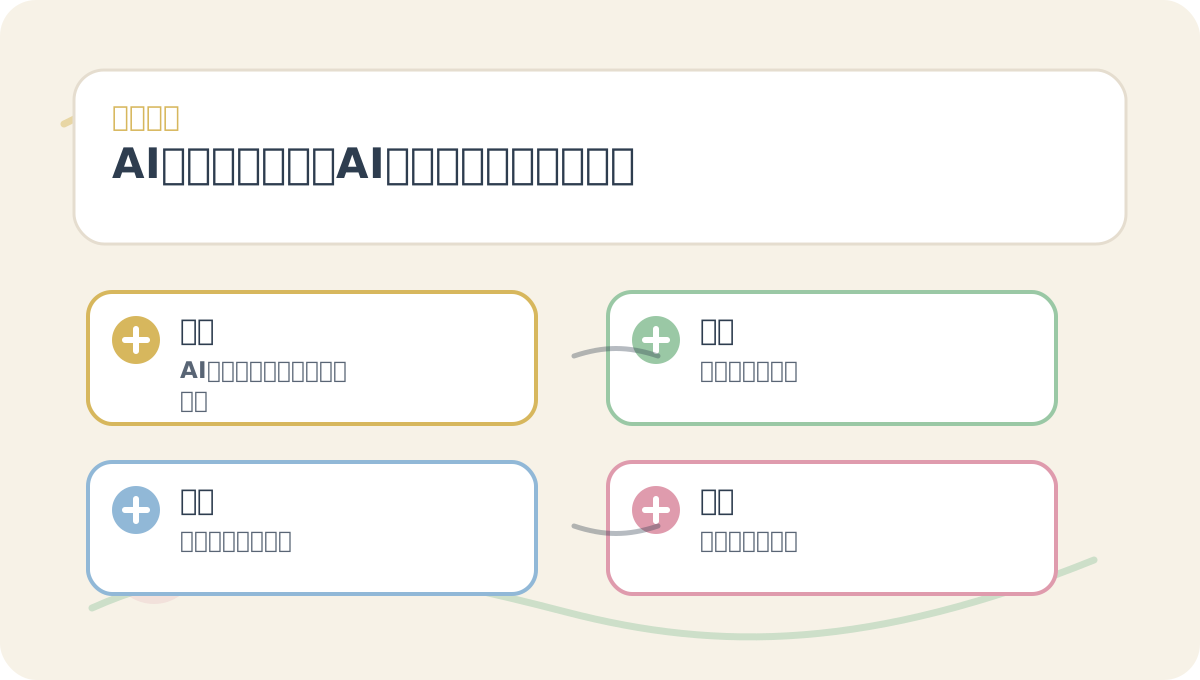
While reading “AI Product Management Fundamentals: How AI Differs from Traditional Product Management”, start by reviewing the tasks, concepts, exercises, and judgment points embedded in the illustrations—then return to the main text to fill in supporting details. This approach helps you quickly assess which real-world scenarios this content applies to.
In upcoming articles, we’ll examine real-world AI product success stories—exploring key success factors, common challenges, and practical strategies for overcoming them.
Apply This Lesson
Turn this article into AI software, model, API, and security decisions.
English Article FAQ
Use this article as evidence before choosing AI tools
How should I use this AI Tutorials article?
Use it as the implementation or learning layer, then connect the idea to AI software buyer guides, tool comparisons, benchmarks, API choices, and security checks before making a production decision.
Is this English article different from the Chinese original?
The English edition is localized for global AI readers while preserving the original diagrams, screenshots, prompts, code examples, and source context from the Chinese article.
What should I read after Example: Loading user behavior data?
Continue with AI Software Buyer Guides, AI Tools Workbench, Best AI Coding Agents, AI Model Benchmarks, OpenAI vs Anthropic API, or LLM Security Tools depending on the decision you need to make.
Can this article alone choose an AI product or model?
No. Treat the article as evidence and context, then validate fit with pricing, privacy requirements, integration effort, benchmark results, workflow tests, and fallback planning.
Continue