English translation
3. Core Characteristics of AI Products
AI Article Decision Snapshot
Turn the lesson into workflow, model, budget, and security checks before choosing tools.
Use this quick snapshot before leaving the article. It keeps the next search tied to practical AI software, model/API, cost, privacy, and implementation questions.
Workflow fit
Identify the real job behind the article: coding, research, document review, support, analytics, content, or internal automation.
Model or tool decision
Decide whether the next step is a software shortlist, an AI tool comparison, an API platform choice, or a model benchmark.
Budget and usage signal
Estimate seats, API calls, prompt volume, retries, review time, and fallback work before assuming the workflow is cheap.
Security and privacy review
Check whether source code, customer data, private documents, prompts, logs, or embeddings will enter the AI workflow.
The fundamental distinction between AI products and conventional features lies in their outputs: rather than being deterministic results of fixed logic, AI outputs are shaped by data, models, context, and user feedback. Product managers must deliberately design for this inherent uncertainty—not ignore or pretend it doesn’t exist.
When evaluating an AI feature, don’t rely solely on a single demo result. To assess whether it’s ready for real-world deployment, examine its behavior across at least four scenarios: typical (normal) inputs, edge cases, low-quality or noisy inputs, and fallback behavior upon failure.
In the previous article, we explored the growing importance of AI in product management—highlighting how rapid advances in artificial intelligence present both novel challenges and unprecedented opportunities for product managers. This article dives deeper into the defining characteristics of AI products: traits that shape not only their design and development, but also their go-to-market strategy and user experience. Understanding these characteristics lays the essential groundwork for our next discussion—comparing AI-driven product management with traditional approaches.
Core Characteristics of AI Products
1. Self-Learning and Adaptability
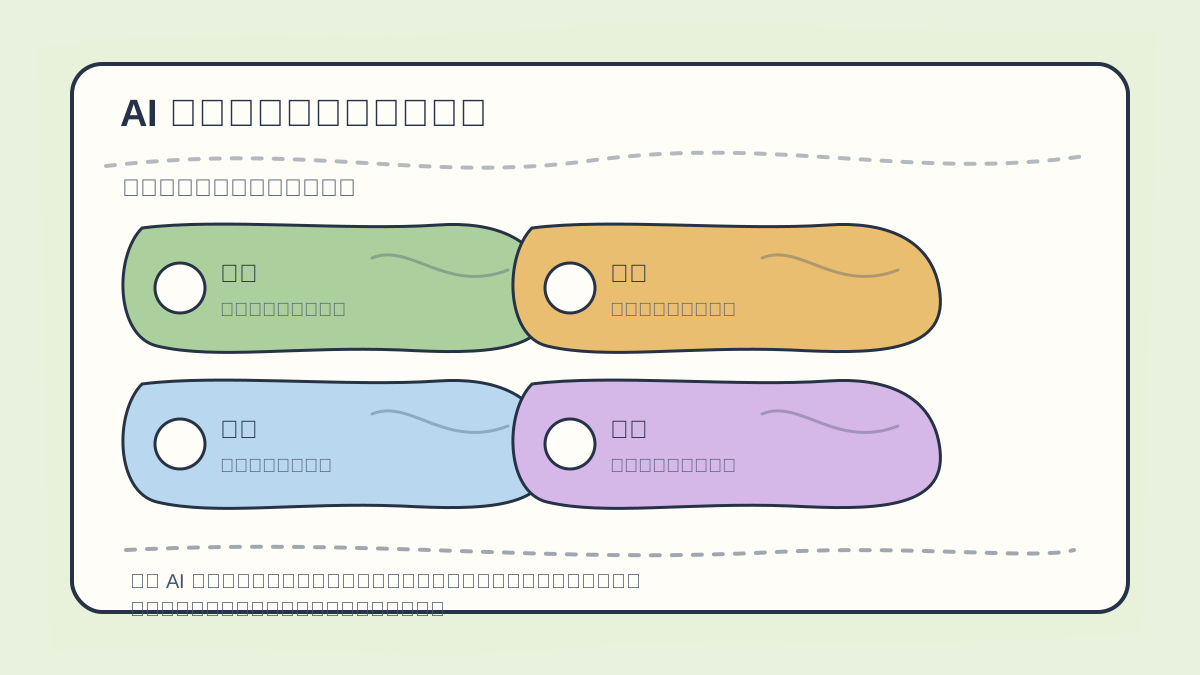
When assessing AI product characteristics, focus on four key dimensions: output instability, user expectations, data-related risks, and appropriate evaluation metrics. Only by embedding these constraints directly into product design can features become truly robust and reliable.
AI products possess self-learning capabilities—meaning they continuously refine their behavior based on user interactions and feedback. This trait manifests widely, notably in recommendation systems. For example, e-commerce platforms use AI to analyze users’ browsing history and purchase patterns, iteratively tuning recommendation algorithms to improve personalization accuracy.
Case Study: Netflix Recommendation System
Netflix’s recommendation engine relies on sophisticated algorithms that process vast amounts of user data—including viewing history, ratings, and behavioral signals. It dynamically adjusts recommendations in real time, sustaining viewer engagement and freshness—and thereby boosting long-term retention.
def recommend_movies(user_id):
    # Assume a function exists to fetch the user's viewing history
    watched_movies = get_watched_movies(user_id)

    # Build a recommendation model based on viewing history
    recommendations = model.recommend(watched_movies)

    return recommendations
2. Data-Driven Architecture
AI products are fundamentally powered by large volumes of data. Model performance is highly sensitive to both data quantity and quality. Product managers must understand how to acquire, store, and preprocess data to ensure effective model training.
Case Study: Intelligent Customer Support System
An intelligent customer support system trains natural language processing (NLP) models using tens of thousands of historical customer queries and resolutions. To achieve high accuracy and responsiveness, product managers must ensure training data is diverse, representative, and accurately labeled.
3. Complexity and Inherent Uncertainty
The technical complexity of AI introduces significant uncertainty into the product development lifecycle. Model training and hyperparameter tuning require extensive experimentation—often multiple iterations—before desired performance thresholds are met. This contrasts sharply with traditional software development, where requirements and outcomes are typically more predictable and linear. As a result, AI product cycles often demand longer iteration timelines and greater tolerance for ambiguity.
Case Study: Image Recognition Application
When developing an image recognition application, product managers may observe wide variance in model accuracy across different image categories (e.g., lighting conditions, object occlusion, resolution). Improving robustness requires iterative cycles of data collection, model architecture selection, and hyperparameter optimization—demanding strong adaptability and decision-making under uncertainty from the product manager.
4. Intelligent User Interaction
AI products enable significantly more intelligent and contextual user interactions. Voice assistants, for instance, interpret natural-language utterances and deliver timely, relevant responses. Such intelligent interaction elevates user satisfaction and strengthens the emotional and functional bond between users and the product.
Case Study: Smart Speakers
Devices like Amazon Echo leverage NLP and speech recognition to engage users conversationally. Product managers must deeply understand user intent patterns and common failure modes—then prioritize improvements in speech understanding, response relevance, and error recovery—to elevate the overall voice-user experience.
5. High-Degree Personalization
AI products excel at delivering deeply personalized experiences by analyzing rich behavioral and preference data. Every user interaction contributes new signals, enabling the system to progressively tailor content, functionality, and timing—making services increasingly aligned with individual needs.
Case Study: Online Learning Platforms
Online learning platforms track learners’ progress, quiz scores, time-on-task, and engagement patterns to dynamically recommend courses, practice exercises, and supplementary resources. When designing such recommendation engines, product managers must account for diverse learning styles, goals, and pacing preferences—ensuring personalization enhances, rather than overwhelms, the learning journey.
If you haven’t yet fully internalized “Core Characteristics of AI Products”, revisit this card and walk through its four actionable steps.
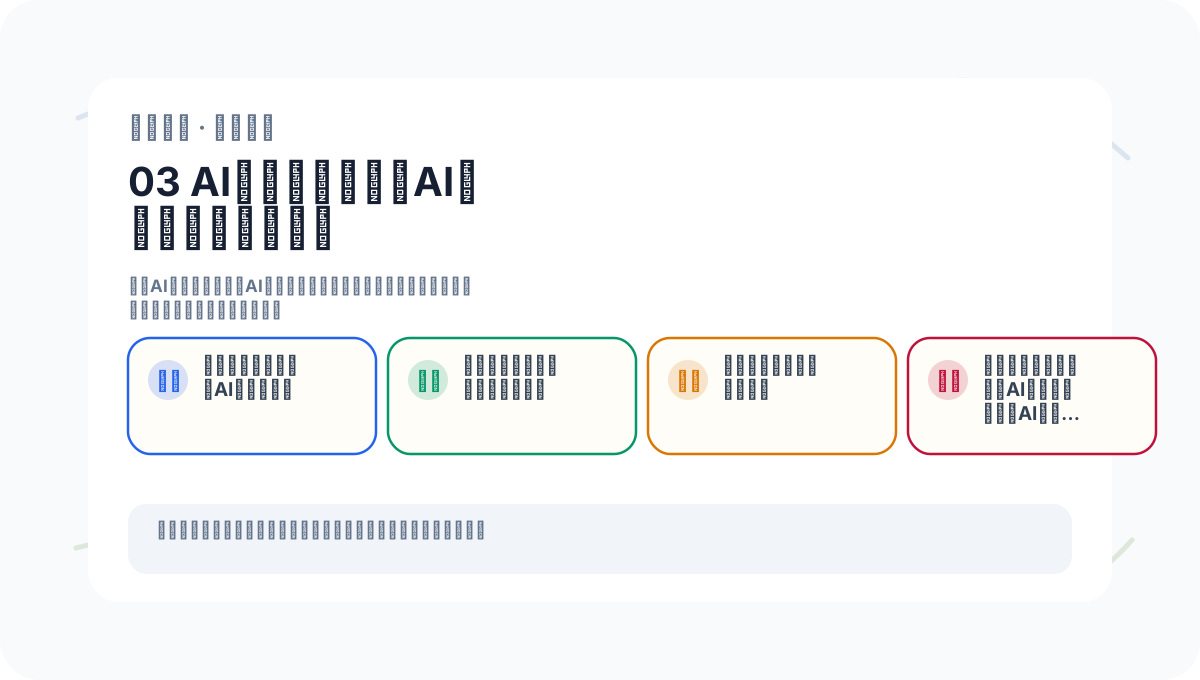
When reviewing “Core Characteristics of AI Products”, avoid launching a large-scale initiative right away. Instead, start with one simple, concrete example to verify whether the core concepts are clear and actionable.
Summary
These distinctive characteristics fundamentally differentiate AI products from traditional ones—across design, development, and operational management. They demand that product managers cultivate new competencies: fluency in data fundamentals, intuition for self-learning systems, and resilience in navigating ambiguity. In our next article, we’ll explore how AI reshapes product management practices—delving into concrete strategies for leading effectively in AI-driven environments.
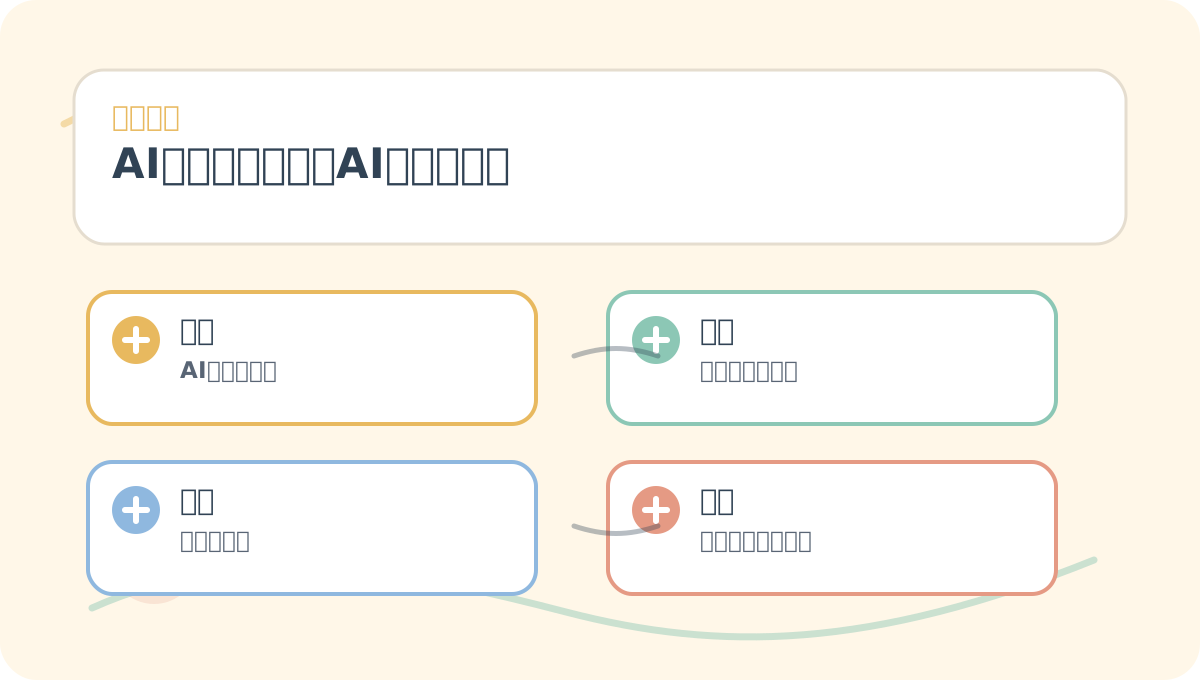
After reading “Core Characteristics of AI Products”, take one minute to reflect:
- Are the key concepts clearly distinguished?
- Can the practice steps be reliably reproduced?
- Can you restate the main conclusions in your own words?
Apply This Lesson
Turn this article into AI software, model, API, and security decisions.
English Article FAQ
Use this article as evidence before choosing AI tools
How should I use this AI Tutorials article?
Use it as the implementation or learning layer, then connect the idea to AI software buyer guides, tool comparisons, benchmarks, API choices, and security checks before making a production decision.
Is this English article different from the Chinese original?
The English edition is localized for global AI readers while preserving the original diagrams, screenshots, prompts, code examples, and source context from the Chinese article.
What should I read after 3. Core Characteristics of AI Products?
Continue with AI Software Buyer Guides, AI Tools Workbench, Best AI Coding Agents, AI Model Benchmarks, OpenAI vs Anthropic API, or LLM Security Tools depending on the decision you need to make.
Can this article alone choose an AI product or model?
No. Treat the article as evidence and context, then validate fit with pricing, privacy requirements, integration effort, benchmark results, workflow tests, and fallback planning.
Continue