English translation
Extract user reviews
AI Article Decision Snapshot
Turn the lesson into workflow, model, budget, and security checks before choosing tools.
Use this quick snapshot before leaving the article. It keeps the next search tied to practical AI software, model/API, cost, privacy, and implementation questions.
Workflow fit
Identify the real job behind the article: coding, research, document review, support, analytics, content, or internal automation.
Model or tool decision
Decide whether the next step is a software shortlist, an AI tool comparison, an API platform choice, or a model benchmark.
Budget and usage signal
Estimate seats, API calls, prompt volume, retries, review time, and fallback work before assuming the workflow is cheap.
Security and privacy review
Check whether source code, customer data, private documents, prompts, logs, or embeddings will enter the AI workflow.

The biggest pitfall in AI product research is chasing buzzwords. A more robust approach is to return to real user scenarios: observe how users currently complete tasks, where they waste time, where errors occur, and where they’re willing to pay for better outcomes.

When conducting research, preserve raw evidence: verbatim interview transcripts, screen recordings of user interactions, data screenshots, and documented competitor workflows. Later, when evaluating whether a model-based feature is worth building, you’ll rely on this evidence.
In previous chapters, we explored successful AI product case studies and learned how those products captured market rhythm and addressed user needs. Compared to traditional products, market research for AI products is especially critical—because AI products often involve complex technologies and rapidly evolving market dynamics. Mastering appropriate market research methods and tools is therefore essential for every AI product manager.
1. Purpose of Market Research
The primary purpose of market research is to gather actionable insights about the target market, potential users, and their underlying needs. This enables us to:

Before launching research, first validate five key elements: the user’s core problem, the current workflow, available data assets, competitor solutions, and measurable success metrics. For AI products, never rely solely on asking users what they say they want.
- Identify viable market opportunities
- Understand genuine user pain points
- Make product decisions grounded in empirical evidence
2. Common Market Research Methods
2.1 Quantitative Research
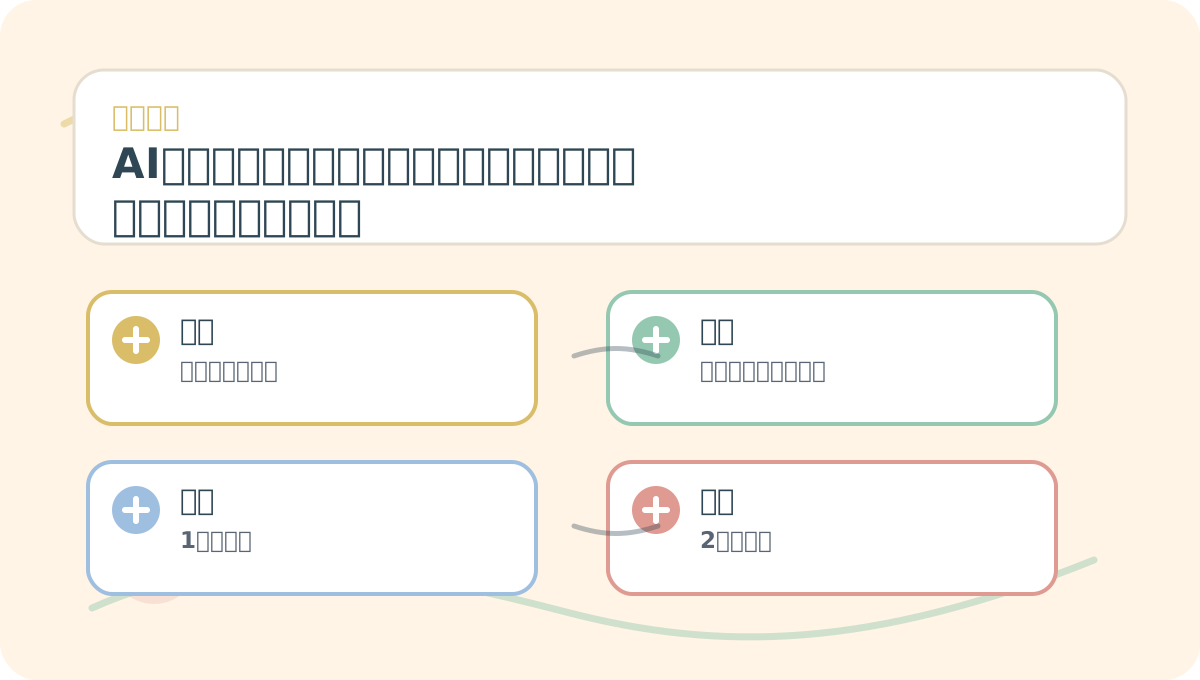
The AI Product Manager Tutorial Series: Market Research and User Needs — Methods and Tools for Market Research is best read through the lens of “Scenario → Concept → Action → Outcome.” First align these four dimensions; only then dive into parameters, code snippets, or process details in the main text.
Quantitative research collects numerical data via surveys, controlled experiments, and similar approaches—enabling statistical analysis. Common techniques include:
- Online Surveys: Use tools like
SurveyMonkeyorGoogle Formsto design questionnaires and collect large-scale user feedback. - A/B Testing: Deploy multiple versions of a feature or interface to measure relative performance and user preference.
Case Study:
Suppose you’re developing an AI-powered health management app. To gauge demand for specific features, you deploy an online survey asking users which health metrics matter most (e.g., nutrition, exercise, sleep). Statistical analysis reveals that 80% of respondents prioritize real-time dietary tracking—giving your team a clear, data-backed direction for feature development.
2.2 Qualitative Research
Qualitative research focuses on deep understanding of user behaviors, motivations, and contextual constraints. Common techniques include:
- User Interviews: Conduct one-on-one, open-ended interviews with target users to uncover nuanced insights and unmet needs.
- Focus Groups: Facilitate guided discussions among a small group of representative users to explore collective perceptions of a product or feature.
Case Study:
If you’re building an AI voice assistant, run a focus group to explore everyday usage experiences. Participants may reveal that poor dialect and accent recognition significantly hampers usability—highlighting a concrete opportunity to improve speech models and boost satisfaction.
2.3 Competitive Analysis
Competitive analysis involves systematically studying rival products to understand market positioning, functional gaps, and user expectations. Key activities include:
- Feature Comparison: Map and contrast capabilities across competing products to identify strengths, weaknesses, and whitespace opportunities.
- User Review Analysis: Mine public reviews (e.g., from app stores or forums) to surface recurring complaints, praise, and latent needs.
Case Study:
Suppose several AI-powered language-learning apps already exist. By analyzing App Store and Google Play reviews, you discover consistent criticism of one competitor’s grammar analysis engine—users report inaccurate feedback and confusing explanations. You can prioritize building a more intuitive, pedagogically sound grammar analyzer in your own product.
3. Market Research Tools
Here are practical tools to support your market research efforts:
- Survey Tools:
Google Forms,SurveyMonkey,Typeform - Interview Tools:
Zoom,Skype(for remote interviews),Otter.ai(for automated transcription) - Competitive Intelligence Tools:
SimilarWeb,AppAnnie,BuzzSumo
Practical Tool & Code Example
Below is a simple Python example demonstrating how to scrape user reviews from a competitor’s Google Play listing using requests and BeautifulSoup:
import requests
from bs4 import BeautifulSoup

URL = 'https://play.google.com/store/apps/details?id=com.example.app'
response = requests.get(URL)
soup = BeautifulSoup(response.text, 'html.parser')

# Extract user reviews
reviews = soup.find_all('div', class_='review-text')
for i, review in enumerate(reviews[:5]):
    print(f"Review {i+1}: {review.text.strip()}")
This type of web scraping helps product managers gather authentic, unsolicited user feedback—serving as valuable input for competitive benchmarking and opportunity prioritization.

After completing AI Product Manager Tutorial Series: Market Research and User Needs — Methods and Tools for Market Research, try applying it to your own scenario. Pay special attention to whether inputs, processing logic, and outputs align coherently.

To apply AI Product Manager Tutorial Series: Market Research and User Needs — Methods and Tools for Market Research to your actual work, start by narrowing the scope—focus on validating just one critical decision point.
4. Summary
This article reviewed core market research methodologies—including quantitative research, qualitative research, and competitive analysis—as well as supporting tools and practical implementation examples. These approaches empower AI product managers to develop a rigorous, evidence-based understanding of markets and users, enabling smarter, more strategic product decisions. In the next chapter, we’ll delve deeper into techniques for identifying and uncovering user needs—so you can build AI products that truly resonate with your audience.
Apply This Lesson
Turn this article into AI software, model, API, and security decisions.
English Article FAQ
Use this article as evidence before choosing AI tools
How should I use this AI Tutorials article?
Use it as the implementation or learning layer, then connect the idea to AI software buyer guides, tool comparisons, benchmarks, API choices, and security checks before making a production decision.
Is this English article different from the Chinese original?
The English edition is localized for global AI readers while preserving the original diagrams, screenshots, prompts, code examples, and source context from the Chinese article.
What should I read after Extract user reviews?
Continue with AI Software Buyer Guides, AI Tools Workbench, Best AI Coding Agents, AI Model Benchmarks, OpenAI vs Anthropic API, or LLM Security Tools depending on the decision you need to make.
Can this article alone choose an AI product or model?
No. Treat the article as evidence and context, then validate fit with pricing, privacy requirements, integration effort, benchmark results, workflow tests, and fallback planning.
Continue