English translation
How to Identify User Needs: Market Research and User Requirements for AI Product Managers
AI Article Decision Snapshot
Turn the lesson into workflow, model, budget, and security checks before choosing tools.
Use this quick snapshot before leaving the article. It keeps the next search tied to practical AI software, model/API, cost, privacy, and implementation questions.
Workflow fit
Identify the real job behind the article: coding, research, document review, support, analytics, content, or internal automation.
Model or tool decision
Decide whether the next step is a software shortlist, an AI tool comparison, an API platform choice, or a model benchmark.
Budget and usage signal
Estimate seats, API calls, prompt volume, retries, review time, and fallback work before assuming the workflow is cheap.
Security and privacy review
Check whether source code, customer data, private documents, prompts, logs, or embeddings will enter the AI workflow.
A user saying they want a certain AI feature does not mean that feature is truly important. Product managers must uncover the underlying task, assess how frequently the pain point occurs, and estimate the value delivered by solving it.
Frame each need as a single sentence: “When users are in [specific context], they want to accomplish [specific task], but are currently blocked by [specific obstacle].” If you can’t articulate it this way, the need hasn’t yet been clearly identified.
In our previous article, we thoroughly explored methods and tools for market research. By applying a variety of techniques and instruments, we can gather rich, multifaceted data. This data not only helps us understand the broader market landscape but also lays the essential groundwork for identifying user needs—our focus in this article. Here, we’ll dive deep into how to extract authentic user needs from market research findings—and translate them into actionable guidance for AI product development.
Why Identifying User Needs Matters
First and foremost, accurately identifying user needs is fundamental to product success. Even the most advanced technology or brilliant idea will likely fail if it doesn’t address real user needs. Therefore, understanding those needs sits at the very heart of the entire product development process.
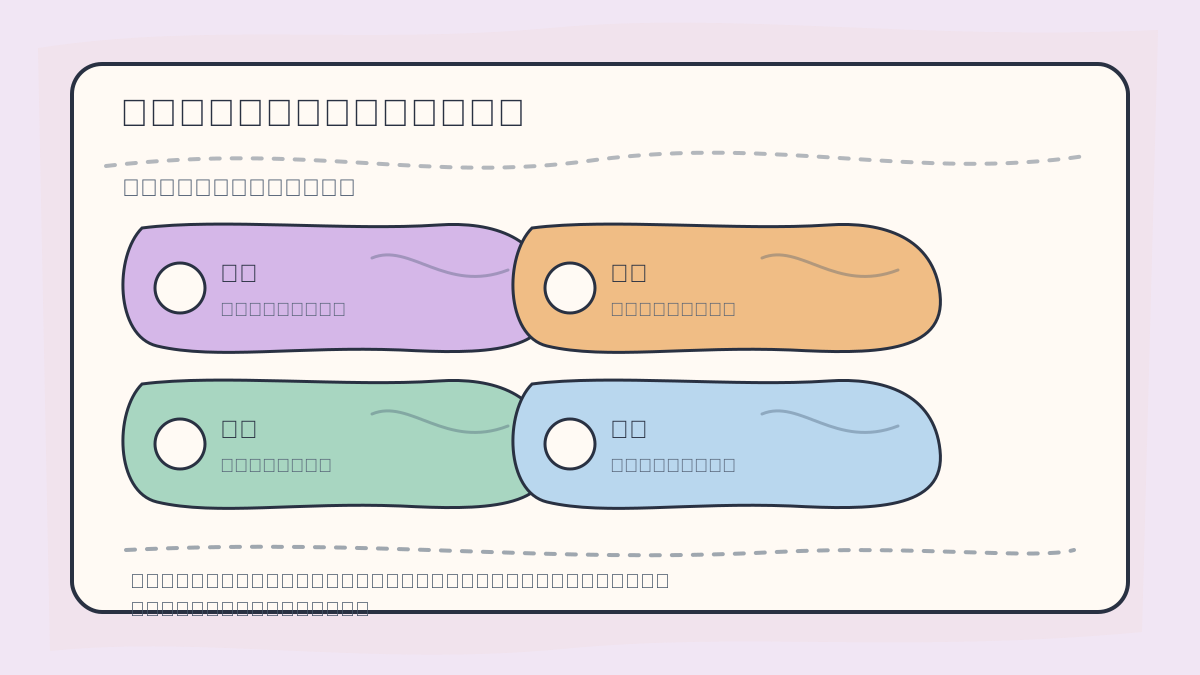
When identifying needs, start by documenting:
- How users currently perform the task,
- Where they get stuck,
- Why they take workarounds, and
- Which outcomes they’re willing to pay for.
A need is not just a wish—it’s a concrete, observable behavior rooted in context.
Steps to Identify User Needs
-
Data Analysis
Collected data must be rigorously analyzed to extract insights directly tied to user needs. Tools likeExcel,Tableau, or more advanced Python libraries such asPandasandNumPysupport this analysis.For example, analyzing user feedback may reveal that many users report slow response times in an existing AI product—pointing directly to a high-priority performance requirement for our next iteration.
import pandas as pd # Assume we have a feedback dataset data = pd.read_csv('user_feedback.csv') response_times = data['response_time'] avg_response_time = response_times.mean() print(f'Average user response time: {avg_response_time} seconds') -
User Interviews
Direct conversations with users yield deep qualitative insights—revealing unspoken motivations, emotions, and contextual nuances that surveys often miss.When conducting interviews, open-ended questions help surface authentic perspectives, such as:
- “What’s the biggest challenge you face when using similar products?”
- “Which new features would most meaningfully improve your experience in future versions?”
-
User Journey Mapping
Mapping the end-to-end user journey enables us to see the product through the user’s eyes—identifying needs, friction points, and emotional shifts at every touchpoint.For instance, when designing an AI chatbot, we might map the full flow: from question submission → response delivery → resolution confirmation. Along this path, we pinpoint moments of confusion or where additional guidance (e.g., clarification prompts, fallback options) would significantly improve usability.
-
User Behavior Analysis
Tools likeGoogle AnalyticsorMixpanellet us track and analyze actual usage patterns—revealing which features users engage with, where they drop off, and how they navigate the product.from sklearn.cluster import KMeans import numpy as np # Assume behavioral data: [session_duration, actions_per_session] behavior_data = np.array([[1, 20], [2, 30], [3, 40], [4, 50], [5, 60]]) kmeans = KMeans(n_clusters=2) kmeans.fit(behavior_data) print(f'Clustering result: {kmeans.labels_}')
Case Study
Consider an AI-powered learning platform. Initial market research—via online surveys—suggested users wanted “more personalized learning recommendations.” But follow-up user interviews uncovered a deeper layer: users didn’t just want static recommendations—they needed dynamic, progress-aware adjustments. This insight led the team to develop an adaptive recommendation engine, dramatically improving engagement and learning outcomes.
Don’t stop after reading “Market Research and User Needs — How to Identify User Needs.” Go back, pick one step, try it yourself—even on a small scale—and note where you get stuck. That hands-on reflection makes future learning far more grounded and effective.
Validating User Needs
Once needs are identified, validating their relevance and priority is critical. Use these approaches:
- Concept Testing: Before building prototypes, share early ideas via sketches or mockups—and gather feedback through interviews or small-scale usability tests.
- A/B Testing: After launch, run controlled experiments comparing different feature implementations to measure impact on key metrics (e.g., retention, task completion).
- Continuous Feedback Loops: Maintain ongoing dialogue with users—collecting input, prioritizing improvements, and iterating regularly.
If “Market Research and User Needs — How to Identify User Needs” still feels incomplete, revisit this card—and walk through its four actions step-by-step.
When reviewing “Market Research and User Needs — How to Identify User Needs,” avoid launching a large project upfront. Instead, test the core logic with one simple example—to confirm whether your foundational understanding is clear and actionable.
Summary
Identifying user needs within market research is both complex and indispensable. By combining data analysis, direct user interviews, journey mapping, and behavioral analytics, we transform raw information into precise, actionable insights—guiding AI product strategy with user-centered clarity. Sustaining close collaboration with users—and continuously validating and refining our understanding—positions us to build solutions that truly resonate, differentiate, and succeed.
In our next article, we’ll explore how competitive analysis and strategic market positioning can further strengthen our AI product’s competitiveness.
Apply This Lesson
Turn this article into AI software, model, API, and security decisions.
English Article FAQ
Use this article as evidence before choosing AI tools
How should I use this AI Tutorials article?
Use it as the implementation or learning layer, then connect the idea to AI software buyer guides, tool comparisons, benchmarks, API choices, and security checks before making a production decision.
Is this English article different from the Chinese original?
The English edition is localized for global AI readers while preserving the original diagrams, screenshots, prompts, code examples, and source context from the Chinese article.
What should I read after How to Identify User Needs: Market Research and User Requirements for AI Product Managers?
Continue with AI Software Buyer Guides, AI Tools Workbench, Best AI Coding Agents, AI Model Benchmarks, OpenAI vs Anthropic API, or LLM Security Tools depending on the decision you need to make.
Can this article alone choose an AI product or model?
No. Treat the article as evidence and context, then validate fit with pricing, privacy requirements, integration effort, benchmark results, workflow tests, and fallback planning.
Continue