English translation
Introduction to AI Security and Privacy
AI Article Decision Snapshot
Turn the lesson into workflow, model, budget, and security checks before choosing tools.
Use this quick snapshot before leaving the article. It keeps the next search tied to practical AI software, model/API, cost, privacy, and implementation questions.
Workflow fit
Identify the real job behind the article: coding, research, document review, support, analytics, content, or internal automation.
Model or tool decision
Decide whether the next step is a software shortlist, an AI tool comparison, an API platform choice, or a model benchmark.
Budget and usage signal
Estimate seats, API calls, prompt volume, retries, review time, and fallback work before assuming the workflow is cheap.
Security and privacy review
Check whether source code, customer data, private documents, prompts, logs, or embeddings will enter the AI workflow.
Security Risk Assessment Framework
When discussing AI security and privacy, I always begin by situating the model within its broader system. Risks do not reside solely in algorithms—they also lurk in input forms, knowledge bases, logs, access permissions, APIs, and even in the human who ultimately uses the output to make decisions.
After reading this section, start by sketching your own AI application data flow diagram: Where does the data originate? Which services process it? Who can access it? And what actions or decisions does the final output influence? Any part you cannot confidently map is precisely where your next round of inquiry should begin.
1.1 What Is Artificial Intelligence?
In today’s rapidly evolving technological landscape, Artificial Intelligence (AI) has emerged as a transformative force reshaping how we live and work. From autonomous vehicles to intelligent personal assistants, AI applications are now ubiquitous. Yet despite widespread familiarity with the term, many lack a deep, grounded understanding of what AI truly entails.
While working through the Introduction, we recommend documenting the input conditions, processing actions, and observable outcomes together on one page—making future review quick and effective.
When reviewing the Introduction, consolidate key concepts, procedural steps, and observable outcomes onto a single page for efficient reflection.
1.1.1 Defining Artificial Intelligence
Artificial Intelligence refers to the set of technologies that enable machines—via computer programs and algorithms—to perform tasks typically requiring human intelligence. These tasks include, but are not limited to, language comprehension, image recognition, decision-making, and problem-solving. More specifically, AI can be broadly categorized into two types:
-
Narrow AI (also known as Weak AI): AI systems designed and trained for a specific, well-defined task. For example, voice assistants like
SiriorAlexacan understand and respond to spoken commands—but they cannot generalize beyond their programmed capabilities to handle unrelated, unanticipated tasks. -
General AI (also known as Strong AI or Artificial General Intelligence, AGI): A theoretical form of AI capable of understanding, learning, and applying intelligence across the full range of human cognitive tasks—regardless of domain or complexity. While actively researched, AGI remains unrealized and exists only in conceptual and experimental frameworks.
1.1.2 Core Components of Artificial Intelligence
The implementation of AI typically relies on several foundational technical components:
-
Machine Learning: A method enabling computers to learn from data without being explicitly programmed.
Machine learningalgorithms improve performance over time by identifying patterns in experience. Common techniques include decision trees, support vector machines, and neural networks. For instance, in image classification, a model trained on large volumes of labeled images learns to distinguish between objects such as cats and dogs. -
Natural Language Processing (NLP): A field focused on enabling computers to understand, interpret, generate, and respond meaningfully to human language. NLP powers applications such as speech recognition, text analytics, and machine translation. For example, using Python’s
NLTKlibrary, developers can implement lexical analysis and sentiment analysis:import nltk from nltk.sentiment import SentimentIntensityAnalyzer # Initialize the sentiment analyzer sia = SentimentIntensityAnalyzer() # Analyze sentiment of a sentence sentence = "Artificial intelligence will shape the future." sentiment = sia.polarity_scores(sentence) print(sentiment) -
Computer Vision: A discipline enabling machines to “see,” interpret, and act upon visual information—including images and video. Computer vision systems can detect objects, recognize scenes, and identify activities. For example, the
OpenCVlibrary is widely used in surveillance systems for real-time facial recognition.
1.1.3 Real-World AI Application Examples
AI has already permeated numerous industries. Below are several representative use cases:
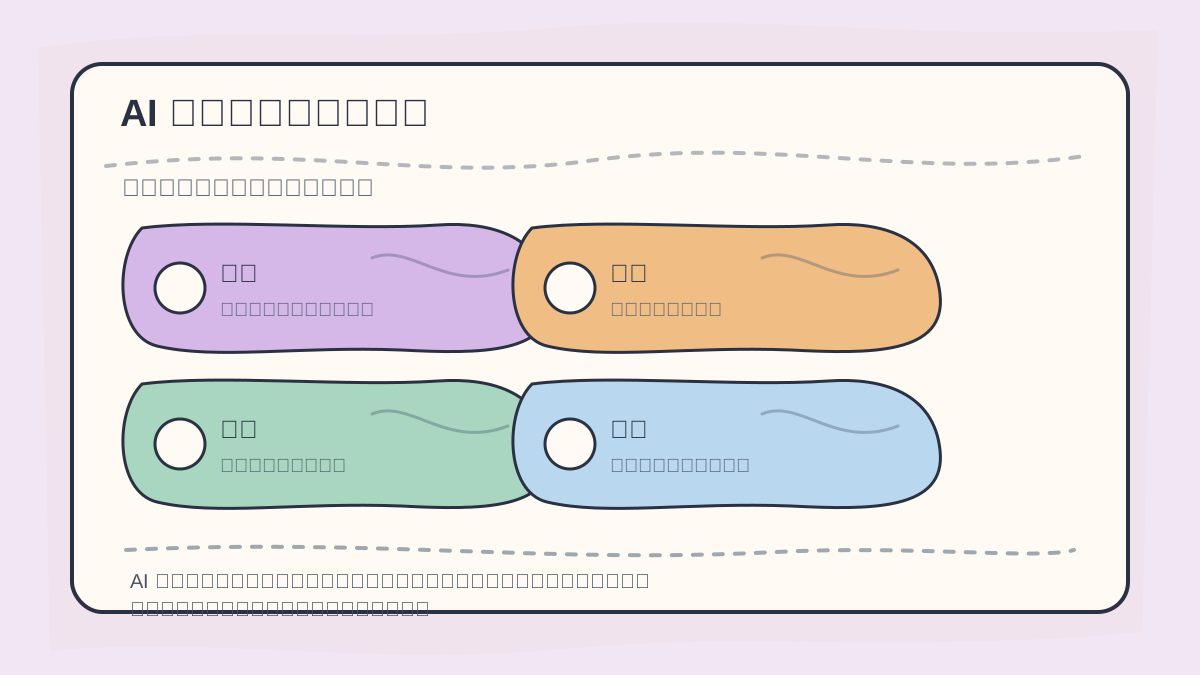
AI security and privacy are not addressed by adding a compliance statement just before deployment. Instead, clearly define data handling practices, access controls, data retention policies, and incident response procedures upfront. Doing so fundamentally reshapes tool selection, architecture decisions, and deployment strategies.
-
Healthcare: AI assists clinicians in diagnosing diseases. For example, deep learning models analyze medical imaging (e.g., X-rays or MRIs) to detect early-stage cancerous lesions with high sensitivity.
-
Finance: Banks deploy AI for credit risk assessment and market forecasting. Machine learning models analyze historical customer behavior and transactional data to predict loan default probabilities.
-
Smart Homes: Internet-connected devices leverage AI to autonomously regulate environmental settings—such as temperature, lighting, and security systems. For instance, smart thermostats learn user preferences and adjust heating/cooling schedules accordingly.
1.1.4 Key Challenges Facing AI
Despite its immense benefits, AI confronts significant challenges. First among them are data privacy and security. AI systems often require vast amounts of personal data for training—raising critical questions about how to extract value from data while rigorously safeguarding individual privacy. Second, algorithmic bias has become a major concern: if training data reflects societal inequities or skewed representations, AI systems may perpetuate—and even amplify—those biases, undermining fairness and trust in automated decisions.
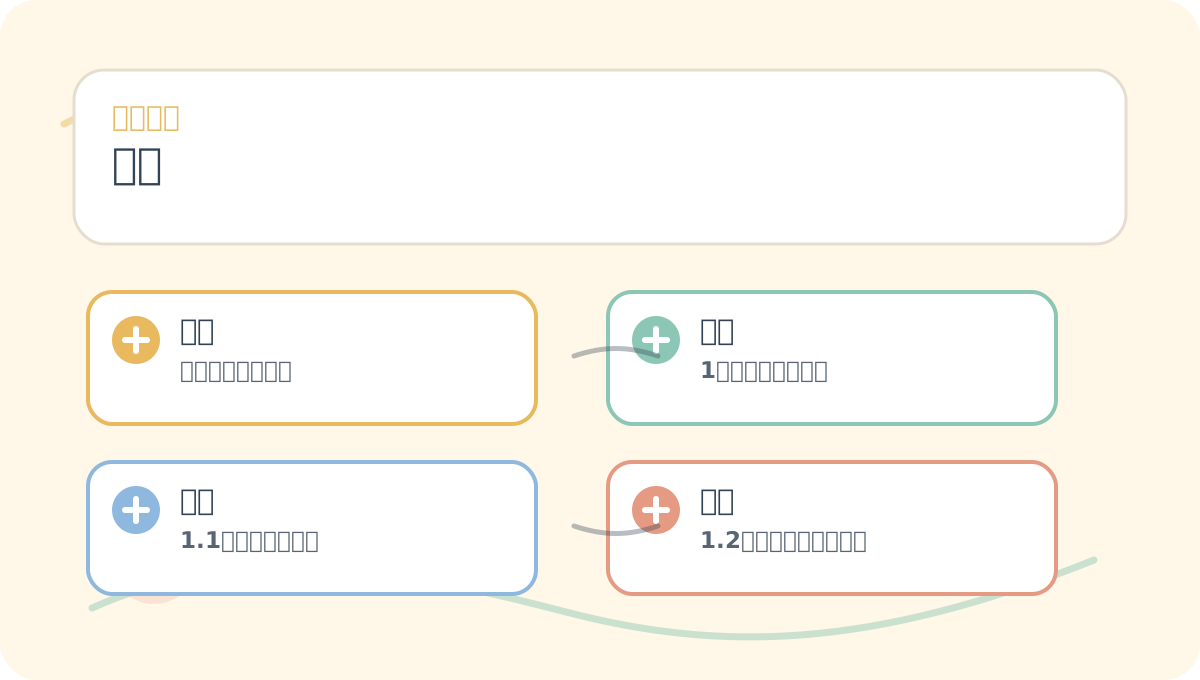
Don’t stop at “I understood” after reading the Introduction. Instead, pick one step and try implementing it yourself—then document exactly where you got stuck. This hands-on reflection makes subsequent learning far more robust and grounded.
In summary, Artificial Intelligence is not merely a cutting-edge technology—it is a foundational pillar shaping our collective future. In the chapters ahead, we will delve deeply into the intertwined domains of AI security and privacy, equipping practitioners to harness technological progress responsibly—without compromising essential safeguards.
Apply This Lesson
Turn this article into AI software, model, API, and security decisions.
English Article FAQ
Use this article as evidence before choosing AI tools
How should I use this AI Tutorials article?
Use it as the implementation or learning layer, then connect the idea to AI software buyer guides, tool comparisons, benchmarks, API choices, and security checks before making a production decision.
Is this English article different from the Chinese original?
The English edition is localized for global AI readers while preserving the original diagrams, screenshots, prompts, code examples, and source context from the Chinese article.
What should I read after Introduction to AI Security and Privacy?
Continue with AI Software Buyer Guides, AI Tools Workbench, Best AI Coding Agents, AI Model Benchmarks, OpenAI vs Anthropic API, or LLM Security Tools depending on the decision you need to make.
Can this article alone choose an AI product or model?
No. Treat the article as evidence and context, then validate fit with pricing, privacy requirements, integration effort, benchmark results, workflow tests, and fallback planning.
Continue