English translation
Introduction
AI Article Decision Snapshot
Turn the lesson into workflow, model, budget, and security checks before choosing tools.
Use this quick snapshot before leaving the article. It keeps the next search tied to practical AI software, model/API, cost, privacy, and implementation questions.
Workflow fit
Identify the real job behind the article: coding, research, document review, support, analytics, content, or internal automation.
Model or tool decision
Decide whether the next step is a software shortlist, an AI tool comparison, an API platform choice, or a model benchmark.
Budget and usage signal
Estimate seats, API calls, prompt volume, retries, review time, and fallback work before assuming the workflow is cheap.
Security and privacy review
Check whether source code, customer data, private documents, prompts, logs, or embeddings will enter the AI workflow.
Security Risk Assessment Framework
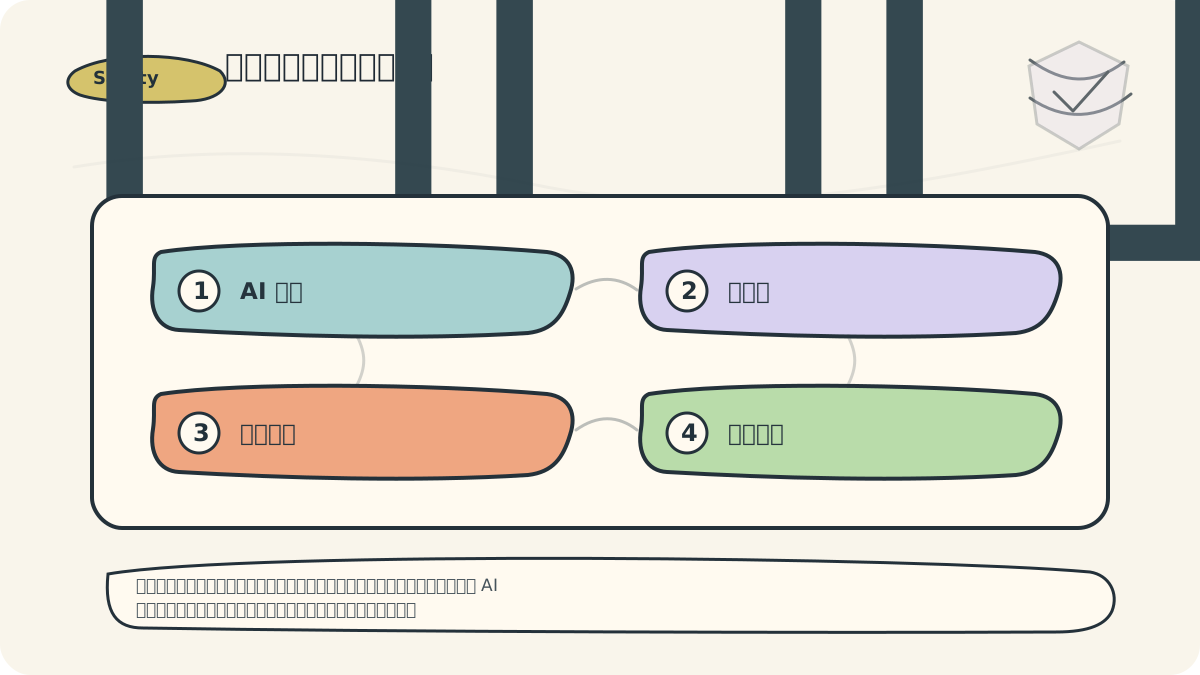
If a security and privacy tutorial begins immediately with regulations and jargon, readers often disengage early. Instead, I recommend first building a foundational vocabulary of AI systems, then exploring attack surfaces and privacy rights, and finally anchoring these concepts in real-world development workflows.

After completing each section, challenge yourself to identify a concrete example: Where does this risk manifest—within inputs, the model itself, training data, APIs, or human-operated processes? Only when you can precisely locate a risk’s origin do you truly understand it.

When entering the domain of security and privacy, begin by clarifying what exactly needs protection: user data, prompt content, model outputs, system privileges, or business decisions. Defining scope clearly ensures no critical risks are overlooked.
Tutorial Objectives and Structure
In this section, we detail the objectives and structure of this tutorial to guide you step-by-step through understanding and mastering security and privacy issues in artificial intelligence (AI).
When reviewing the Introduction, avoid launching large-scale projects right away. Start instead with a single, simple example to verify whether the core narrative is clear.
If the Introduction hasn’t yet been fully internalized, revisit the four actionable steps outlined on this card to reinforce comprehension.
This tutorial aims to equip readers with a comprehensive framework for AI security and privacy—spanning theory, practice, and case studies. Its specific objectives are:
-
Grasp Foundational Concepts: Help readers master the basic definitions of “security” and “privacy,” and understand their significance and interrelationship within AI contexts.
-
Analyze Risks and Challenges: Use real-world case studies to illuminate practical security and privacy risks—such as data breaches and model attacks—that arise during AI deployment.
-
Explore Mitigations and Best Practices: Provide actionable countermeasures and industry-validated best practices to help readers safeguard security and privacy when designing and implementing AI systems.
-
Strengthen Technical Proficiency: Through code examples and tool introductions, enhance readers’ ability to apply security and privacy techniques directly within AI systems.
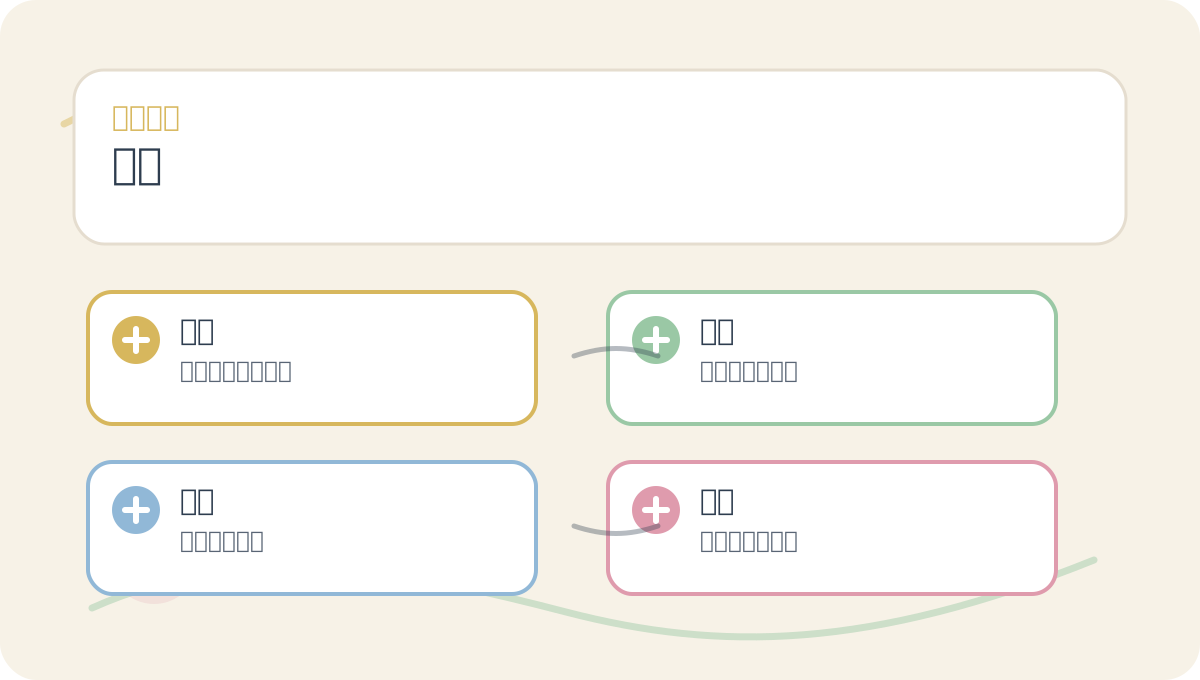
While reading the Introduction, first examine the tasks, concepts, exercises, and decision points illustrated in the accompanying figures—then return to the main text to fill in supporting details. This approach makes it easier to map tutorial content to authentic, real-world scenarios.
To achieve these objectives, the tutorial follows this structured progression:
-
Chapter 1: Introduction
- 1.1 The Relationship Between AI and the Real World
- 1.2 Defining Security and Privacy
- 1.3 Tutorial Objectives and Structure (this section)
-
Chapter 2: Fundamental AI Concepts
- 2.1 Categories of Artificial Intelligence
- 2.2 Distinguishing Deep Learning from Machine Learning
- 2.3 Overview of Common Algorithms
-
Chapter 3: Legal and Regulatory Frameworks for Security and Privacy
- 3.1 Survey of Current Regulations
- 3.2 Impact of Data Protection Laws
- 3.3 Case Studies in Regulatory Compliance
-
Chapter 4: Risk Assessment and Management
- 4.1 Risk Identification
- 4.2 Risk Assessment Methodologies
- 4.3 Risk Mitigation Strategies
-
Chapter 5: Technical Tools and Implementation
- 5.1 Data Encryption and Anonymization Techniques
- 5.2 Building Secure Models
- 5.3 Case Studies and Hands-on Practice
-
Chapter 6: Real-World Case Analyses
- 6.1 Success Stories
- 6.2 Failure Analyses
- 6.3 Key Lessons Learned
By integrating theoretical frameworks with practical case studies, this tutorial helps readers understand AI-related security and privacy challenges—and their solutions—from multiple perspectives. For instance, later chapters will explore technical defenses against adversarial attacks, a pervasive security threat. In practice, we’ll demonstrate how to use Python’s torchattacks library to rigorously test model robustness—ensuring your AI systems resist manipulation and exploitation.
As AI advances rapidly and becomes increasingly embedded across industries, ensuring security and privacy has become an urgent, non-negotiable priority. By working through this tutorial, you will gain clarity on potential vulnerabilities in AI implementations—and acquire the knowledge and tools needed to proactively protect user privacy and data integrity.
Apply This Lesson
Turn this article into AI software, model, API, and security decisions.
English Article FAQ
Use this article as evidence before choosing AI tools
How should I use this AI Tutorials article?
Use it as the implementation or learning layer, then connect the idea to AI software buyer guides, tool comparisons, benchmarks, API choices, and security checks before making a production decision.
Is this English article different from the Chinese original?
The English edition is localized for global AI readers while preserving the original diagrams, screenshots, prompts, code examples, and source context from the Chinese article.
What should I read after Introduction?
Continue with AI Software Buyer Guides, AI Tools Workbench, Best AI Coding Agents, AI Model Benchmarks, OpenAI vs Anthropic API, or LLM Security Tools depending on the decision you need to make.
Can this article alone choose an AI product or model?
No. Treat the article as evidence and context, then validate fit with pricing, privacy requirements, integration effort, benchmark results, workflow tests, and fallback planning.
Continue