English translation
Build a simple convolutional neural network
AI Article Decision Snapshot
Turn the lesson into workflow, model, budget, and security checks before choosing tools.
Use this quick snapshot before leaving the article. It keeps the next search tied to practical AI software, model/API, cost, privacy, and implementation questions.
Workflow fit
Identify the real job behind the article: coding, research, document review, support, analytics, content, or internal automation.
Model or tool decision
Decide whether the next step is a software shortlist, an AI tool comparison, an API platform choice, or a model benchmark.
Budget and usage signal
Estimate seats, API calls, prompt volume, retries, review time, and fallback work before assuming the workflow is cheap.
Security and privacy review
Check whether source code, customer data, private documents, prompts, logs, or embeddings will enter the AI workflow.
Security Risk Assessment Framework

The purpose of AI classification is not to memorize definitions—but to identify where risks lie. Rule-based systems are vulnerable to logical flaws; machine learning systems hinge on data quality and feature selection; deep learning models raise concerns about interpretability; and generative applications introduce additional risks related to output reliability and tool permissions.

When evaluating an AI project, I first determine its category—and then ask: Where is it most likely to fail? Is the failure due to incorrect rules, biased data, model drift, or misuse of generated outputs?
Before diving deeper into artificial intelligence (AI), understanding its classification is essential. This section introduces fundamental AI categories to provide you with a comprehensive conceptual foundation. AI can be classified along several dimensions—the most common being functional, technical implementation, and application domain.
1. Functional Classification
Based on capability and scope, AI is commonly divided into two broad functional categories:
1.1 Narrow AI (Weak AI)
Narrow AI refers to systems designed specifically for well-defined, constrained tasks. These systems excel within their designated domains but possess no consciousness, self-awareness, or general reasoning ability. Examples include:
- Voice Assistants: Such as Apple’s Siri or Amazon’s Alexa—capable of executing simple voice commands, checking weather, or playing music, yet unable to perform complex reasoning or cross-domain inference.
- Recommendation Systems: Like those used by Netflix or Spotify—these algorithms suggest movies or music based on user history, but they do not comprehend user emotions or personality traits.
Such systems typically achieve high performance in their intended tasks—but are entirely incapable outside those narrow boundaries.
1.2 General AI (Strong AI)
In contrast, General AI denotes systems theoretically capable of understanding, learning, and performing any intellectual task that a human can. While this remains hypothetical and unrealized today, its goal is to develop AI with broad cognitive flexibility, self-awareness, and emotional capacity. A potential illustration might be an intelligent domestic robot capable of cooking, cleaning, engaging in social interaction, and adapting to novel household challenges.
2. Technical Implementation Classification
AI systems can also be categorized by how they are built and operate:
2.1 Rule-Based Systems
These rely on explicit, hand-coded logic and deterministic inference rules. Classic examples include early expert systems like MYCIN—a medical diagnostic system that applied “if-then” rules to identify bacterial infections and recommend antibiotics.
2.2 Machine Learning
Machine learning refers to AI systems that improve performance through experience—i.e., by learning patterns from data. Based on learning paradigms, machine learning further divides into:
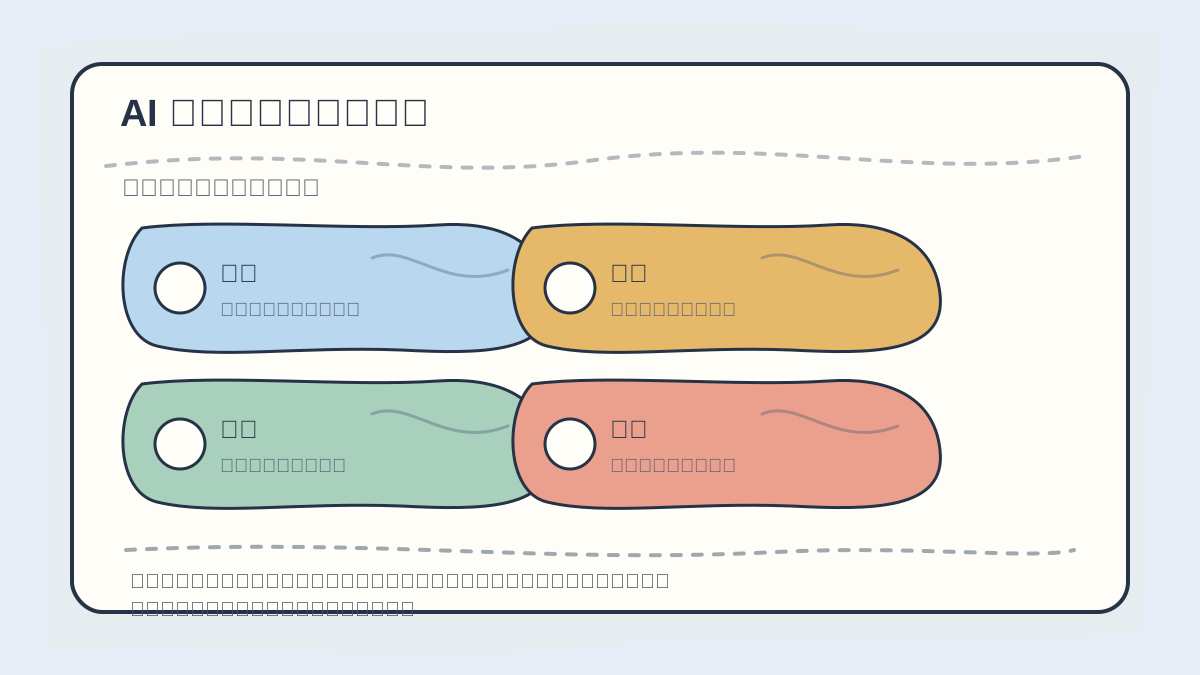
While studying AI classification, simultaneously consider how rule-based systems, machine learning models, generative models, and agents each handle data, make decisions, and introduce distinct risk profiles.
- Supervised Learning: Models train on labeled datasets. For example, predicting house prices using historical data pairing square footage and sale price.
- Unsupervised Learning: Models discover hidden structures in unlabeled data. For instance, clustering customers by purchasing behavior to identify market segments.
- Reinforcement Learning: Agents learn optimal behaviors via trial-and-error interactions with an environment. A canonical example is training autonomous vehicles to navigate traffic by rewarding safe, efficient driving decisions.
2.3 Deep Learning
Deep learning is a subfield of machine learning that employs multi-layered neural networks to automatically extract hierarchical representations from raw data. It excels at processing large-scale, unstructured inputs—especially images and speech. A widely recognized application is image classification using convolutional neural networks (CNNs), such as distinguishing cats from dogs.
import tensorflow as tf
from tensorflow.keras import layers, models

# Build a simple convolutional neural network
model = models.Sequential()
model.add(layers.Conv2D(32, (3, 3), activation='relu', input_shape=(64, 64, 3)))
model.add(layers.MaxPooling2D((2, 2)))
model.add(layers.Conv2D(64, (3, 3), activation='relu'))
model.add(layers.MaxPooling2D((2, 2)))
model.add(layers.Flatten())
model.add(layers.Dense(64, activation='relu'))
model.add(layers.Dense(1, activation='sigmoid'))
3. Application Domain Classification
AI can also be grouped by the context or sector in which it operates:
3.1 Domain-Specific AI
AI deployed in specialized fields—such as healthcare or finance—tackles highly complex, regulated problems. Examples include AI-powered medical imaging analysis for detecting tumors or algorithmic high-frequency trading systems in financial markets.
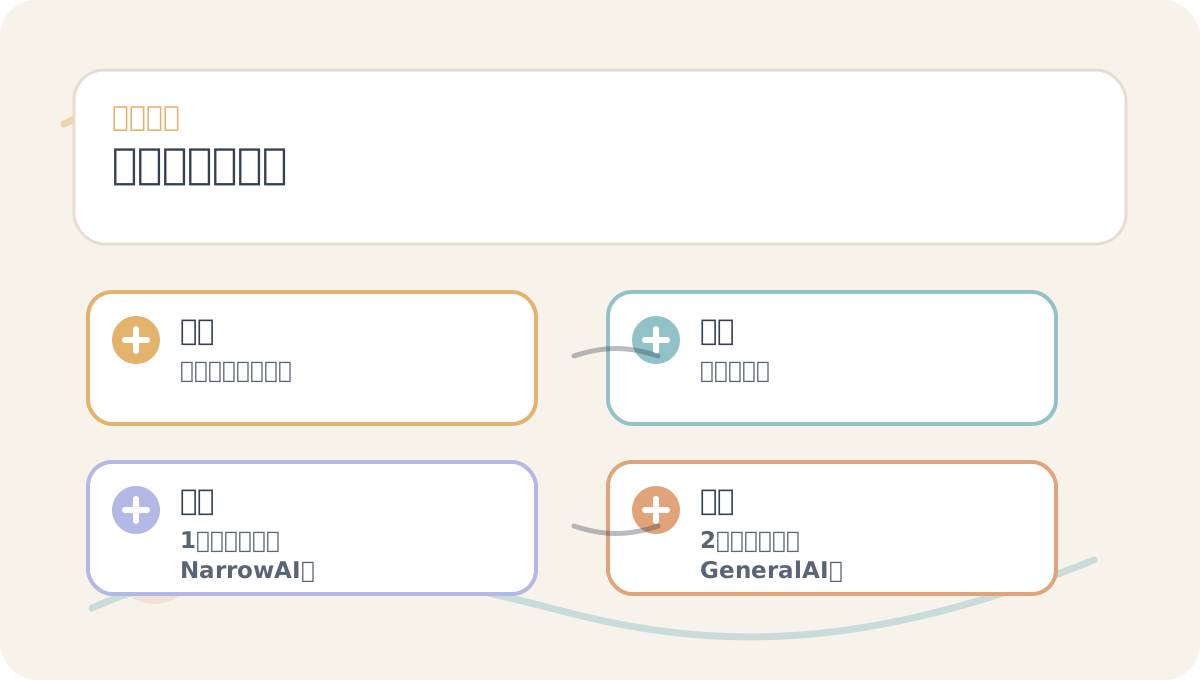
Content like “AI Classification” easily gets lost in technical detail. First grasp the central narrative illustrated in the diagram—then return to the text to verify environmental assumptions, input/output specifications, and evaluation criteria.
3.2 General-Purpose AI
These systems support broad analytical and decision-support functions across diverse contexts. On social media platforms, for example, AI analyzes user engagement data to optimize ad targeting and enhance platform personalization.
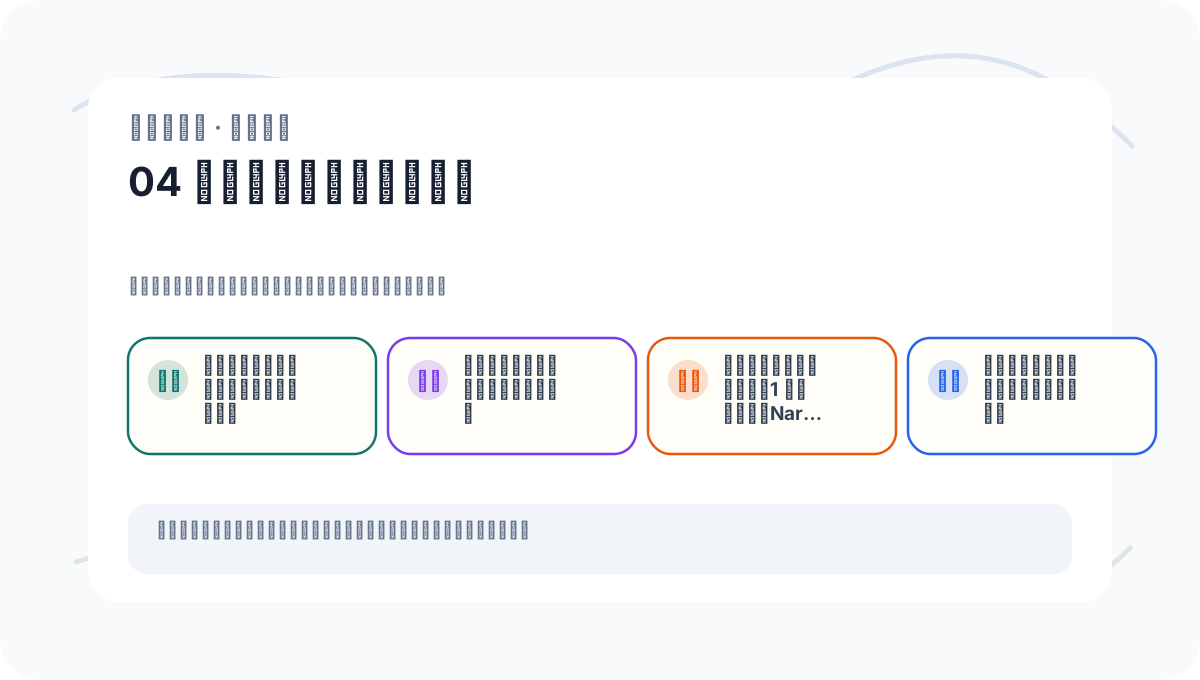
Having read this section, consolidate “AI Classification” into a retrospective table: clearly articulate the core framework first, then validate it using a small, concrete use case.
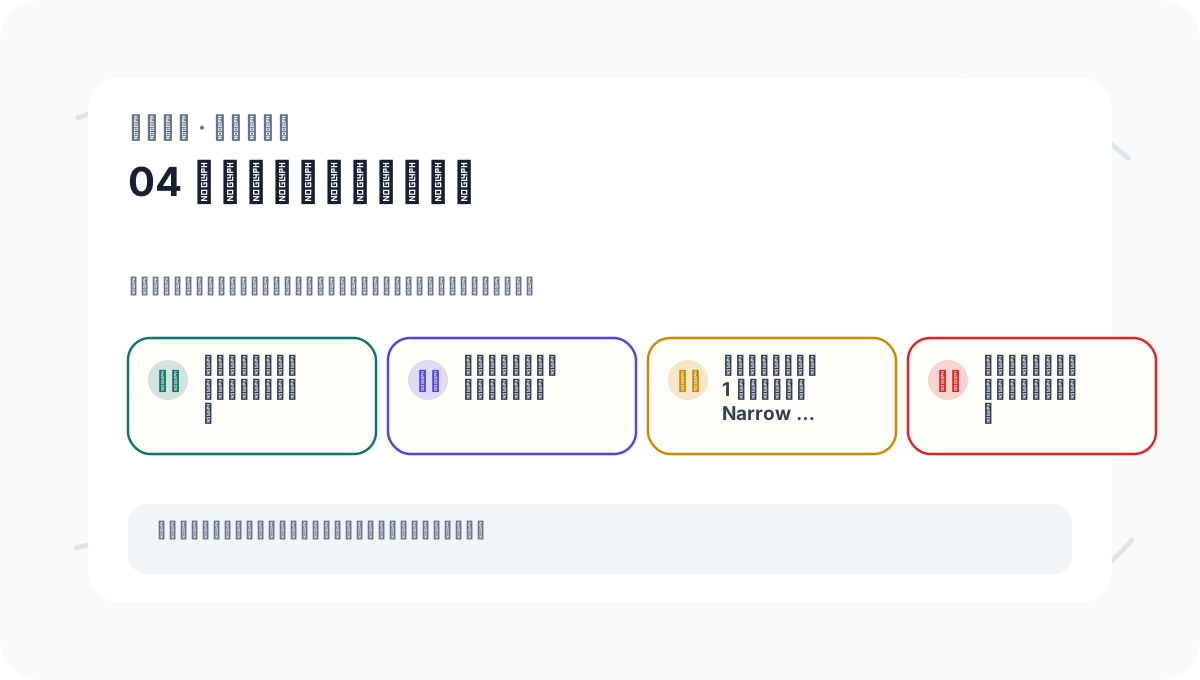
After finishing “AI Classification,” select a simple real-world example and walk through the full classification workflow end-to-end—then assess which steps you can already execute independently.
Summary
This chapter outlined key AI classifications: Narrow vs. General AI, Rule-Based Systems vs. Machine Learning, Deep Learning, and Domain-Specific vs. General-Purpose AI. This taxonomy establishes a foundational lens for analyzing AI capabilities, limitations, and associated risks—and sets the stage for deeper exploration of machine learning and deep learning techniques. In the next section, we will examine how ML and DL models are actually constructed, trained, and evaluated—revealing the underlying mechanics behind modern AI systems.
Apply This Lesson
Turn this article into AI software, model, API, and security decisions.
English Article FAQ
Use this article as evidence before choosing AI tools
How should I use this AI Tutorials article?
Use it as the implementation or learning layer, then connect the idea to AI software buyer guides, tool comparisons, benchmarks, API choices, and security checks before making a production decision.
Is this English article different from the Chinese original?
The English edition is localized for global AI readers while preserving the original diagrams, screenshots, prompts, code examples, and source context from the Chinese article.
What should I read after Build a simple convolutional neural network?
Continue with AI Software Buyer Guides, AI Tools Workbench, Best AI Coding Agents, AI Model Benchmarks, OpenAI vs Anthropic API, or LLM Security Tools depending on the decision you need to make.
Can this article alone choose an AI product or model?
No. Treat the article as evidence and context, then validate fit with pricing, privacy requirements, integration effort, benchmark results, workflow tests, and fallback planning.
Continue