English translation
Conceptual example: Python code injecting malicious image samples
AI Article Decision Snapshot
Turn the lesson into workflow, model, budget, and security checks before choosing tools.
Use this quick snapshot before leaving the article. It keeps the next search tied to practical AI software, model/API, cost, privacy, and implementation questions.
Workflow fit
Identify the real job behind the article: coding, research, document review, support, analytics, content, or internal automation.
Model or tool decision
Decide whether the next step is a software shortlist, an AI tool comparison, an API platform choice, or a model benchmark.
Budget and usage signal
Estimate seats, API calls, prompt volume, retries, review time, and fallback work before assuming the workflow is cheap.
Security and privacy review
Check whether source code, customer data, private documents, prompts, logs, or embeddings will enter the AI workflow.
Security Risk Assessment Framework
The attack surface of AI applications extends from user inputs to knowledge bases, plugins, model providers, logs, and tool permissions. The OWASP LLM Top 10 2025 has identified prompt injection, sensitive information leakage, supply chain vulnerabilities, data and model poisoning, and over-privileged agent behavior as top-tier risks.
You can use the OWASP Top 10 for LLM Applications 2025 as a reference checklist for risk identification.
I mark all external inputs in red: user text, uploaded files, web content, retrieved document snippets, and plugin return values. Any input whose origin cannot be fully controlled must never be treated as trusted system instructions.
3.1 Potential Attack Surfaces
In today’s digital era, artificial intelligence (AI) systems are widely deployed across domains such as healthcare, finance, and autonomous driving. While these systems significantly enhance efficiency and accuracy, they also introduce numerous security risks. To understand these risks, we must first recognize the potential attack surfaces within AI systems.
When revisiting “Security Risks in AI Systems”, avoid launching large-scale initiatives upfront. Instead, begin with a single, simple example to verify whether the core logic is clear and well-articulated.
If you haven’t yet fully internalized “Security Risks in AI Systems”, revisit this card and walk through its four actionable steps.
1. Components of an AI System and Their Attack Surfaces
A typical AI system generally comprises the following components:
- Data Sources: Datasets used to train and test AI models.
- Models: AI models built using machine learning algorithms, responsible for learning patterns from data and generating predictions.
- Interfaces: Channels enabling user interaction with the AI system—commonly APIs or user interfaces.
- Storage: Databases or cloud platforms storing models, data, and related metadata.
Each component represents a potential target for attackers, who may exploit these surfaces to achieve malicious objectives.
2. Common Attack Types
AI systems face several distinct categories of attacks:
2.1 Data Attacks
Data attacks involve tampering with the training or testing data used by AI models. Key risks include:
- Malicious Data Injection: Attackers may inject biased or erroneous samples into training datasets, degrading model performance. For instance, inserting specially crafted images into an image recognition dataset could cause systematic misclassification of specific objects.
# Conceptual example: Python code injecting malicious image samples
import numpy as np

def inject_malicious_data(original_data, malicious_sample):
    return np.append(original_data, malicious_sample, axis=0)

# Hypothetical original dataset and malicious sample
original_data = np.array([[0, 1], [1, 0]])  # Original dataset
malicious_sample = np.array([[1, 1]])       # Malicious sample

# Inject malicious sample into original dataset
new_data = inject_malicious_data(original_data, malicious_sample)
print(new_data)  # Output: new dataset containing the malicious sample
2.2 Model Attacks
These attacks directly target the AI model itself—for example, via model hijacking or reverse engineering. Common techniques include:
- Model Stealing: Attackers may reconstruct model architecture and parameters through repeated API queries and inference responses (e.g., via model extraction attacks).
- Adversarial Attacks: Inputs are subtly perturbed to produce incorrect model outputs. In natural language processing, minor spelling changes can cause misinterpretation—for example, altering “weather” to “wheather” may confuse sentiment analysis.
# Adversarial attack example: simple text perturbation
original_text = "The weather is nice today."
adversarial_text = "Teh wheather is nice today."  # Intentional typos

print("Original text: ", original_text)
print("Adversarial text: ", adversarial_text)
# The model may misclassify or misinterpret this adversarial input
3. Exposure Risks and Consequences
Successful exploitation of AI system attack surfaces can lead to severe consequences, including:
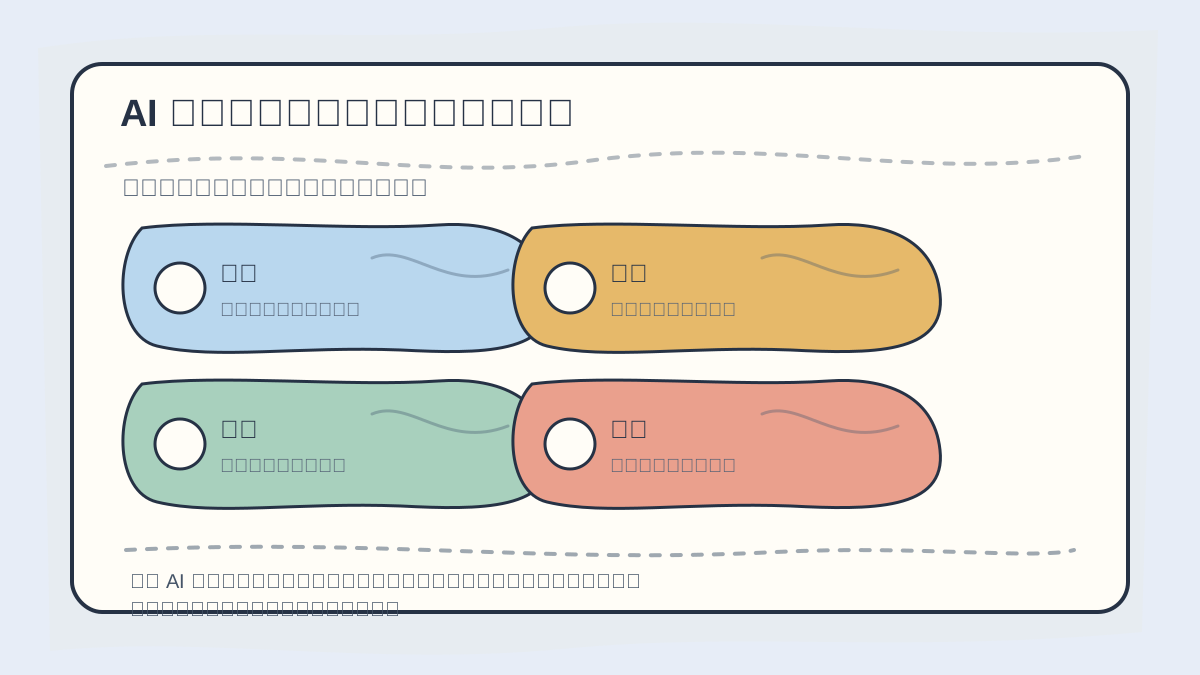
When auditing AI system security risks, prioritize checking: data provenance, prompt injection vectors, tool permissions, model output integrity, and log storage practices. Risks most frequently emerge at integration points—where components interface.
- Data Leakage: Sensitive or personally identifiable information (PII) may be exposed, resulting in privacy violations and regulatory penalties.
- Model Degradation: Compromised training data or adversarial inputs may severely impair model reliability and decision-making accuracy.
- Financial Loss: In financial services, for example, manipulated models or fraudulent inputs could trigger erroneous trades, credit decisions, or fraud detection failures—leading to substantial monetary losses.
4. Preventive Measures
To mitigate security risks in AI systems, organizations should adopt the following proactive measures:
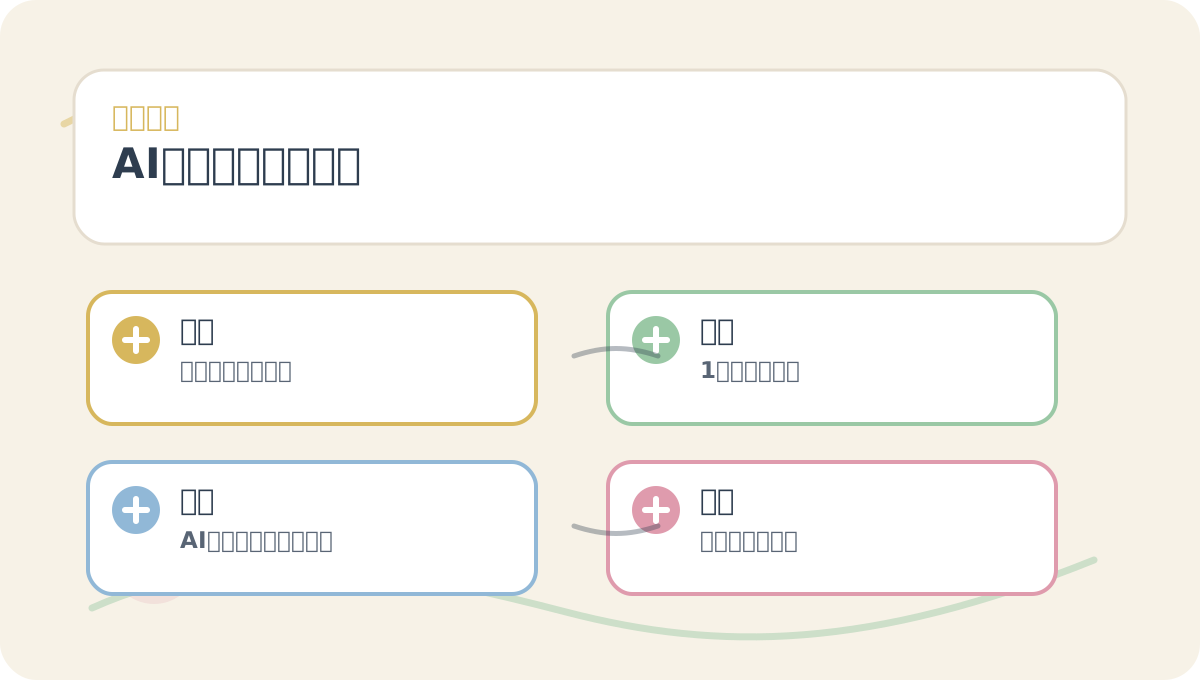
Before diving into the main text of “Security Risks in AI Systems”, quickly scan the accompanying illustrations: What question does each image pose? Which conceptual distinctions need clarification? Which step invites hands-on experimentation? And—critically—what criteria define successful completion?
- Data Validation and Cleansing: Rigorously validate all incoming data to detect and filter malicious or anomalous inputs before they reach the model.
- Model Protection: Apply encryption, watermarking, or API-level access controls to deter unauthorized model extraction or tampering.
- Adversarial Detection: Implement robust input sanitization, anomaly detection, and confidence-thresholding mechanisms to identify and reject adversarial inputs.
By systematically mapping and understanding AI system attack surfaces, organizations can better identify vulnerabilities and implement targeted, layered defenses—ensuring resilience, trustworthiness, and operational continuity.
Summary
As AI technologies become increasingly embedded in critical infrastructure and daily life, comprehending—and proactively addressing—their inherent security risks is not optional; it is essential. Sustainable AI innovation requires equal emphasis on technical advancement and security assurance.
Next, Chapter Three will delve deeper into two pivotal threats: data poisoning and model hijacking—both central challenges in modern AI security research and practice.
Apply This Lesson
Turn this article into AI software, model, API, and security decisions.
English Article FAQ
Use this article as evidence before choosing AI tools
How should I use this AI Tutorials article?
Use it as the implementation or learning layer, then connect the idea to AI software buyer guides, tool comparisons, benchmarks, API choices, and security checks before making a production decision.
Is this English article different from the Chinese original?
The English edition is localized for global AI readers while preserving the original diagrams, screenshots, prompts, code examples, and source context from the Chinese article.
What should I read after Conceptual example: Python code injecting malicious image samples?
Continue with AI Software Buyer Guides, AI Tools Workbench, Best AI Coding Agents, AI Model Benchmarks, OpenAI vs Anthropic API, or LLM Security Tools depending on the decision you need to make.
Can this article alone choose an AI product or model?
No. Treat the article as evidence and context, then validate fit with pricing, privacy requirements, integration effort, benchmark results, workflow tests, and fallback planning.
Continue