English translation
Security Risks in AI Systems: Data Poisoning and Model Hijacking
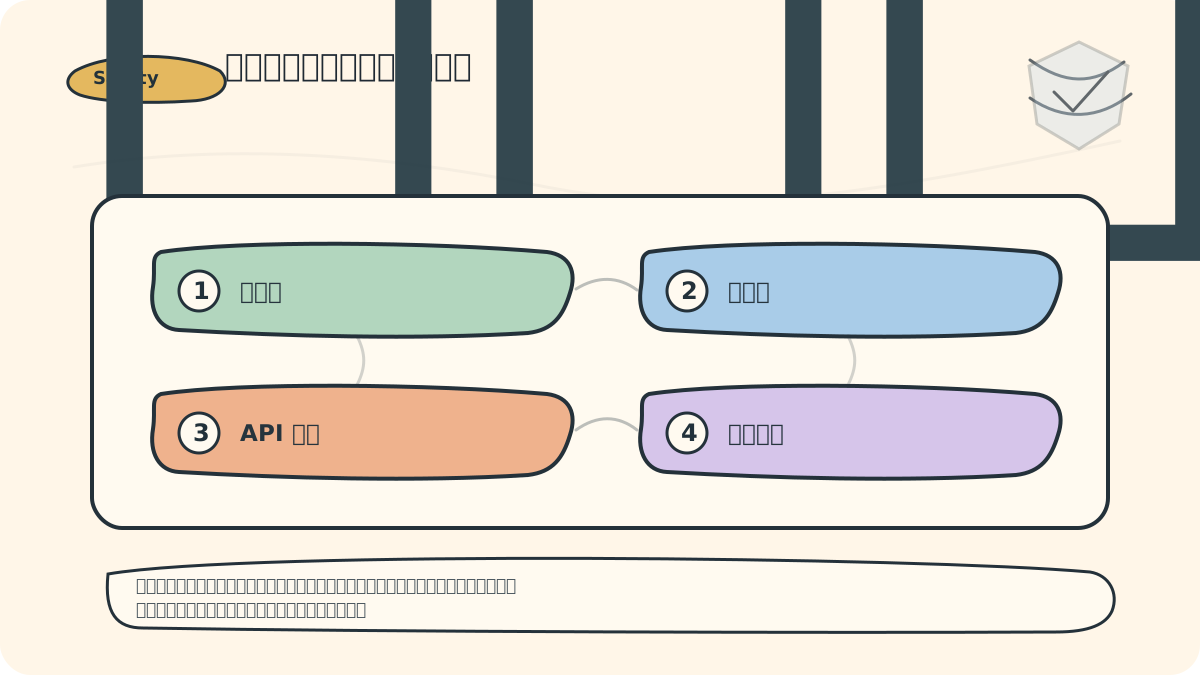
AI Article Decision Snapshot
Turn the lesson into workflow, model, budget, and security checks before choosing tools.
Use this quick snapshot before leaving the article. It keeps the next search tied to practical AI software, model/API, cost, privacy, and implementation questions.
Workflow fit
Identify the real job behind the article: coding, research, document review, support, analytics, content, or internal automation.
Model or tool decision
Decide whether the next step is a software shortlist, an AI tool comparison, an API platform choice, or a model benchmark.
Budget and usage signal
Estimate seats, API calls, prompt volume, retries, review time, and fallback work before assuming the workflow is cheap.
Security and privacy review
Check whether source code, customer data, private documents, prompts, logs, or embeddings will enter the AI workflow.
Security Risk Assessment Framework
Data poisoning and model hijacking share a key characteristic: attackers need not target the model directly. Instead, they degrade the materials, versions, or invocation chains that the model depends on. Defense must therefore begin at entry points and change management.

If a knowledge base allows uploads by multiple contributors, I require every upload to be logged with its source, responsible owner, and version number. When issues arise, rolling back to the previous version is far more reliable than trying to guess which dataset caused the problem.
In the previous section, we explored potential attack surfaces of AI systems—an essential foundation for understanding AI security risks. Next, we delve into two common attack types: data poisoning and model hijacking. These threats not only impair model performance but can also lead to severe privacy breaches and security incidents.
Data Poisoning
Data poisoning refers to the deliberate injection of malicious data into training datasets, causing the resulting model to degrade in performance or deviate toward attacker-defined objectives. Such attacks typically occur during the model training phase—especially when models rely on publicly available or user-generated data.
Case Study: Malicious Data Injection
Consider an AI model designed for spam filtering. An attacker might construct a batch of emails containing manipulative content. By crafting seemingly benign emails that embed subtle adversarial features, the attacker injects them into the training data. As a result, the trained model may misclassify legitimate emails as spam—or inadvertently expose sensitive user information.
Technical Approaches to Data Poisoning
Data poisoning attacks fall into several categories:
- Label Manipulation: Attackers assign incorrect labels to portions of the data—for example, labeling “legitimate” emails as “spam.”
- Feature Manipulation: Attackers alter data features to induce erroneous learning. For instance, in image recognition, attackers may deliberately inject images with corrupted features to bias the model’s classification behavior.
- Backdoor Attacks: Attackers embed specific patterns (e.g., invisible watermarks) into training samples so that the model produces targeted outputs whenever those patterns appear during inference.
Defensive Mechanisms
To mitigate data poisoning, researchers have proposed several defensive strategies:

When analyzing data poisoning and model hijacking, first identify which data the attacker can modify, which inputs they can control, and which anomalous behaviors they can trigger.
- Anomalous Sample Detection: Use statistical methods or auxiliary ML models to identify and filter out suspicious or outlier data points.
- Data Validation and Cleaning: Rigorously review and verify data before it enters the training pipeline.
- Model Validation: After training, evaluate the model on clean, unaffected test sets to assess its generalization capability and robustness.
Model Hijacking
Unlike data poisoning, model hijacking occurs when attackers gain unauthorized access to, tamper with, or replace an AI model—thereby coercing it into making decisions advantageous to the attacker. Model hijacking implies the attacker has already obtained access to the trained model.
Case Study: API Hijacking
In cloud environments, many organizations expose their AI services via public APIs. Attackers may exploit trojans, SQL injection, or other vulnerabilities to seize control over these APIs. For example, if an attacker compromises the API of a medical diagnostic model, they could submit malicious input data to obtain dangerously inaccurate clinical recommendations—directly endangering patient health.
Technical Approaches to Model Hijacking
Model hijacking can be achieved through multiple techniques:
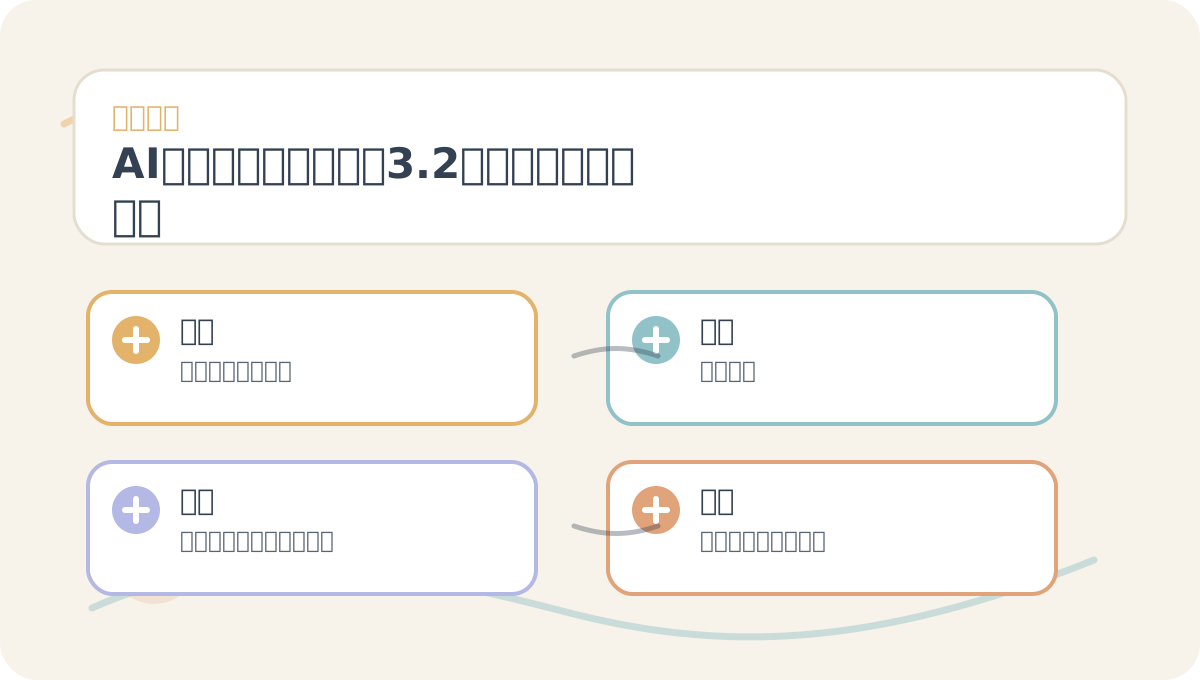
Before reading “Security Risks in AI Systems: Section 3.2 — Data Poisoning and Model Hijacking,” first study the visual path from problem to outcome shown in this diagram. After reading, revisit the text to verify whether you can independently reproduce each step.
- Model Extraction: Attackers repeatedly query the model’s API to reconstruct a functional replica closely approximating the original model.
- Model Tampering: Attackers directly access and modify the model’s weight files to suit their objectives.
- Malicious Replacement: Attackers substitute the original model entirely with a different, maliciously designed model—used for fraud or other harmful purposes.
Defensive Mechanisms
Strategies to prevent model hijacking include:
- Access Control: Enforce strong authentication and fine-grained authorization policies to restrict API access.
- Model Encryption: Encrypt model weights and artifacts to prevent unauthorized extraction or modification.
- Monitoring and Auditing: Continuously monitor API usage patterns, detect anomalous activity, and enable rapid response to emerging security incidents.
Having read this section, consolidate “Security Risks in AI Systems: Section 3.2 — Data Poisoning and Model Hijacking” into a retrospective table: clearly outline the core narrative first, then validate understanding using a small, concrete task.
After completing “Security Risks in AI Systems: Section 3.2 — Data Poisoning and Model Hijacking,” select a small representative example and walk through the full workflow end-to-end. Then assess which steps you can now execute independently.
Summary
Understanding data poisoning and model hijacking reveals how profoundly such security risks can undermine AI systems. Through case-based analysis, we see that technical safeguards alone are insufficient—organizational security culture and incident response readiness are equally critical. Ongoing attention to and research on these evolving threats ensures our AI systems remain not only intelligent and efficient, but also resilient against emerging security and privacy challenges.
Next, we will examine adversarial attacks, exploring practical strategies to protect AI models from precise, targeted manipulations—and their potentially serious real-world consequences.
Apply This Lesson
Turn this article into AI software, model, API, and security decisions.
English Article FAQ
Use this article as evidence before choosing AI tools
How should I use this AI Tutorials article?
Use it as the implementation or learning layer, then connect the idea to AI software buyer guides, tool comparisons, benchmarks, API choices, and security checks before making a production decision.
Is this English article different from the Chinese original?
The English edition is localized for global AI readers while preserving the original diagrams, screenshots, prompts, code examples, and source context from the Chinese article.
What should I read after Security Risks in AI Systems: Data Poisoning and Model Hijacking?
Continue with AI Software Buyer Guides, AI Tools Workbench, Best AI Coding Agents, AI Model Benchmarks, OpenAI vs Anthropic API, or LLM Security Tools depending on the decision you need to make.
Can this article alone choose an AI product or model?
No. Treat the article as evidence and context, then validate fit with pricing, privacy requirements, integration effort, benchmark results, workflow tests, and fallback planning.
Continue