Realtime AI News
Nvidia open-sources its factory agent blueprint, with Siemens as first anchor
Nvidia released its Factory Operations Blueprint, FOX, in early access on GitHub, giving developers a way to build always-on factory manager agents and specialists for inspection, root-cause analysis and fleet management. Siemens is already integrating FOX-built agents into Intelligence Center X, an effort Nvidia estimates can cut costs by 20%.
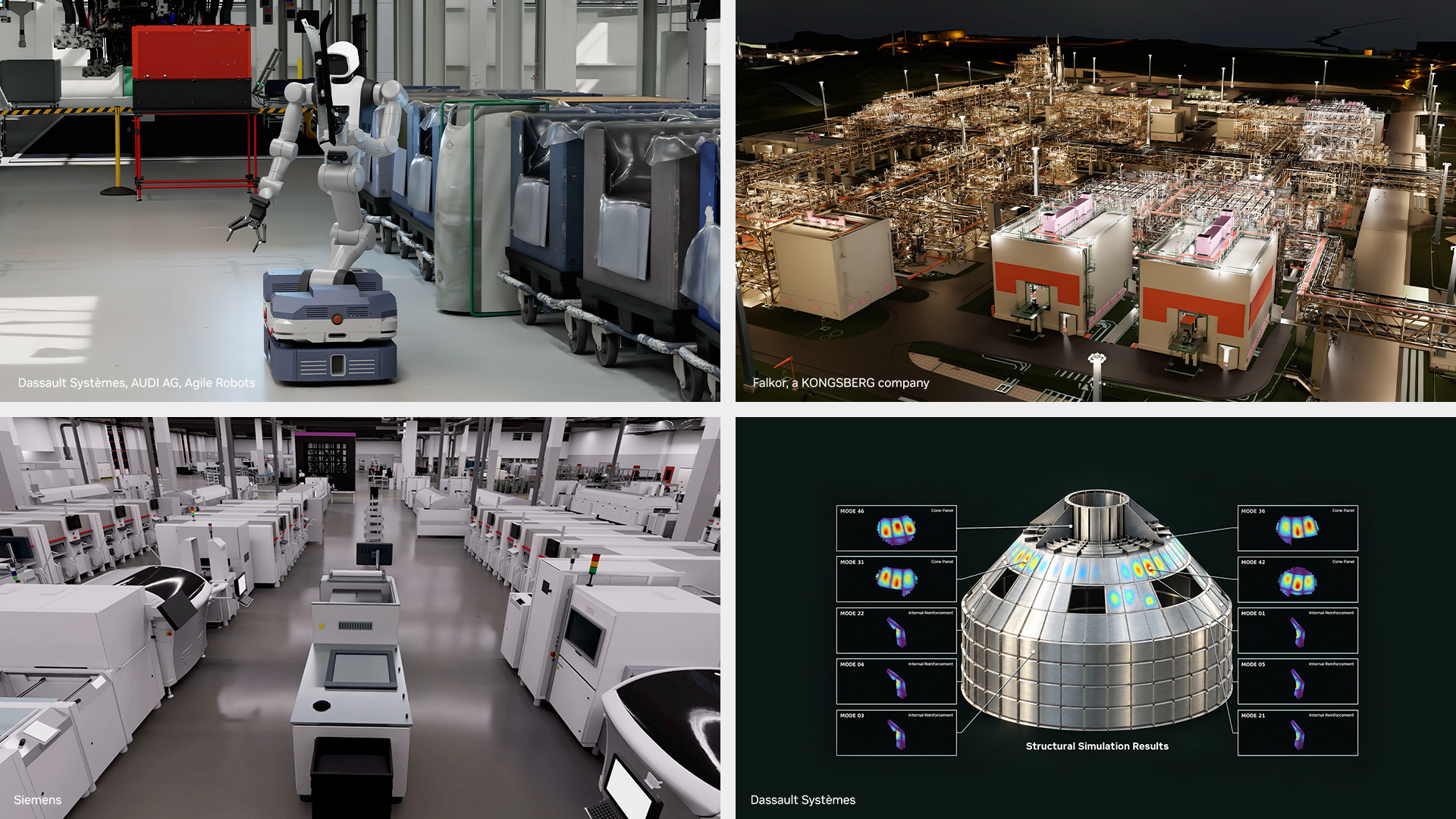
Nvidia's European industrial pitch now has a repository attached to it: the Factory Operations Blueprint, or FOX, is available in early access on GitHub, giving developers a path to build always-on factory manager agents plus specialist agents for visual inspection, root-cause analysis, report generation and fleet management.
The design is deliberately connective. FOX-built agents can reach frontier models such as Cosmos and Nemotron and also foundational knowledge in CAD, PLM, simulation software and IT/OT systems, so they can watch operations in real time, correlate what a camera saw with what a machine logged, and coordinate a response.
Cosmos in-context learning is the detail that makes this practical: agents adapt from examples and documentation without fine-tuning. Factory floors rarely have a clean, labeled dataset waiting, and they cannot pause production for a training run.
Siemens is the named anchor customer. It is integrating FOX-built agents into Intelligence Center X to identify root causes and coordinate factory operations, with an estimated 20% cost saving. Its Process Preparation X agents use Cosmos Data Factory tools to generate defect images for circuit-board inspection, an approach Siemens says cut calibration time for inspection processes by 40% at its Erlangen electronics plant.
Around the factory, Nvidia pushed the same accelerated-computing argument into engineering. cuDSS is now generally available for the dense math behind structural, fluid, electromagnetic and semiconductor simulation; Mercedes-Benz runs Siemens Simcenter STAR-CCM+ on Nvidia GPUs to compare aerodynamic designs and uses Cosmos 3 with the Metropolis VSS blueprint for vehicle inspection and windshield assembly verification.
The hardware numbers are concrete: imec benchmarks S-Litho at up to 40x speedup, Infineon uses Sentaurus Device with CUDA libraries for a 12x speedup in 3D breakdown simulation of power devices, and Leonardo works with Neural Concept to bring aircraft geometry and aerodynamic results together in Omniverse libraries.
Digital twins fill out the picture. Audi built a battery-production twin on Omniverse libraries to test production concepts before equipment exists and, with Dassault Systemes and Agile Robots, validates humanoid and logistics flows in DELMIA twins; Schaeffler connects humanoid actuator twins to Isaac, and Wandelbots validates assembly workflows with NOVA on Isaac Sim.
For manufacturing, the real threshold is not model capability but whether an agent can earn the trust of both IT and OT at once. Schneider Electric and AVEVA are applying the method to AI infrastructure itself, building an AI factory twin for Nscale so engineers can compare power, cooling and equipment layouts before anyone touches a rack; whether FOX becomes a default starting point or just another blueprint depends on how reproducible the Siemens result proves to be.
Why it matters
Open-sourcing the factory agent blueprint positions Nvidia as a standard-setter for industrial agents, not just a compute vendor. If Siemens' cost and calibration numbers replicate, agents move from pilots into default production-line configuration.
Nearby Updates
All10/21, 18:30
Nvidia's European cloud partners scale up, and start fencing in agents
Nvidia used GTC Berlin to detail how European, Nordic, African and Central Asian cloud partners are expanding regional AI capacity on its DSX platform, with Nscale reporting 37% more GPUs and nearly 50% higher inference throughput inside the same power budget. It also introduced the OpenShell reference architecture, which enforces agent access boundaries in silicon.
10/21, 18:30
NVIDIA's cuDSS reaches general availability, moving simulation workloads onto GPUs
NVIDIA said cuDSS, a library in its CUDA-X family, is now generally available. The release targets a critical step in engineering and scientific simulation, shifting that computation onto GPUs rather than leaving it on CPU-bound paths.
10/21, 18:30
NVIDIA expands confidential computing to help frontier model builders scale securely
NVIDIA is expanding its confidential computing capabilities so frontier model builders can spread workloads across global infrastructure while keeping models and data protected. The same-day OpenShell Reference Architecture is pitched as part of a portfolio for deploying agents safely at scale, with confidential computing sitting underneath as the layer that protects what those agents depend on.
10/21, 18:45
Google Cloud and NVIDIA Take Vera Rubin to General Availability With A5X Instances
Google Cloud and NVIDIA said A5X instances built on NVIDIA Vera Rubin reach general availability next month, with planned expansion into Europe. The platform combines Vera Rubin NVL72, ConnectX-9 SuperNICs, Google Cloud's Virgo network and fourth-generation liquid cooling, and Google Cloud plans to scale to as many as 960,000 Rubin GPUs across multiple sites.