Realtime AI News
NVIDIA Cosmos adds training, evaluation and deployment tools plus Data Factory blueprints
NVIDIA has expanded Cosmos with new training tools, simulation checkpoints and Cosmos Data Factory blueprints for building world models faster. The company says Cosmos ranks top five on six open model leaderboards, with Porsche, ANYbotics and ADNOC already using the blueprints for driving and industrial inspection.
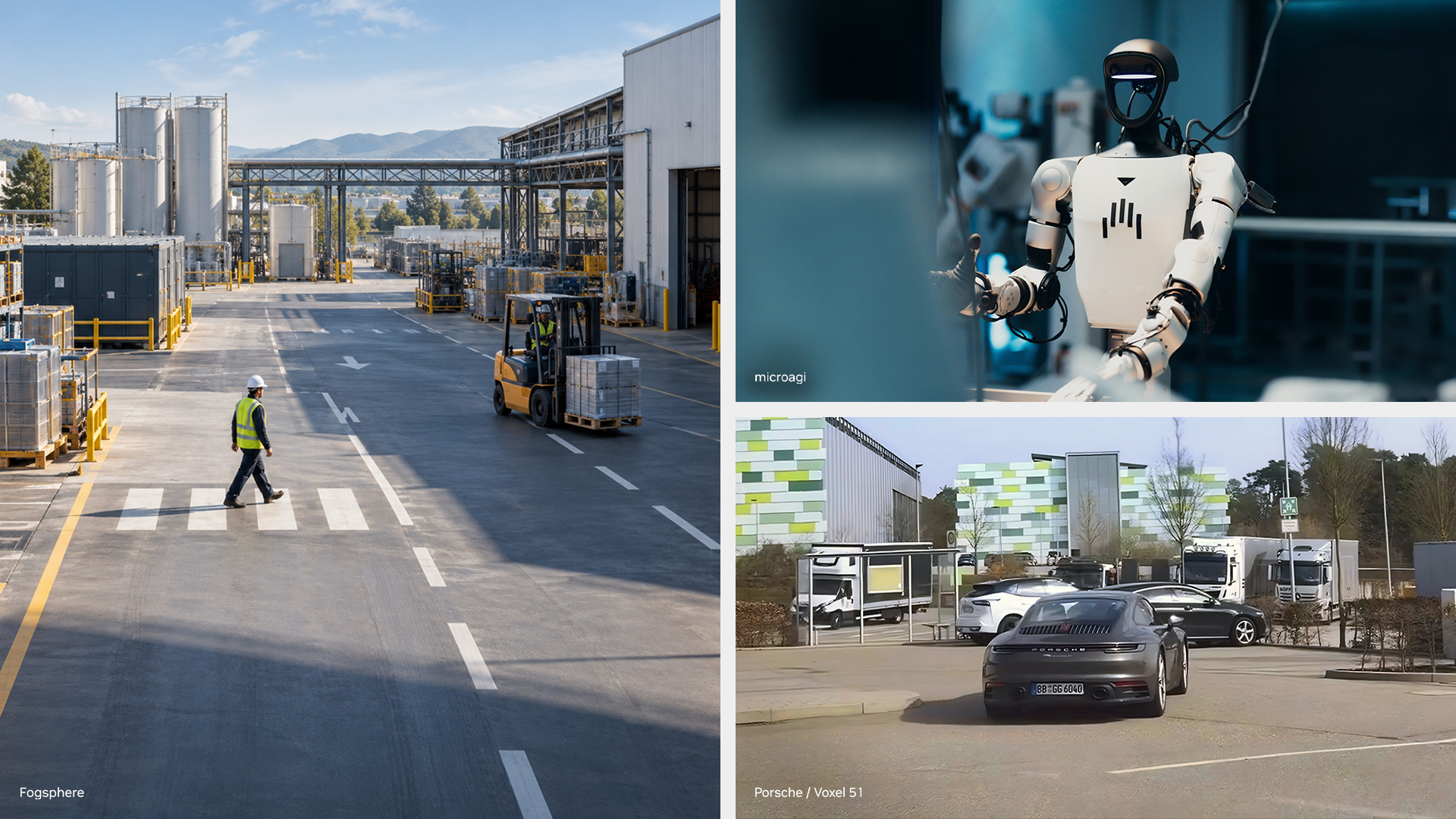
NVIDIA expanded its Cosmos platform on October 22, adding training tools, simulation checkpoints and Cosmos Data Factory blueprints meant to help developers train, evaluate and deploy world models faster. In NVIDIA's framing, world models are the infrastructure that lets physical AI systems understand and simulate the real world.
Cosmos Data Factory now ships five cloud-native blueprints: curating and labeling driving data while adding synthetic examples of hard-to-capture scenarios, turning still images into synthetic video of rare or unsafe events, generating printed circuit board, metal and glass defect images for inspection models, and changing weather and lighting in existing footage while preserving scene structure.
A second data-side update is Cosmos Curator. The GPU-accelerated tool for curating video training datasets now supports multimodal, multisensory inputs and processing blocks, so training data no longer has to come from a single camera feed.
Training and deployment are packaged as agent skills: developers can fine-tune and run reinforcement learning on open models such as GR00T, Alpamayo, QWEN and Pi0.5, compress them with distillation and quantization, and deploy through Cosmos NIM microservices. NVIDIA claims up to twice the inference speed with no quality loss in validated configurations.
Customer examples come with numbers. Porsche searches and augments autonomous driving footage in Voxel51, which NVIDIA says could cut repeated physical test drives by up to 90 percent and shorten development cycles by up to 85 percent. ANYbotics generated more than 1,500 synthetic video clips to train inspection robots to spot liquid spills, and ADNOC uses synthetic data to cover hazards it cannot safely stage across 65 sites.
NVIDIA also says the Cosmos platform ranks in the top five on six different open model leaderboards. That is a vendor claim without third-party verification, but the intent is clear: NVIDIA is selling model weights, data tooling and a deployment stack alongside GPUs.
The real bottleneck in physical AI is usually not architecture but long-tail data — the dangerous, rare or impractical situations nobody can film. Blueprinted synthetic data pipelines attack exactly that gap, which is why Cosmos is being turned from a model collection into a factory.
What to watch is openness and cost: whether synthetic data holds up on real production lines, whether the 90 and 85 percent figures can be reproduced, and whether open-weight world models fragment into incompatible data formats and toolchains.
Why it matters
The physical AI race is shifting from architecture to data pipelines: whoever can cheaply synthesize dangerous and rare conditions will get world models into production first.
Nearby Updates
All10/22, 13:00
NVIDIA widens DSX platform as GE Vernova, Hitachi Energy and Schneider Electric plug in
NVIDIA detailed how energy and electrical equipment makers are building on its DSX AI Factory Platform, with GE Vernova, Hitachi Energy, Schneider Electric and Siemens Energy contributing grid simulation, storage certification and Vera Rubin power and cooling reference designs. NVIDIA says power is now infrastructure's biggest bottleneck, with more than $300 billion of equipment backlogged and over 200 gigawatts of projects waiting in U.S. interconnection queues.
10/22, 13:00
NVIDIA pitches open models to European retail: 90% cheaper serving at Shopify, warehouses simulated first
NVIDIA detailed European retail deployments built on its open models and accelerated computing, including Shopify post-training Nemotron 3.5 Lightning for a Sidekick subagent to cut serving costs 90 percent while answering seven times faster. Otto Group, Zooplus, Photoroom and L'Oréal also appear, with warehouse operations tested in Omniverse simulation before physical rollout.
10/22, 13:00
NVIDIA's Earth-2 lands in Europe with StormScope EU, a 10-minute regional forecast model
NVIDIA said European organizations are putting Earth-2 open models into operational weather work and introduced StormScope EU, a regional nowcasting model that predicts cloud conditions across 16 Meteosat channels every 10 minutes using EUMETSAT observations. AXA, Vaisala Xweather, University of Manchester and TotalEnergies are already building on it.
10/22, 13:00
NVIDIA's open models move into European public services, country by country
NVIDIA rounded up European public-sector projects built on open models, from deepset's expansion of the European Commission's AI@EC platform to Polish medical imaging and agentic systems for 400-plus labor offices, plus sovereign offerings in Germany, France and the UK. The UK and Germany each published million-record localized synthetic persona datasets.