Realtime AI News
Lambda Adopts NVIDIA Photonics CPO Switches to Harden 10,000-GPU AI Factories
Lambda is deploying NVIDIA Photonics co-packaged optics (CPO) switches to connect NVIDIA GB300 NVL72 racks carrying more than 10,000 GPUs. The cloud provider is betting that a faster, more efficient and more resilient network is what keeps very large training clusters productive.
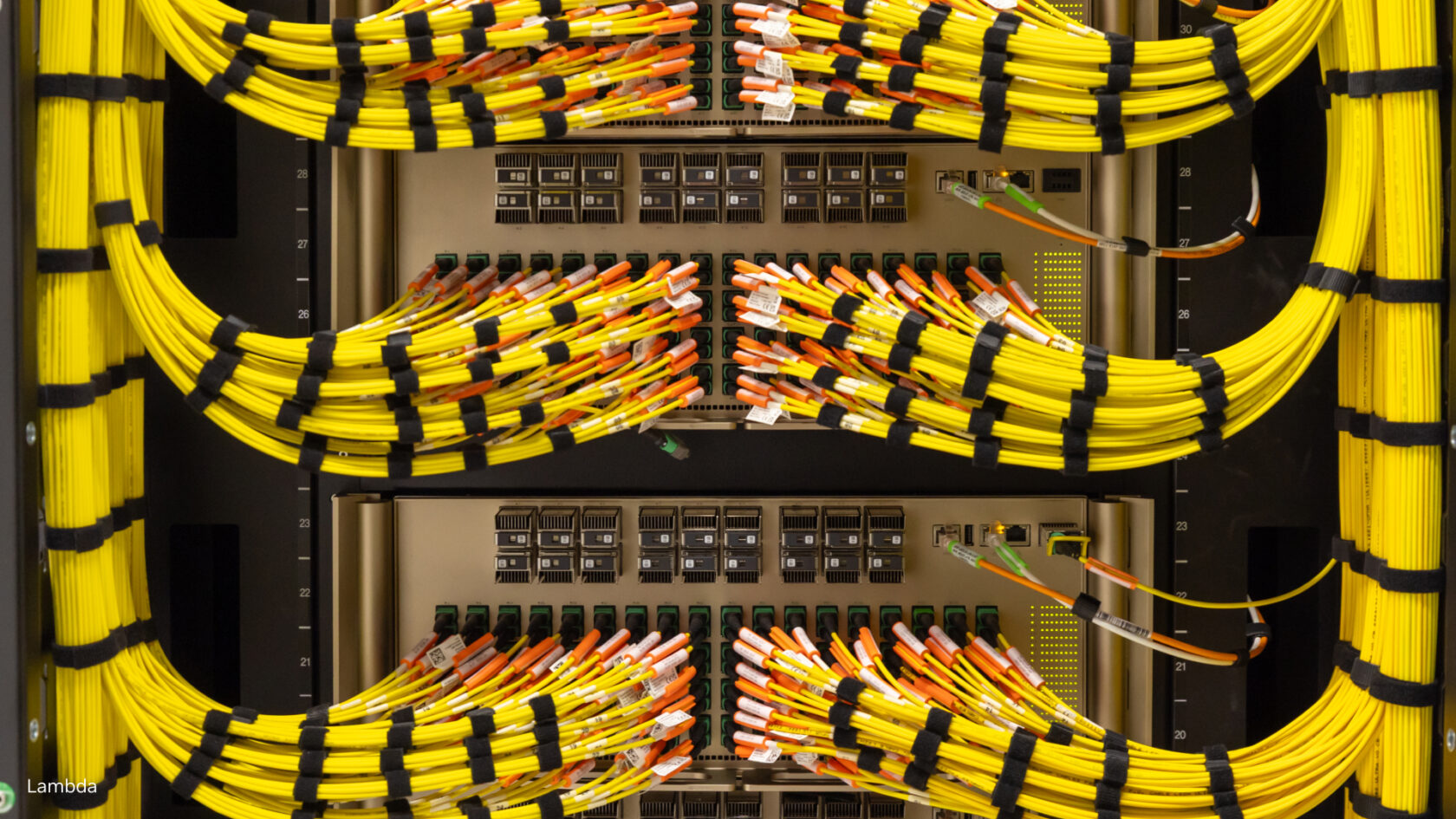
Training a large model means thousands of GPUs have to work as one machine, and the network between them has to be fast, efficient and resilient. Lambda is addressing that layer with NVIDIA Photonics co-packaged optics (CPO) switches.
According to NVIDIA's blog, the cloud provider is using those switches to connect NVIDIA GB300 NVL72 racks with more than 10,000 GPUs in total. GB300 NVL72 is NVIDIA's rack-scale system for large AI workloads, packing many GPUs and their high-speed interconnect into a single rack.
CPO changes where the optics live. Instead of pluggable modules at the face of the switch, the optical engine is packaged together with the switch silicon. At the scale of a 10,000-GPU cluster, port counts and optical link counts multiply quickly, so the density, power draw and failure points of the optics become first-order network design questions.
For a GPU cloud like Lambda, the network is not an accessory; it decides whether the cluster is usable. A single flapping or failed link can stall a job that spans thousands of GPUs and leave expensive compute sitting idle.
That is the frame NVIDIA puts around the announcement: fast, efficient and resilient. The first two are about throughput and power per bit; the third is about how many things can break before training actually stops.
The supply-side signal matters as much as the deployment. When a cloud provider wires a current-generation rack system with CPO switches rather than pluggable modules, it shifts where optics sit inside the AI factory and, eventually, which suppliers hold which part of the value chain.
What the published material does not give is numbers. No port rate, no measured power saving and no failure-rate comparison between CPO and pluggable optics appear in the summary NVIDIA released; the disclosure is about architecture and scale, not benchmarks.
The next things to watch are whether this configuration spreads to other AI factories, and whether CPO supply, serviceability and field experience can keep pace as clusters grow past 10,000 GPUs.
Why it matters
Lambda's use of CPO switches in a 10,000-GPU GB300 NVL72 deployment moves optical interconnect from supporting hardware to a core determinant of AI factory uptime; if other clouds follow, the optics supply chain reshapes around co-packaged designs.
Nearby Updates
All11/17, 00:00
NVIDIA Extends Slurm to Put Quantum Processors Inside Supercomputing Workflows
NVIDIA is expanding Slurm's support for quantum processors so supercomputing centres can schedule quantum hardware alongside their existing scientific workloads. The move lands as nearly 30 centres prepare to deploy more than 50 quantum processors, a roughly sevenfold rise in deployments over five years.
11/17, 00:07
Report: OpenAI Explored Buying Interpretability Startup Goodfire for Over $5 Billion
OpenAI explored acquiring the AI interpretability startup Goodfire in a transaction valued at more than $5 billion, The Information reported. The figure, if accurate, would rank among the largest sums ever attached to a company working on AI interpretability.
11/16, 23:52
Audible turns to AI audio previews to help listeners pick audiobooks
Audible has added AI-generated audio previews that summarize a book's themes and reader reception alongside the traditional narrated sample. The feature targets audiobook discovery, where a short sample reveals the narrator but says little about whether a long book is worth the commitment.
11/16, 23:02
US Tightens AI Chip Export Controls to Cover Remote Access to Overseas Compute
The Commerce Department is rolling out an interim final rule requiring licenses to send AI chips and servers to data centers anywhere in the world if that compute could reach companies in China or other restricted countries. It sets a 12 million TPP threshold, roughly 750 Nvidia H100 or H200 chips, and rescinds the Biden-era AI Diffusion Rule.