Realtime AI News
Nvidia expands CUDA-X with cuPhoton, cuPotential and cuSpa for AI research agents
Nvidia expanded its CUDA-X libraries with cuPhoton, cuPotential and cuSpa, aimed at research in astrophysics, materials science and single-cell biology. The company says the speedups let scientists analyse larger datasets and model more complex systems, while giving AI agents callable tools for discovery.
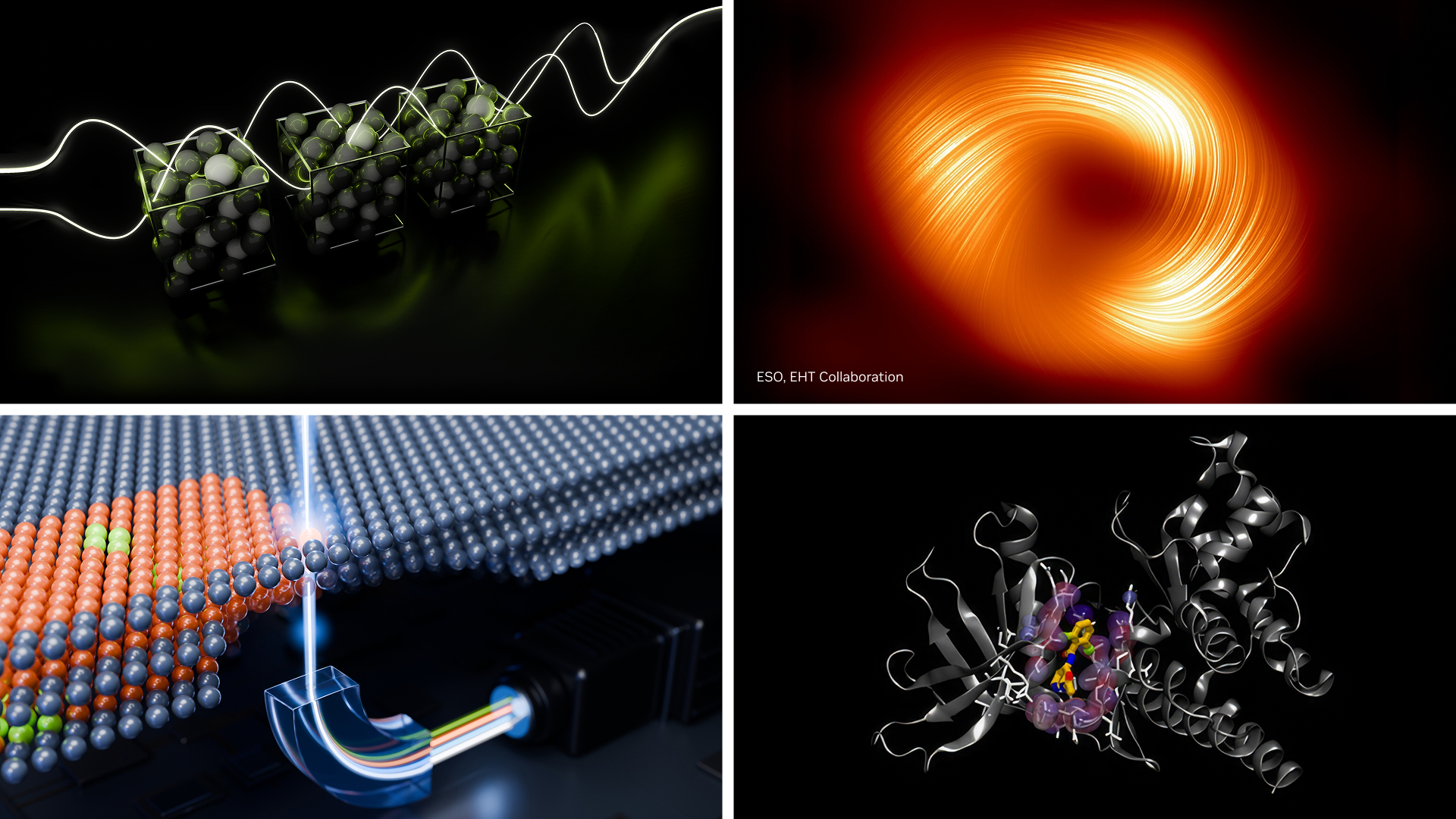
Nvidia expanded its CUDA-X library family on November 16, adding cuPhoton, cuPotential and cuSpa to the set of GPU-accelerated tools researchers use across scientific computing.
The libraries target data-heavy work in fields the company names explicitly: astrophysics, materials science and single-cell biology. What those areas share is scale — datasets big enough and systems complex enough that conventional pipelines hit a ceiling on volume before they hit one on method.
Nvidia frames the speedups as a way to change the scale of questions scientists can ask, not merely to shorten run times. Larger datasets and more complex system models are the practical payoff of the acceleration.
The more interesting shift is the agent angle: Nvidia says the new libraries give AI agents the tools to help researchers make discoveries, which turns domain libraries into callable capabilities rather than stand-alone software.
That matters because scientific agents are only as useful as the instruments they can operate. A model that can plan an experiment but cannot run a simulation is still a chatbot; one that can invoke a validated numerical library is closer to a research assistant.
Nvidia's post does not quantify the speedups with benchmark figures, so the performance claim remains directional until published results or independent testing appear. For research users, numerical stability and reproducibility typically matter more than peak throughput anyway.
The questions to watch are availability — which libraries ship as stable releases versus previews — and whether mainstream agent frameworks pick up these calls as first-class tools. If integration is smooth, scientific computing could become one of the first places where agents produce verifiable value.
Sources
Why it matters
Exposing validated scientific libraries as agent-callable tools could make research one of the first domains where agents deliver measurable output.
Nearby Updates
All11/17, 00:00
Nvidia's Vera Rubin debuts in MLPerf with a training sweep and 10x agentic efficiency gain
Nvidia published Vera Rubin's first MLPerf results, claiming leadership across training, post-training and agentic inference, and a sweep of every MLPerf Training v6.1 benchmark. In its first MLPerf Endpoints submission, the platform reports more than 10x generational gains in throughput per watt for agentic AI.
11/17, 00:00
Nvidia unveils Rubin HPC, a 50,000-core-plus GPU built for science agents
At SC26, Nvidia announced Rubin HPC, a new GPU in its Vera Rubin platform aimed at simulation and data processing for science, engineering and analytics, with more than 50,000 CUDA cores on a single chip. Nvidia says the card scales data movement alongside compute, paired with sparse-data acceleration and seventh-generation NVLink, to shorten the loop from an agent's hypothesis to a simulated result.
11/17, 00:00
NVIDIA Extends Slurm to Put Quantum Processors Inside Supercomputing Workflows
NVIDIA is expanding Slurm's support for quantum processors so supercomputing centres can schedule quantum hardware alongside their existing scientific workloads. The move lands as nearly 30 centres prepare to deploy more than 50 quantum processors, a roughly sevenfold rise in deployments over five years.
11/17, 00:00
Lambda Adopts NVIDIA Photonics CPO Switches to Harden 10,000-GPU AI Factories
Lambda is deploying NVIDIA Photonics co-packaged optics (CPO) switches to connect NVIDIA GB300 NVL72 racks carrying more than 10,000 GPUs. The cloud provider is betting that a faster, more efficient and more resilient network is what keeps very large training clusters productive.