English translation
Introduction to AutoML: Background and Significance
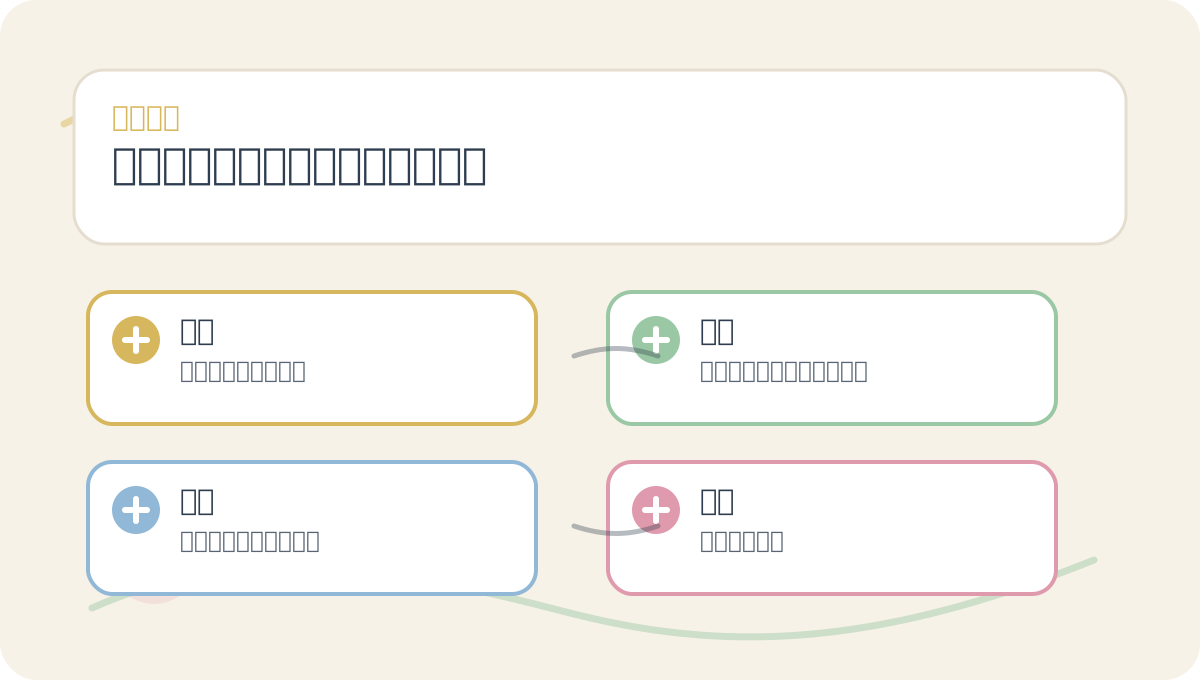
AI Article Decision Snapshot
Turn the lesson into workflow, model, budget, and security checks before choosing tools.
Use this quick snapshot before leaving the article. It keeps the next search tied to practical AI software, model/API, cost, privacy, and implementation questions.
Workflow fit
Identify the real job behind the article: coding, research, document review, support, analytics, content, or internal automation.
Model or tool decision
Decide whether the next step is a software shortlist, an AI tool comparison, an API platform choice, or a model benchmark.
Budget and usage signal
Estimate seats, API calls, prompt volume, retries, review time, and fallback work before assuming the workflow is cheap.
Security and privacy review
Check whether source code, customer data, private documents, prompts, logs, or embeddings will enter the AI workflow.

The value of AutoML lies not in replacing human judgment, but in automating repetitive modeling steps—freeing people to focus on data understanding, business objectives, and production risks.

I first assess whether automation is warranted: Is the data stable? Are evaluation metrics well-defined? Will results be reviewed by humans?
In today’s rapidly evolving data-driven era, enterprises and research institutions face massive volumes of data and increasingly complex model selection challenges. Traditional machine learning workflows demand substantial domain expertise and hands-on experience—not only for data preprocessing and feature engineering, but also for model selection, hyperparameter tuning, and more. Such processes are time-consuming and often fail to deliver tangible results within tight deadlines. Optimizing the ML workflow—boosting efficiency while lowering technical barriers—has thus become an urgent priority.
Background of AutoML
Automated Machine Learning (AutoML) emerged precisely to address these challenges. AutoML refers to the use of automated algorithms and tools to streamline the generation, evaluation, and optimization of machine learning models. As ML techniques become more widespread, many organizations seek to rapidly build and deploy high-performing models—without needing to master intricate technical details from scratch. By automating routine tasks, AutoML significantly accelerates model development and empowers non-experts to participate meaningfully in ML applications.

AutoML does not eliminate all human judgment—it accelerates repeatable search and comparison processes. When data quality, task type, evaluation criteria, or production monitoring are unclear, stronger automation can easily lead users astray.
Case Study: Credit Scoring in Finance
In finance, building credit scoring models traditionally requires deep knowledge of statistical analysis and multiple ML methods. With AutoML tools such as TPOT and H2O.ai, financial institutions can rapidly generate higher-accuracy predictive models through automated pipelines. This allows data scientists to concentrate on interpreting data and designing business-relevant solutions—rather than getting bogged down in low-level model implementation details.
Importance of AutoML
1. Lowering Technical Barriers
When reading “Introduction to AutoML: Background and Importance”, start by reviewing the tasks, concepts, exercises, and decision points illustrated in the accompanying figures—then return to the main text to fill in supporting details. This approach helps you quickly assess which real-world scenarios this content applies to.
AutoML enhances accessibility to ML technologies for general users. Even those without intermediate-to-advanced ML experience can build models using intuitive graphical interfaces or simple APIs. Research shows that non-technical users can build and optimize models in just a few hours using AutoML—whereas the same task would typically require weeks of effort by experienced data scientists.
2. Boosting Productivity and Efficiency
AutoML dramatically increases team productivity. Developers and data scientists no longer need to spend excessive time manually selecting and tuning models; instead, they can redirect their efforts toward deeper data understanding and uncovering business value. In practice, AutoML tools routinely reduce model development time by at least 50%.
3. Enabling Model Optimization
AutoML leverages search algorithms and ensemble techniques to automatically explore vast spaces of models and hyperparameter combinations—identifying optimal configurations. For example, AutoKeras employs Neural Architecture Search (NAS) to autonomously select the best neural network architecture and hyperparameters—achieving performance on par with human experts.
4. Accelerating Innovation
In fast-changing markets, businesses must respond swiftly to emerging challenges. AutoML’s rapid iteration capability enables organizations to adapt strategies dynamically. In e-commerce, for instance, automated optimization of recommendation systems allows companies to quickly align with shifting consumer preferences—thereby improving conversion rates and customer satisfaction.

When reviewing “Introduction to AutoML: Background and Importance”, place key concepts, operational steps, and observable outcomes on a single page for efficient reflection.

When practicing “Introduction to AutoML: Background and Importance”, write input conditions, processing actions, and observable outcomes together—making future review straightforward.
Summary
In summary, AutoML’s significance extends far beyond simplifying model construction. Its broader impact lies in dismantling technical barriers and accelerating enterprise-wide data intelligence transformation. Through automation, more industries and organizations can harness the power of data—better meeting market demands and driving innovation. As AutoML technology continues to mature and evolve, we anticipate ever more groundbreaking applications and real-world deployments.
In the next chapter, we will outline this tutorial’s goals and structure—guiding you step-by-step toward applying AutoML techniques to solve practical problems.
Apply This Lesson
Turn this article into AI software, model, API, and security decisions.
English Article FAQ
Use this article as evidence before choosing AI tools
How should I use this AI Tutorials article?
Use it as the implementation or learning layer, then connect the idea to AI software buyer guides, tool comparisons, benchmarks, API choices, and security checks before making a production decision.
Is this English article different from the Chinese original?
The English edition is localized for global AI readers while preserving the original diagrams, screenshots, prompts, code examples, and source context from the Chinese article.
What should I read after Introduction to AutoML: Background and Significance?
Continue with AI Software Buyer Guides, AI Tools Workbench, Best AI Coding Agents, AI Model Benchmarks, OpenAI vs Anthropic API, or LLM Security Tools depending on the decision you need to make.
Can this article alone choose an AI product or model?
No. Treat the article as evidence and context, then validate fit with pricing, privacy requirements, integration effort, benchmark results, workflow tests, and fallback planning.
Continue