English translation
AutoML-Zero Tutorial Series Part 2: Goals and Architecture
AI Article Decision Snapshot
Turn the lesson into workflow, model, budget, and security checks before choosing tools.
Use this quick snapshot before leaving the article. It keeps the next search tied to practical AI software, model/API, cost, privacy, and implementation questions.
Workflow fit
Identify the real job behind the article: coding, research, document review, support, analytics, content, or internal automation.
Model or tool decision
Decide whether the next step is a software shortlist, an AI tool comparison, an API platform choice, or a model benchmark.
Budget and usage signal
Estimate seats, API calls, prompt volume, retries, review time, and fallback work before assuming the workflow is cheap.
Security and privacy review
Check whether source code, customer data, private documents, prompts, logs, or embeddings will enter the AI workflow.

Learning AutoML shouldn’t be limited to clicking buttons in tools. First, grasp the full end-to-end workflow; only then will you understand how tools automate parts of it—leading to deeper, more robust learning.

Each section’s content will be mapped back onto a roadmap: Which step does this section address? What is its output? And what does the next step depend on?
In the previous article, we explored the background and significance of Automated Machine Learning (AutoML), clarifying its pivotal role in today’s data-driven decision-making landscape. As technology advances and data volumes explode, traditional machine learning model development has grown increasingly complex and time-consuming—spurring the rise of AutoML. In response to this trend, this tutorial aims to provide readers with a clear, actionable pathway to understanding and applying AutoML effectively.
Tutorial Objectives
This tutorial seeks to equip readers with a deep, systematic understanding of AutoML—including its foundational concepts, implementation steps, and real-world applications. Specifically, our objectives are:

When examining AutoML’s objectives and structure, don’t fixate solely on model search. Data preparation, search space design, evaluation methodology, and production monitoring are all integral links in the chain—omitting any one compromises result reliability.
-
Understand Core AutoML Concepts:
Introduce the definition, key characteristics, and high-level workflow of AutoML—enabling readers to internalize its fundamental principles. -
Master AutoML Tools and Techniques:
Examine widely used AutoML tools—includingTPOT,AutoKeras, andH2O.ai—to help readers select the most appropriate tool for their specific use case. -
Conduct Case-Based Analysis:
Walk through concrete dataset examples to demonstrate how AutoML is applied in practice—from data preprocessing and feature engineering to model training and evaluation. -
Guide Real-World AutoML Implementation:
Share best practices and proven solutions for common challenges encountered during AutoML project deployment—empowering readers to successfully apply AutoML in production settings.
Tutorial Structure
To present AutoML knowledge systematically, this tutorial is organized into the following sections:
To apply “AutoML Tutorial Series: Objectives and Structure” to your own task, start by narrowing the scope—focus first on validating just one critical decision point.
After completing “AutoML Tutorial Series: Objectives and Structure,” try adapting it to a new scenario of your own—paying close attention to whether inputs, processing steps, and outputs align coherently.
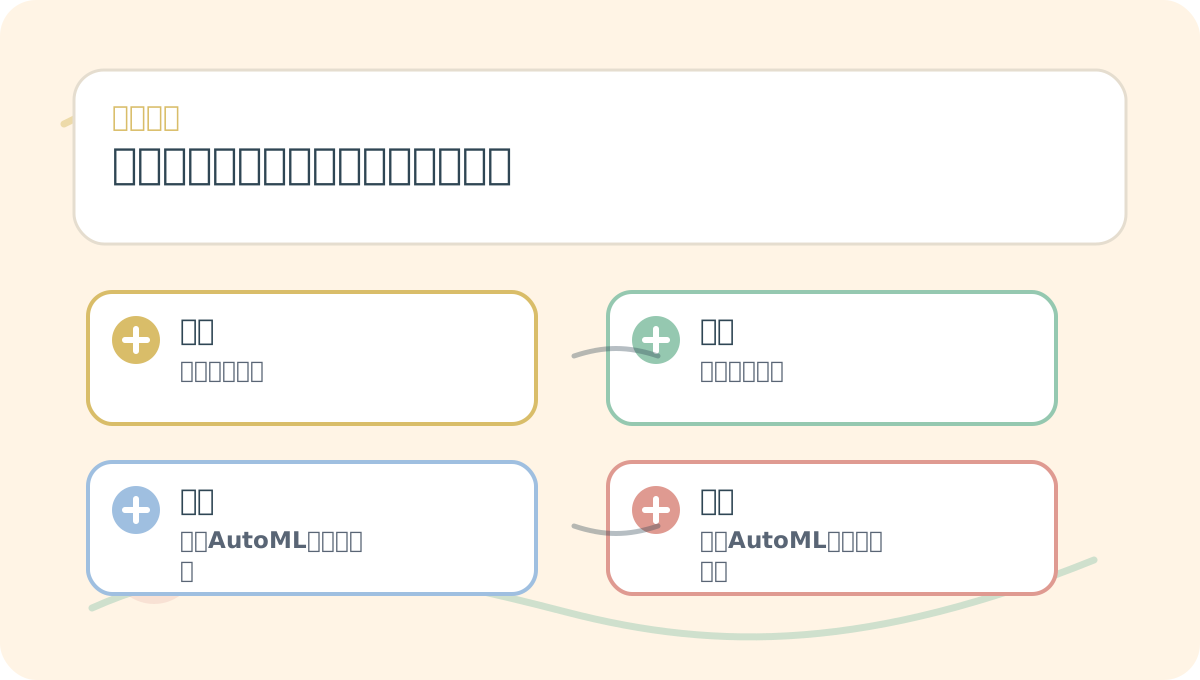
While reading “AutoML Tutorial Series: Objectives and Structure,” begin by identifying your target use case—then explicitly connect key concepts and hands-on exercises to it. This contextual anchoring prevents you from memorizing isolated terms without grasping their functional relevance.
-
Defining AutoML:
- In the next article, we’ll formally define AutoML, contrasting it with traditional ML workflows to highlight its unique advantages and value proposition.
-
Core Components of AutoML:
- Delve into essential technical pillars—including automated feature selection, model selection, and hyperparameter optimization—with illustrative case studies.
-
Survey of Popular AutoML Tools:
- Provide an overview of leading AutoML platforms and libraries, accompanied by usage examples and comparative analysis of strengths and limitations.
-
Implementing and Applying AutoML:
- Offer a step-by-step walkthrough of deploying AutoML in real projects—covering data preprocessing, model training, hyperparameter tuning, and performance evaluation.
-
Future Trends and Challenges:
- Look ahead to emerging directions in AutoML research and adoption, while addressing persistent challenges—helping readers anticipate and prepare for future evolution.
By engaging with both the theory and hands-on practice in this tutorial, readers will build foundational AutoML competencies—and strengthen their competitiveness in the broader data science ecosystem. We look forward to continuing this exploration of AutoML with you in the upcoming sections!
Apply This Lesson
Turn this article into AI software, model, API, and security decisions.
English Article FAQ
Use this article as evidence before choosing AI tools
How should I use this AI Tutorials article?
Use it as the implementation or learning layer, then connect the idea to AI software buyer guides, tool comparisons, benchmarks, API choices, and security checks before making a production decision.
Is this English article different from the Chinese original?
The English edition is localized for global AI readers while preserving the original diagrams, screenshots, prompts, code examples, and source context from the Chinese article.
What should I read after AutoML-Zero Tutorial Series Part 2: Goals and Architecture?
Continue with AI Software Buyer Guides, AI Tools Workbench, Best AI Coding Agents, AI Model Benchmarks, OpenAI vs Anthropic API, or LLM Security Tools depending on the decision you need to make.
Can this article alone choose an AI product or model?
No. Treat the article as evidence and context, then validate fit with pricing, privacy requirements, integration effort, benchmark results, workflow tests, and fallback planning.
Continue