English translation
Load dataset
AI Article Decision Snapshot
Turn the lesson into workflow, model, budget, and security checks before choosing tools.
Use this quick snapshot before leaving the article. It keeps the next search tied to practical AI software, model/API, cost, privacy, and implementation questions.
Workflow fit
Identify the real job behind the article: coding, research, document review, support, analytics, content, or internal automation.
Model or tool decision
Decide whether the next step is a software shortlist, an AI tool comparison, an API platform choice, or a model benchmark.
Budget and usage signal
Estimate seats, API calls, prompt volume, retries, review time, and fallback work before assuming the workflow is cheap.
Security and privacy review
Check whether source code, customer data, private documents, prompts, logs, or embeddings will enter the AI workflow.

Bayesian optimization guides the next trial using historical results—ideal for tasks where each training run is costly. It emphasizes achieving near-optimal performance with fewer trials.

I evaluate progress by examining whether the search trajectory steadily improves—not just by the final best score.
In machine learning, hyperparameter optimization is a critical step for improving model performance. In the previous tutorial, we discussed common hyperparameter tuning methods such as grid search and random search. While simple and easy to use, these approaches suffer from low efficiency in high-dimensional parameter spaces—and often demand substantial computational resources and time.
This article delves into Bayesian optimization, a hyperparameter optimization method grounded in Bayesian statistics. Compared to traditional methods, Bayesian optimization more effectively leverages existing information to select the next set of model parameters—enabling faster convergence to the optimal hyperparameter configuration.
Core Principles of Bayesian Optimization
The central idea behind Bayesian optimization is to iteratively approximate the optimal hyperparameters using a surrogate model—typically a Gaussian process. The process can be summarized in the following steps:

When applying Bayesian optimization for hyperparameter search, first assess: the objective function, the search space, the surrogate model, the acquisition function, the budget constraint, and validation set variability.
-
Surrogate Model Construction: At each iteration, Bayesian optimization trains a surrogate model using the current hyperparameters and their corresponding performance (e.g., validation accuracy). A widely used choice is the Gaussian Process (GP), which provides both predictive mean and uncertainty estimates.
-
Selecting New Hyperparameters: Based on the surrogate model, an acquisition function selects the next candidate hyperparameters. Common acquisition functions include Expected Improvement (EI) and Upper Confidence Bound (UCB).
-
Evaluation and Update: The newly selected hyperparameters are used to train and evaluate the model; the resulting performance metric is then fed back to update the surrogate model.
Through this iterative, information-driven process, Bayesian optimization achieves faster convergence to the optimum—even under tight resource constraints.
Practical Example: Bayesian Optimization Using scikit-optimize
In this section, we demonstrate how to implement Bayesian optimization using the scikit-optimize library—with a Random Forest classifier as our example model.
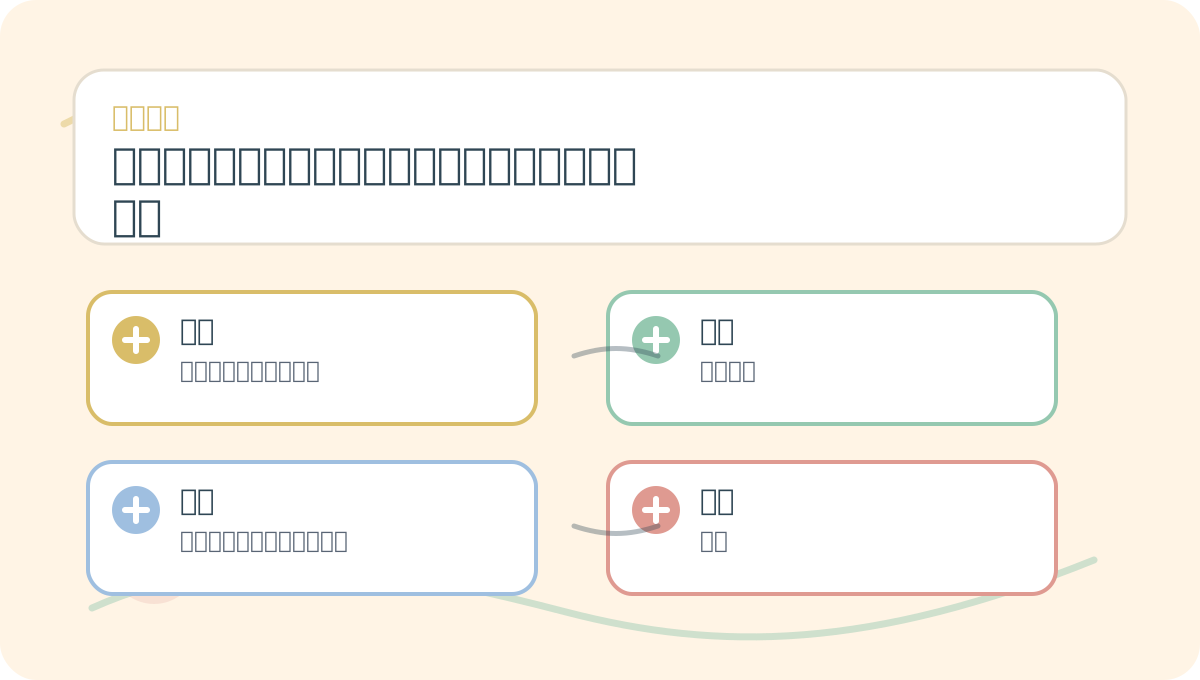
When reading “Bayesian Optimization in AutoML: Applications in Hyperparameter Optimization”, first identify the target scenario, then connect key concepts with hands-on actions. This approach helps avoid memorizing isolated terms—keeping the big picture clear while diving into details.
First, ensure scikit-optimize is installed:
pip install scikit-optimize
Next, import required libraries, load the dataset, and define the objective function:
import numpy as np
from sklearn.datasets import load_iris
from sklearn.model_selection import train_test_split
from sklearn.ensemble import RandomForestClassifier
from skopt import BayesSearchCV

# Load dataset
iris = load_iris()
X, y = iris.data, iris.target
X_train, X_test, y_train, y_test = train_test_split(X, y, test_size=0.2, random_state=42)

# Define hyperparameter search space
param_space = {
    'n_estimators': (10, 100),      # number of trees in the forest
    'max_depth': (1, 10),           # maximum depth of the trees
    'min_samples_split': (2, 10)    # minimum samples required to split an internal node
}

# Define objective and optimizer
clf = RandomForestClassifier(random_state=42)
opt = BayesSearchCV(clf, param_space, n_iter=32, cv=3, n_jobs=-1)
opt.fit(X_train, y_train)

# Output best hyperparameters and score
print("Best hyperparameters:", opt.best_params_)
print("Best cross-validation score:", opt.best_score_)
Code Walkthrough
- Data Loading & Splitting: Load the Iris dataset using
load_iris, then split it into training and test sets. - Hyperparameter Space Definition: Specify the hyperparameters and their feasible ranges using a dictionary.
- Bayesian Optimizer Instantiation: Use
BayesSearchCVto perform hyperparameter search—configuring the number of iterations (n_iter) and cross-validation folds (cv). - Model Fitting: Call
fit()to execute the Bayesian search and train the optimized model. - Result Reporting: Print the best-found hyperparameters and their associated cross-validation score.
Advantages and Limitations of Bayesian Optimization
Advantages
- Efficiency: Leverages prior evaluations to shrink the effective search space—leading to faster convergence.
- Uncertainty-Aware Exploration: Quantifies prediction uncertainty for each candidate hyperparameter—a major advantage in high-dimensional or noisy settings.
Limitations
- Sensitivity to Initialization: Optimization outcomes may depend significantly on initial sampling points.
- Computational Cost: Fitting Gaussian process models becomes increasingly expensive as dimensionality grows.

Having read “Bayesian Optimization in AutoML: Applications in Hyperparameter Optimization”, summarize it into a retrospective table: clarify the core narrative first, then verify understanding using a small-scale task.

After finishing “Bayesian Optimization in AutoML: Applications in Hyperparameter Optimization”, try walking through a minimal end-to-end example yourself—then assess which steps you can now execute independently.
Conclusion
In this article, we thoroughly introduced the principles of Bayesian optimization and demonstrated its application in hyperparameter tuning—illustrated via a concrete implementation using scikit-optimize. Subsequent articles will explore ensemble learning, covering how to combine multiple models to boost predictive performance. As a powerful, sample-efficient optimization strategy, Bayesian optimization significantly accelerates model development—and is an essential skill for every machine learning engineer.
Apply This Lesson
Turn this article into AI software, model, API, and security decisions.
English Article FAQ
Use this article as evidence before choosing AI tools
How should I use this AI Tutorials article?
Use it as the implementation or learning layer, then connect the idea to AI software buyer guides, tool comparisons, benchmarks, API choices, and security checks before making a production decision.
Is this English article different from the Chinese original?
The English edition is localized for global AI readers while preserving the original diagrams, screenshots, prompts, code examples, and source context from the Chinese article.
What should I read after Load dataset?
Continue with AI Software Buyer Guides, AI Tools Workbench, Best AI Coding Agents, AI Model Benchmarks, OpenAI vs Anthropic API, or LLM Security Tools depending on the decision you need to make.
Can this article alone choose an AI product or model?
No. Treat the article as evidence and context, then validate fit with pricing, privacy requirements, integration effort, benchmark results, workflow tests, and fallback planning.
Continue