English translation
AutoML Tutorial #21: Ensemble Learning Concepts for Model Integration and Automation
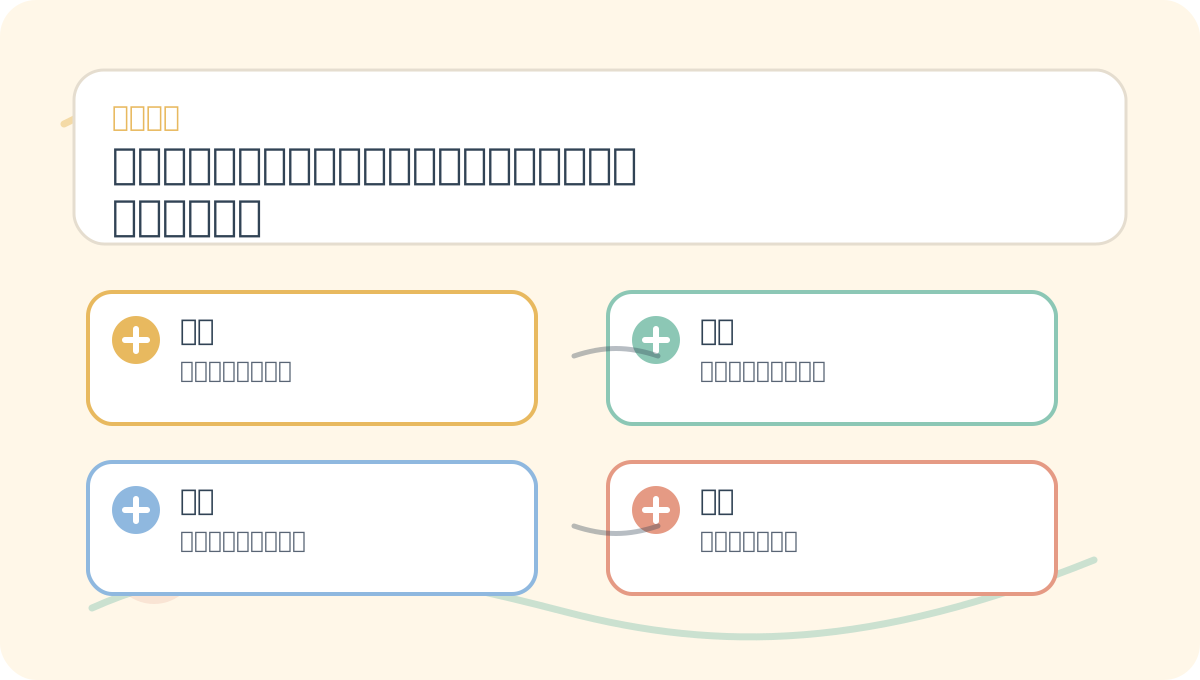
AI Article Decision Snapshot
Turn the lesson into workflow, model, budget, and security checks before choosing tools.
Use this quick snapshot before leaving the article. It keeps the next search tied to practical AI software, model/API, cost, privacy, and implementation questions.
Workflow fit
Identify the real job behind the article: coding, research, document review, support, analytics, content, or internal automation.
Model or tool decision
Decide whether the next step is a software shortlist, an AI tool comparison, an API platform choice, or a model benchmark.
Budget and usage signal
Estimate seats, API calls, prompt volume, retries, review time, and fallback work before assuming the workflow is cheap.
Security and privacy review
Check whether source code, customer data, private documents, prompts, logs, or embeddings will enter the AI workflow.

The key to ensemble learning lies in ensuring complementarity among multiple models—not merely stacking more models. Diversity and validation strategy determine whether an ensemble delivers real value.

I will compare the performance of single models versus ensemble models on hard examples. Increased complexity must yield stable, measurable gains.
In the previous article, we delved deeply into Bayesian optimization for hyperparameter tuning—learning how probabilistic modeling enables efficient search for optimal hyperparameters. As model optimization advances, model ensembling becomes increasingly critical in machine learning. This article focuses on the core concepts of ensemble learning, laying the groundwork for subsequent coverage of how AutoML can automate model ensembling.
What Is Ensemble Learning?
Ensemble learning is a technique that improves predictive performance by combining multiple base learners (also called models). Compared to a single model, ensemble methods better capture data complexity and underlying patterns—enhancing both model stability and accuracy.

When learning ensemble learning, first consider: base-model diversity; voting or weighted aggregation; Bagging; Boosting; Stacking; and validation-set performance.
Core Idea of Ensemble Learning
The fundamental principle behind ensemble learning is “wisdom of the crowd.” Specifically, it combines multiple weak learners—models whose performance is only slightly better than random guessing (e.g., shallow decision trees)—into a single strong learner. During ensembling, predictions from individual weak learners are aggregated via a defined strategy to produce superior overall results.
Common Ensemble Learning Methods
Ensemble methods fall broadly into two categories: Bagging and Boosting.
-
Bagging (Bootstrap Aggregating)
- Bagging constructs multiple distinct training datasets by bootstrapping (random sampling with replacement) from the original dataset, then trains identical base models on each. Final predictions are obtained via averaging (for regression) or majority voting (for classification).
- A classic example is Random Forest, which aggregates predictions from many decision trees.
from sklearn.ensemble import RandomForestClassifier from sklearn.datasets import load_iris from sklearn.model_selection import train_test_split # Load data iris = load_iris() X, y = iris.data, iris.target X_train, X_test, y_train, y_test = train_test_split(X, y, test_size=0.2, random_state=42) # Build Random Forest model model = RandomForestClassifier(n_estimators=100, random_state=42) model.fit(X_train, y_train) accuracy = model.score(X_test, y_test) print(f"Model Accuracy: {accuracy:.2f}") -
Boosting
- Boosting trains models sequentially: each new model focuses on correcting errors made by its predecessor. It achieves this by increasing the weights of misclassified instances, thereby directing subsequent models toward harder-to-predict samples. The final prediction is a weighted sum of all individual model outputs.
- Popular boosting algorithms include AdaBoost, Gradient Boosting, and XGBoost.
from sklearn.ensemble import AdaBoostClassifier
from sklearn.tree import DecisionTreeClassifier

# Define base learner
base_model = DecisionTreeClassifier(max_depth=1)
boosting_model = AdaBoostClassifier(base_estimator=base_model, n_estimators=50, random_state=42)
boosting_model.fit(X_train, y_train)

accuracy_boosting = boosting_model.score(X_test, y_test)
print(f"Boosting Model Accuracy: {accuracy_boosting:.2f}")
Advantages of Ensemble Learning
- Reduced Overfitting: By aggregating predictions across multiple models, ensemble methods typically mitigate overfitting on training data.
- Improved Prediction Accuracy: Combining diverse models enhances robustness and generalization performance.
- Better Handling of Heterogeneous Data: Different models may learn complementary features from the same dataset—so integrating them often captures richer, more comprehensive information.
After reading “AutoML Tutorial Series: Model Ensembling & Automation — Concepts of Ensemble Learning”, reflect on three questions:
- What problem does it solve?
- At which step is error most likely to occur?
- Can I reproduce it end-to-end with a small, self-contained example?
When reviewing “AutoML Tutorial Series: Model Ensembling & Automation — Concepts of Ensemble Learning”, place key concepts, procedural steps, and observable outcomes side-by-side on a single page for effective revision.
When practicing “AutoML Tutorial Series: Model Ensembling & Automation — Concepts of Ensemble Learning”, document input conditions, processing actions, and observable outcomes together—making future review faster and more reliable.
Conclusion
Ensemble learning is a powerful machine learning technique that significantly boosts model performance by synergistically combining strengths of multiple models. In the next article, we’ll explore how Automated Machine Learning (AutoML) tools can automate model ensembling—streamlining model selection, combination, and evaluation to raise the level of automation in ML practice.
Now that you understand the foundational concepts of ensemble learning, stay tuned for the next installment—where we’ll show how AutoML simplifies and accelerates this process, enabling more efficient and accurate modeling.
Apply This Lesson
Turn this article into AI software, model, API, and security decisions.
English Article FAQ
Use this article as evidence before choosing AI tools
How should I use this AI Tutorials article?
Use it as the implementation or learning layer, then connect the idea to AI software buyer guides, tool comparisons, benchmarks, API choices, and security checks before making a production decision.
Is this English article different from the Chinese original?
The English edition is localized for global AI readers while preserving the original diagrams, screenshots, prompts, code examples, and source context from the Chinese article.
What should I read after AutoML Tutorial #21: Ensemble Learning Concepts for Model Integration and Automation?
Continue with AI Software Buyer Guides, AI Tools Workbench, Best AI Coding Agents, AI Model Benchmarks, OpenAI vs Anthropic API, or LLM Security Tools depending on the decision you need to make.
Can this article alone choose an AI product or model?
No. Treat the article as evidence and context, then validate fit with pricing, privacy requirements, integration effort, benchmark results, workflow tests, and fallback planning.
Continue