English translation
Load data
AI Article Decision Snapshot
Turn the lesson into workflow, model, budget, and security checks before choosing tools.
Use this quick snapshot before leaving the article. It keeps the next search tied to practical AI software, model/API, cost, privacy, and implementation questions.
Workflow fit
Identify the real job behind the article: coding, research, document review, support, analytics, content, or internal automation.
Model or tool decision
Decide whether the next step is a software shortlist, an AI tool comparison, an API platform choice, or a model benchmark.
Budget and usage signal
Estimate seats, API calls, prompt volume, retries, review time, and fallback work before assuming the workflow is cheap.
Security and privacy review
Check whether source code, customer data, private documents, prompts, logs, or embeddings will enter the AI workflow.

Model evaluation answers whether a model is usable, not merely which model scores highest. Different tasks and business costs demand different evaluation metrics.

I always examine metrics alongside misclassified samples. If overall scores improve but performance degrades on critical scenarios, the model must not be deployed directly.
In the previous article, we thoroughly discussed the model training phase of the automated machine learning (AutoML) workflow. Training models is a crucial step toward efficient machine learning—but model evaluation ensures those trained models perform well in real-world applications. This article delves into the importance of model evaluation, commonly used evaluation metrics, and how to implement them within an AutoML environment.
Why Model Evaluation Matters
Within the machine learning pipeline, training a model alone is insufficient. We must evaluate the trained model to assess its generalization capability on unseen data. Through evaluation, we gain insight into:
- The model’s overall performance
- Potential overfitting or underfitting issues
- Comparative performance across candidate models
Evaluation not only supports selection of the best-performing model—it also guides subsequent tuning and iterative improvement.
Common Model Evaluation Metrics
Depending on the task type—classification or regression—we select appropriate evaluation metrics. Below are widely used ones.
Classification Tasks
-
Accuracy:
Accuracy is the most fundamental classification metric, representing the proportion of correctly classified samples out of the total. Its formula is:where
TP= True Positives,TN= True Negatives,FP= False Positives, andFN= False Negatives. -
Precision:
Precision measures the fraction of predicted positive instances that are actually positive: -
Recall:
Recall measures the fraction of actual positive instances that are correctly identified as positive: -
F1-score:
The F1-score is the harmonic mean of precision and recall—balancing both metrics:
Regression Tasks
-
Mean Squared Error (MSE):
MSE is a standard metric for regression, quantifying the average squared difference between predictions and true values:where is the actual value and is the predicted value.
-
Root Mean Squared Error (RMSE):
RMSE is the square root of MSE, sharing the same units as the target variable: -
R-squared ():
reflects the proportion of variance in the target variable explained by the model. Values closer to 1 indicate better fit:where is the residual sum of squares and is the total sum of squares.
Model Evaluation in AutoML
In AutoML pipelines, model evaluation typically occurs on both training and validation sets. To ensure robustness and flexibility, cross-validation (CV) is often employed. CV repeatedly partitions the dataset into training and validation folds—yielding more reliable estimates of generalization performance.

When evaluating AutoML models, first confirm:
- The primary task-specific metric
- Validation data split strategy
- Performance of all candidate models
- Signs of overfitting
- Deployment cost implications
Example: Model Evaluation with scikit-learn
Below is a practical demonstration using Python’s scikit-learn.
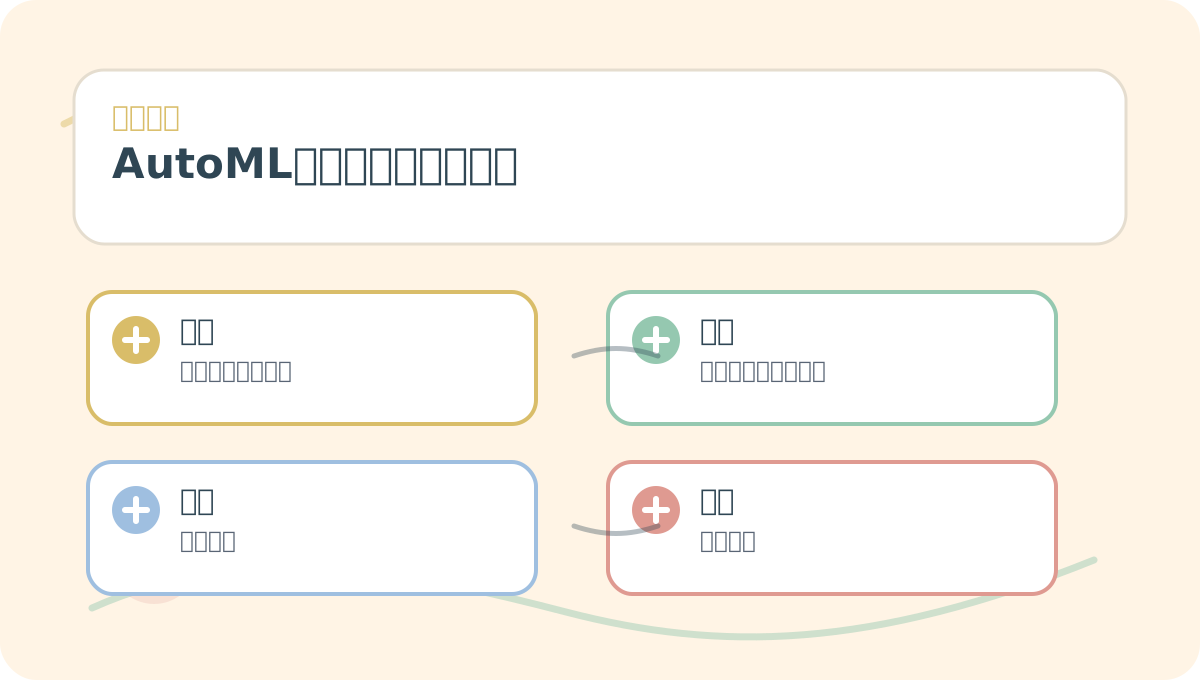
Read “AutoML Workflow: Model Evaluation” through four lenses: Scenario, Concept, Action, and Outcome. Align these four dimensions first—then revisit parameters, code, or workflow details in the main text.
import numpy as np
from sklearn.datasets import load_iris
from sklearn.model_selection import train_test_split, cross_val_score
from sklearn.ensemble import RandomForestClassifier
from sklearn.metrics import accuracy_score, precision_score, recall_score, f1_score

# Load data
data = load_iris()
X = data.data
y = data.target

# Split data: 30% for testing
X_train, X_test, y_train, y_test = train_test_split(X, y, test_size=0.3, random_state=42)

# Define model
model = RandomForestClassifier()

# Train model
model.fit(X_train, y_train)

# Generate predictions
y_pred = model.predict(X_test)

# Evaluate model
accuracy = accuracy_score(y_test, y_pred)
precision = precision_score(y_test, y_pred, average='weighted')
recall = recall_score(y_test, y_pred, average='weighted')
f1 = f1_score(y_test, y_pred, average='weighted')

print(f"Accuracy: {accuracy:.2f}")
print(f"Precision: {precision:.2f}")
print(f"Recall: {recall:.2f}")
print(f"F1-score: {f1:.2f}")

# Apply 5-fold cross-validation
cv_scores = cross_val_score(model, X, y, cv=5)
print(f"Cross-validated Accuracy: {np.mean(cv_scores):.2f}")
In this example, we use RandomForestClassifier for a classification task and evaluate accuracy, precision, recall, and F1-score on the held-out test set. Cross-validation further strengthens confidence in model performance estimates.

After reading this article, consolidate “AutoML Workflow: Model Evaluation” into a retrospective table: clarify the core narrative first, then validate it using a small concrete task.
After finishing “AutoML Workflow: Model Evaluation”, try executing the full workflow on a small sample—then identify which steps you can now perform independently.
Closing Remarks
Model evaluation is an indispensable step in the AutoML workflow—it validates model effectiveness and operational reliability. Selecting appropriate metrics aligned with the task objective—and applying rigorous techniques like cross-validation—are essential for trustworthy assessment.
In the next article, we’ll explore popular AutoML tools and demonstrate how to implement these evaluation practices in real-world settings.
Apply This Lesson
Turn this article into AI software, model, API, and security decisions.
English Article FAQ
Use this article as evidence before choosing AI tools
How should I use this AI Tutorials article?
Use it as the implementation or learning layer, then connect the idea to AI software buyer guides, tool comparisons, benchmarks, API choices, and security checks before making a production decision.
Is this English article different from the Chinese original?
The English edition is localized for global AI readers while preserving the original diagrams, screenshots, prompts, code examples, and source context from the Chinese article.
What should I read after Load data?
Continue with AI Software Buyer Guides, AI Tools Workbench, Best AI Coding Agents, AI Model Benchmarks, OpenAI vs Anthropic API, or LLM Security Tools depending on the decision you need to make.
Can this article alone choose an AI product or model?
No. Treat the article as evidence and context, then validate fit with pricing, privacy requirements, integration effort, benchmark results, workflow tests, and fallback planning.
Continue