English translation
Introduction: Course Objectives and Overview
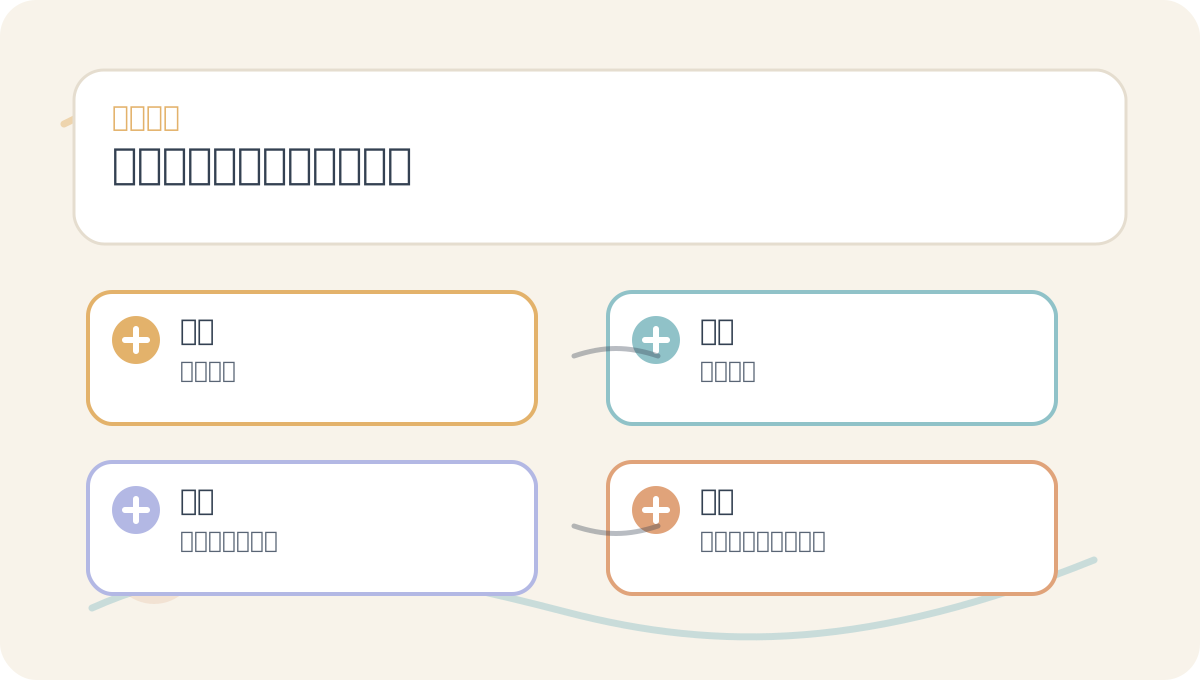
AI Article Decision Snapshot
Turn the lesson into workflow, model, budget, and security checks before choosing tools.
Use this quick snapshot before leaving the article. It keeps the next search tied to practical AI software, model/API, cost, privacy, and implementation questions.
Workflow fit
Identify the real job behind the article: coding, research, document review, support, analytics, content, or internal automation.
Model or tool decision
Decide whether the next step is a software shortlist, an AI tool comparison, an API platform choice, or a model benchmark.
Budget and usage signal
Estimate seats, API calls, prompt volume, retries, review time, and fallback work before assuming the workflow is cheap.
Security and privacy review
Check whether source code, customer data, private documents, prompts, logs, or embeddings will enter the AI workflow.

The core of Bayesian learning lies in combining prior beliefs with new evidence while explicitly representing uncertainty. As you read, structure your understanding around the sequence “Course Objectives → Course Content → Prior → Likelihood,” then return to the code, case studies, or evaluation metrics in the main text for verification.

After reading, validate your understanding using a small, realistic task: identify what the inputs are, where the processing steps occur, and whether the outputs are verifiable; if something fails, first consult the “Course Objectives,” then the “Course Content.”
In today’s rapidly evolving data science landscape, an increasing number of researchers and practitioners recognize the importance of mastering Bayesian learning and statistical inference. This course aims to equip participants with a deep foundational understanding of Bayesian learning—helping them grasp both the underlying theory and practical techniques—thereby enhancing their capabilities in data analysis and machine learning.
Course Objectives
The primary objectives of this tutorial include:

The essence of Bayesian learning is not memorizing a single formula, but learning how to integrate existing beliefs with new evidence. When confronting uncertain problems, this mindset is more valuable than any one-off conclusion.
-
Understand Bayes’ Theorem: Participants will gain a thorough understanding of the principles behind Bayes’ Theorem and its role in data analysis. Through intuitive model explanations, learners will be able to flexibly apply Bayes’ Theorem in real-world scenarios.
-
Master Bayesian Inference Techniques: We will introduce several key Bayesian inference methods—including posterior estimation and Markov Chain Monte Carlo (MCMC). Learners will acquire the skills to extract posterior distributions from data and perform related inferences.
-
Apply the Bayesian Framework to Real-World Problems: Through vivid case studies, this tutorial demonstrates how Bayesian learning can be applied in practice. Learners will explore how to conduct Bayesian data analysis using tools such as Python and R.
-
Compare Bayesian and Frequentist Approaches: We will examine the similarities and differences between Bayesian learning and traditional frequentist statistical methods—delving into their philosophical foundations and respective strengths and limitations.
-
Develop Critical Thinking Skills: Through case discussions and hands-on exercises, participants will cultivate critical thinking abilities to assess the reasonableness and effectiveness of different statistical models in specific contexts.
Course Content
Below are the main modules covered in this course:

When practicing “Introduction: Course Objectives and Content Overview,” we recommend writing the input conditions, processing actions, and observable outcomes together—making future review easier.

When reviewing “Introduction: Course Objectives and Content Overview,” we recommend placing key concepts, procedural steps, and observable outcomes on the same page for efficient re-examination.
Content like “Introduction: Course Objectives and Content Overview” can easily distract learners with details. First follow the central thread shown in the diagram, then return to the main text to verify the environment, inputs, outputs, and judgment criteria.
-
Introduction and Theoretical Foundations: This module introduces the historical background and fundamental concepts of Bayesian learning, clarifying its significance in modern statistics.
-
In-Depth Exploration of Bayes’ Theorem: We will rigorously analyze the mathematical formulation of Bayes’ Theorem, emphasizing the roles and importance of the prior distribution, likelihood function, and posterior distribution—and how they collectively support statistical inference.
-
Bayesian Inference Methods:
- Obtaining the posterior distribution
- MCMC methods and their implementation
-
Case Studies:
- Applying Bayesian methods to medical data analysis
- Building Bayesian models for user behavior prediction
- Using Bayesian networks in decision analysis
-
Software Tools:
- Introduction to Bayesian modeling with
PyMC3andStan - Hands-on example code to help learners get started quickly
- Introduction to Bayesian modeling with
-
Discussion and Summary: Summarize key takeaways from the course and discuss potential next steps and advanced resources for continued learning.
Through this comprehensive curriculum, learners will develop robust Bayesian learning capabilities—enabling them to navigate complex data analysis tasks with confidence and clarity. Next, we will explore the background and motivation for Bayesian learning, laying a solid foundation for the material that follows.
Apply This Lesson
Turn this article into AI software, model, API, and security decisions.
English Article FAQ
Use this article as evidence before choosing AI tools
How should I use this AI Tutorials article?
Use it as the implementation or learning layer, then connect the idea to AI software buyer guides, tool comparisons, benchmarks, API choices, and security checks before making a production decision.
Is this English article different from the Chinese original?
The English edition is localized for global AI readers while preserving the original diagrams, screenshots, prompts, code examples, and source context from the Chinese article.
What should I read after Introduction: Course Objectives and Overview?
Continue with AI Software Buyer Guides, AI Tools Workbench, Best AI Coding Agents, AI Model Benchmarks, OpenAI vs Anthropic API, or LLM Security Tools depending on the decision you need to make.
Can this article alone choose an AI product or model?
No. Treat the article as evidence and context, then validate fit with pricing, privacy requirements, integration effort, benchmark results, workflow tests, and fallback planning.
Continue