English translation
2 Introduction: Background of Bayesian Learning
AI Article Decision Snapshot
Turn the lesson into workflow, model, budget, and security checks before choosing tools.
Use this quick snapshot before leaving the article. It keeps the next search tied to practical AI software, model/API, cost, privacy, and implementation questions.
Workflow fit
Identify the real job behind the article: coding, research, document review, support, analytics, content, or internal automation.
Model or tool decision
Decide whether the next step is a software shortlist, an AI tool comparison, an API platform choice, or a model benchmark.
Budget and usage signal
Estimate seats, API calls, prompt volume, retries, review time, and fallback work before assuming the workflow is cheap.
Security and privacy review
Check whether source code, customer data, private documents, prompts, logs, or embeddings will enter the AI workflow.

Bayesian learning centers on integrating prior judgments with new evidence while explicitly representing uncertainty. As you read, structure your understanding along the following progression: Foundations of Bayesian Theory → From Classical Statistics to Bayesian Learning → Application Domains of Bayesian Learning → Advantages and Challenges of Bayesian Learning. Then, return to the code snippets, case studies, or metrics in the main text to verify and reinforce each concept.

After reading, test your understanding using a small, realistic task: identify what the input is, where the processing occurs, and whether the output is verifiable and actionable. If the task fails, first revisit Foundations of Bayesian Theory, then proceed to From Classical Statistics to Bayesian Learning.
Bayesian learning—a key branch of statistical inference—is gaining increasing attention among researchers and practitioners. Its core idea originates from Bayes’ theorem: a powerful tool for updating probabilistic beliefs. In modern machine learning and data science, Bayesian methods offer a natural and flexible framework for handling uncertainty—an essential capability across many real-world applications.
1. Foundations of Bayesian Theory
Bayes’ theorem can be expressed concisely as:

When studying the background of Bayesian learning, focus on why it is well-suited for reasoning under uncertainty. The interplay among prior judgment, observed evidence, and updated conclusion forms the essence of this approach.
Here, denotes the posterior probability—the probability that hypothesis is true given observed data ; is the likelihood—the probability of observing data assuming holds; is the prior probability of , reflecting pre-existing knowledge or belief; and is the marginal probability of observing , acting as a normalizing constant. In this way, Bayesian learning emphasizes updating our beliefs by combining past experience (the prior) with current evidence (the likelihood).
2. From Classical Statistics to Bayesian Learning
Classical statistical inference largely adopts a frequentist perspective—focusing on long-run behavior over repeated experiments. In contrast, Bayesian learning offers an alternative interpretation of probability: as a quantitative measure of uncertainty and degree of belief. This conceptual shift grants Bayesian learning greater flexibility in practice—especially when information is incomplete or sample sizes are small.
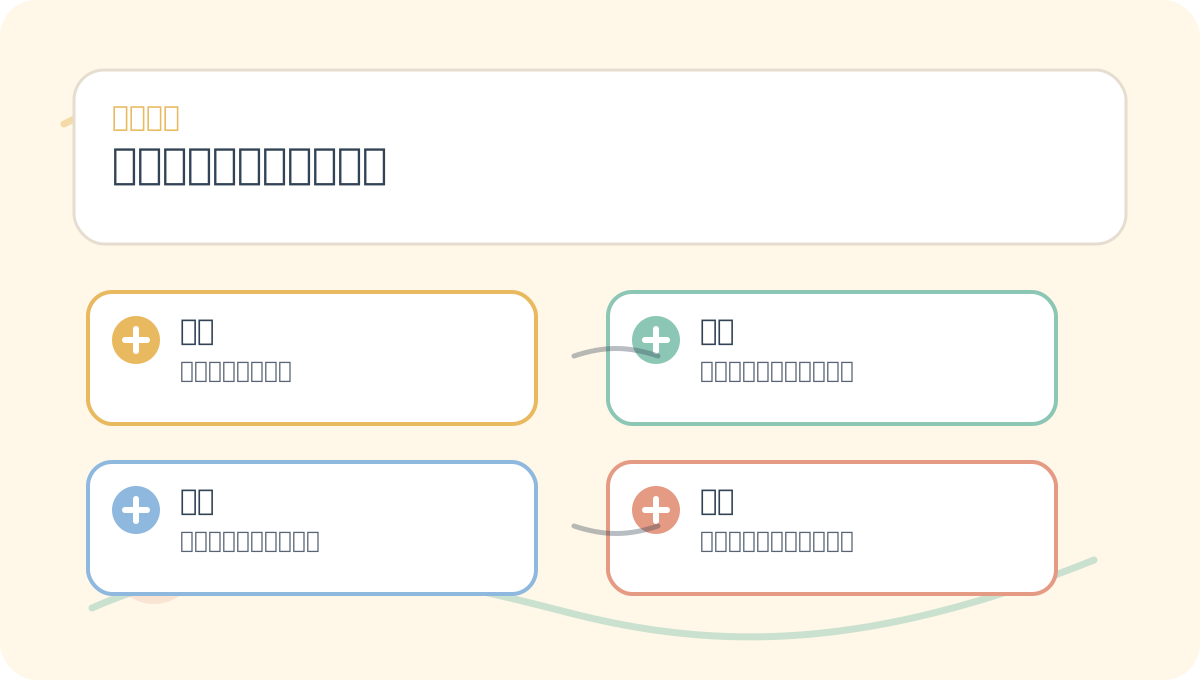
By the end of Introduction: Background of Bayesian Learning, treat the diagram’s workflow as a checklist: Is the problem clearly defined? Are operations concrete and implementable? Can evaluation criteria be reused across contexts?
For example, in medicine, physicians routinely combine a patient’s medical history (prior knowledge) with presenting symptoms (new evidence) to arrive at a diagnosis. Bayesian learning provides a natural formal framework for this process—enabling clinicians to iteratively refine their hypotheses about underlying causes as new symptom data become available.
3. Application Domains of Bayesian Learning
Bayesian learning enjoys broad applicability across numerous fields, including the following key domains:
-
Natural Language Processing (NLP): In text classification tasks, Bayesian algorithms—such as the Naïve Bayes classifier—efficiently handle large-scale textual data and support automatic model adaptation.
from sklearn.naive_bayes import MultinomialNB from sklearn.feature_extraction.text import CountVectorizer # Example data docs = ["I love learning", "I enjoy programming", "Learning makes me happy"] labels = [1, 0, 1] # 1 = positive sentiment, 0 = negative sentiment vectorizer = CountVectorizer() X = vectorizer.fit_transform(docs) model = MultinomialNB() model.fit(X, labels) -
Financial Modeling: In risk assessment and investment decision-making, Bayesian methods quantify uncertainty and integrate historical data to support robust, evidence-informed decisions.
-
Bioinformatics: In genomic data analysis, Bayesian networks capture complex genetic dependencies and deliver predictive insights.
4. Advantages and Challenges of Bayesian Learning
Compared with classical frequentist approaches, Bayesian learning offers several distinct advantages:
-
Natural Incorporation of Prior Information: Bayesian learning allows domain expertise to be formally encoded into models—enhancing predictive performance, especially in low-data regimes.
-
Uncertainty-Aware Inference: Bayesian models inherently yield full posterior distributions over parameters or predictions, enabling principled risk-aware decision-making.
However, Bayesian learning also faces notable challenges—for instance, computing posterior distributions becomes computationally demanding in high-dimensional settings. Consequently, developing efficient approximation and inference techniques remains an active area of research.

After completing Introduction: Background of Bayesian Learning, try applying it to a scenario of your own—paying close attention to whether inputs, processing steps, and outputs align coherently.

To apply Introduction: Background of Bayesian Learning to your own task, begin by narrowing the scope—focus first on validating just one critical inference point.
5. Summary
As a modern paradigm of statistical inference, Bayesian learning stands out for its distinctive conceptual lens and strong practical utility across disciplines. Subsequent sections will delve deeper into foundational concepts of statistical inference—clarifying how Bayesian learning fits within, extends, and enriches those ideas. Mastering these fundamentals equips you to apply Bayesian techniques effectively to real-world problems—and to explore novel frontiers where uncertainty quantification and adaptive learning are paramount.
Apply This Lesson
Turn this article into AI software, model, API, and security decisions.
English Article FAQ
Use this article as evidence before choosing AI tools
How should I use this AI Tutorials article?
Use it as the implementation or learning layer, then connect the idea to AI software buyer guides, tool comparisons, benchmarks, API choices, and security checks before making a production decision.
Is this English article different from the Chinese original?
The English edition is localized for global AI readers while preserving the original diagrams, screenshots, prompts, code examples, and source context from the Chinese article.
What should I read after 2 Introduction: Background of Bayesian Learning?
Continue with AI Software Buyer Guides, AI Tools Workbench, Best AI Coding Agents, AI Model Benchmarks, OpenAI vs Anthropic API, or LLM Security Tools depending on the decision you need to make.
Can this article alone choose an AI product or model?
No. Treat the article as evidence and context, then validate fit with pricing, privacy requirements, integration effort, benchmark results, workflow tests, and fallback planning.
Continue