English translation
Prior distribution parameters
AI Article Decision Snapshot
Turn the lesson into workflow, model, budget, and security checks before choosing tools.
Use this quick snapshot before leaving the article. It keeps the next search tied to practical AI software, model/API, cost, privacy, and implementation questions.
Workflow fit
Identify the real job behind the article: coding, research, document review, support, analytics, content, or internal automation.
Model or tool decision
Decide whether the next step is a software shortlist, an AI tool comparison, an API platform choice, or a model benchmark.
Budget and usage signal
Estimate seats, API calls, prompt volume, retries, review time, and fallback work before assuming the workflow is cheap.
Security and privacy review
Check whether source code, customer data, private documents, prompts, logs, or embeddings will enter the AI workflow.

The core focus of Bayesian learning is to integrate prior beliefs with new evidence while explicitly representing uncertainty. As you read, structure your understanding around the following sequence:
Core Goal of Statistical Inference → Example: Point and Interval Estimation of the Mean → Comparison of Bayesian vs. Classical Statistics → Code Case Study: Bayesian Updating,
then return to the code, examples, or metrics in the main text for verification.

After reading, verify your understanding using a small real-world task:
- What are the inputs?
- Where does processing occur?
- Is the output verifiable and actionable?
If something fails, first revisit the Core Goal of Statistical Inference, then check the Example: Point and Interval Estimation of the Mean.
In the previous article, we explored the background of Bayesian learning, emphasizing how to incorporate uncertainty into practical decision-making. Next, we delve into the fundamental concepts of statistical inference—a critical component of Bayesian learning, especially when applying Bayes’ theorem.
Core Goal of Statistical Inference
The core goal of statistical inference is to draw conclusions about population (or “parent”) characteristics or parameters based on sample data. Typically, we aim to infer general patterns from limited observations. Accordingly, statistical inference falls into two broad categories: point estimation and interval estimation.

When learning statistical inference, focus on the relationships among sample, population, estimator, and confidence level. A single number alone is insufficient—you must also quantify how reliable that estimate is.
-
Point Estimation: Using sample data to compute a single value as an estimate of a population parameter. For example, the sample mean is commonly used to estimate the population mean. Given a sample , the sample mean is:
-
Interval Estimation: Providing a range of values likely to contain the true population parameter. For instance, a confidence interval expresses the plausible range for the population mean—typically constructed from the sample mean and standard error. A 95% confidence interval takes the form:
where is the critical value from the standard normal distribution, is the sample standard deviation, and is the sample size.
Example: Point and Interval Estimation of the Mean
Suppose we wish to estimate the average exam score of students at a university. We randomly select 10 students, whose scores are:
68, 72, 75, 70, 64, 80, 82, 77, 60, 74
-
First, compute the sample mean:
-
Next, compute the sample standard deviation :
If , the 95% confidence interval becomes:
This means we are 95% confident that the true population mean lies between 68.30 and 75.70.
Bayesian vs. Classical Statistics: A Comparison
Traditional statistical inference typically adopts a frequentist perspective, whereas Bayesian statistics rests on subjective probability. Frequentist inference focuses on the sampling distribution of estimators—what would happen if we repeated the experiment many times—while Bayesian inference centers on updating prior knowledge with observed data to obtain a posterior distribution.
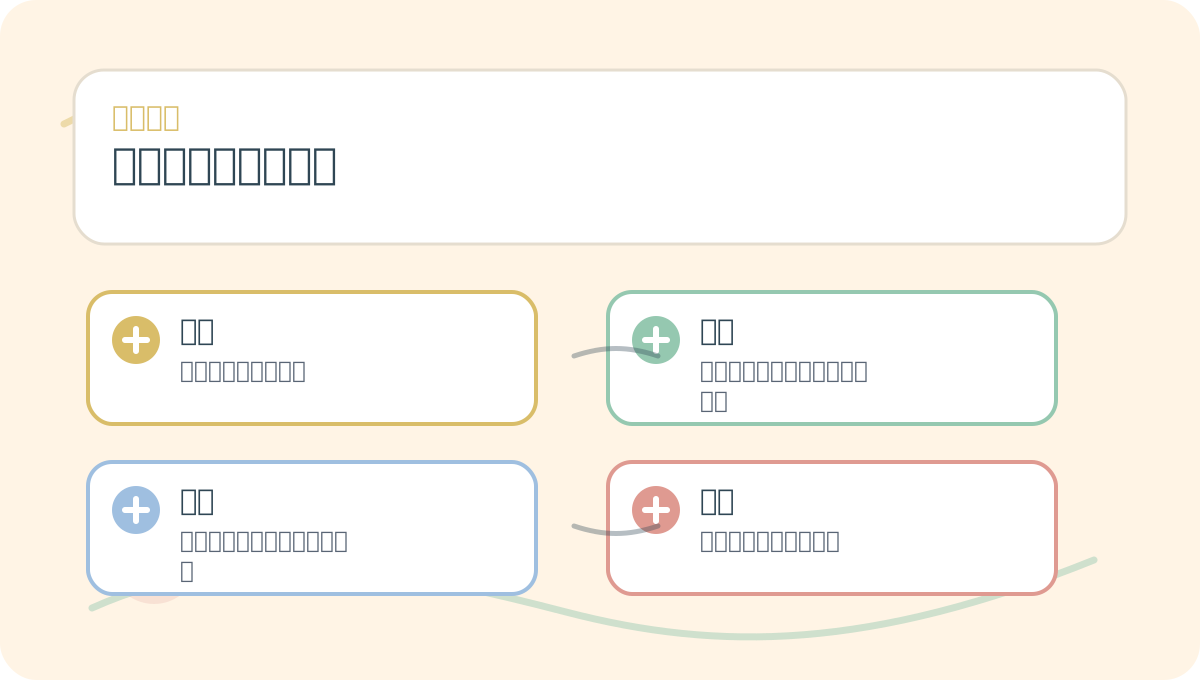
Read “Fundamental Concepts of Statistical Inference” through the lens of Scenario → Concept → Action → Outcome. First align these four elements, then revisit the parameters, code, or workflow in the main text.
- In classical statistics, a point estimate for the population mean yields only a single number—without quantifying uncertainty.
- In contrast, the Bayesian framework combines a prior distribution with data to produce a posterior distribution. This enables richer characterization of uncertainty—not just “what’s the best guess?” but “how uncertain are we about that guess?”
Code Example: Bayesian Updating
Below is a simple Python implementation demonstrating Bayesian inference for the mean:
import numpy as np
import matplotlib.pyplot as plt
import scipy.stats as stats

# Prior distribution parameters
mu_prior = 70
sigma_prior = 10

# Observed data
data = [68, 72, 75, 70, 64, 80, 82, 77, 60, 74]
n = len(data)
mu_sample = np.mean(data)
sigma_sample = np.std(data, ddof=1)

# Posterior mean and standard deviation
mu_posterior = (sigma_prior**2 * mu_sample + sigma_sample**2 * mu_prior) / (sigma_prior**2 + sigma_sample**2)
sigma_posterior = np.sqrt(1 / (1/sigma_prior**2 + 1/sigma_sample**2))

# Plot prior and posterior distributions
x = np.linspace(50, 90, 100)
prior = stats.norm(mu_prior, sigma_prior).pdf(x)
posterior = stats.norm(mu_posterior, sigma_posterior).pdf(x)

plt.plot(x, prior, label='Prior Distribution', color='blue')
plt.plot(x, posterior, label='Posterior Distribution', color='red')
plt.legend()
plt.title('Prior vs Posterior Distribution')
plt.xlabel('Test Scores')
plt.ylabel('Density')
plt.show()
This code defines prior distribution parameters, computes the posterior distribution given observed data, and visualizes both prior and posterior densities. The plot intuitively illustrates how Bayesian inference updates our beliefs in light of new evidence.

If you haven’t fully internalized “Fundamental Concepts of Statistical Inference,” walk through the four actions on this card again.

When reviewing “Fundamental Concepts of Statistical Inference,” avoid tackling large projects upfront. Instead, use a single, simple example to confirm whether the core logic is clear.
Summary
In this article, we introduced the fundamental concepts of statistical inference—including definitions and calculations for point estimation and interval estimation—and highlighted key differences between classical (frequentist) and Bayesian approaches. These foundational ideas set the stage for our next step: a detailed derivation of Bayes’ theorem, and an exploration of its central role in statistical inference.
Apply This Lesson
Turn this article into AI software, model, API, and security decisions.
English Article FAQ
Use this article as evidence before choosing AI tools
How should I use this AI Tutorials article?
Use it as the implementation or learning layer, then connect the idea to AI software buyer guides, tool comparisons, benchmarks, API choices, and security checks before making a production decision.
Is this English article different from the Chinese original?
The English edition is localized for global AI readers while preserving the original diagrams, screenshots, prompts, code examples, and source context from the Chinese article.
What should I read after Prior distribution parameters?
Continue with AI Software Buyer Guides, AI Tools Workbench, Best AI Coding Agents, AI Model Benchmarks, OpenAI vs Anthropic API, or LLM Security Tools depending on the decision you need to make.
Can this article alone choose an AI product or model?
No. Treat the article as evidence and context, then validate fit with pricing, privacy requirements, integration effort, benchmark results, workflow tests, and fallback planning.
Continue