English translation
In the previous article, we thoroughly explored LangChain’s background and design goals, gaining insight into its significance and potential in modern applications. Next, we’ll dive into concrete, real-world use cases to demonstrate how LangChain empowers developers and enterprises—and boosts productivity.
AI Article Decision Snapshot
Turn the lesson into workflow, model, budget, and security checks before choosing tools.
Use this quick snapshot before leaving the article. It keeps the next search tied to practical AI software, model/API, cost, privacy, and implementation questions.
Workflow fit
Identify the real job behind the article: coding, research, document review, support, analytics, content, or internal automation.
Model or tool decision
Decide whether the next step is a software shortlist, an AI tool comparison, an API platform choice, or a model benchmark.
Budget and usage signal
Estimate seats, API calls, prompt volume, retries, review time, and fallback work before assuming the workflow is cheap.
Security and privacy review
Check whether source code, customer data, private documents, prompts, logs, or embeddings will enter the AI workflow.
LangChain excels at integrating large language models (LLMs) into real-world workflows—especially tasks that require reading documents, invoking external tools, or producing outputs in multiple sequential steps. It is not suitable for masking unclear or poorly defined requirements.
Before deciding whether a scenario is viable for LangChain, ask three key questions:
- Where is the source material?
- How will users phrase their queries?
- Who fixes it if the answer is wrong?
If you cannot clearly articulate all three, avoid building complex chains just yet.
In the previous article, we thoroughly explored LangChain’s background and design goals, gaining insight into its significance and potential in modern applications. Next, we’ll dive into concrete, real-world use cases to demonstrate how LangChain empowers developers and enterprises—and boosts productivity.
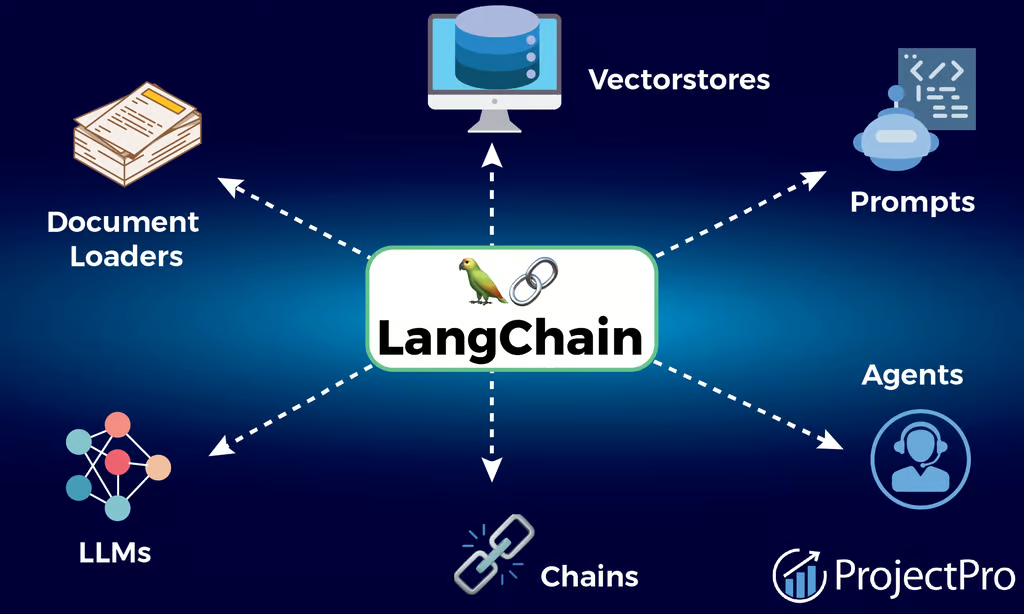
1. Chatbots
A prominent application is building chatbots with natural language understanding capabilities. With LangChain, you can rapidly develop bots that interpret user intent and generate contextually relevant responses. For example, on an e-commerce platform, users can ask natural-language questions about product details—such as real-time stock or specifications—and the chatbot leverages LangChain to extract key information and formulate accurate replies.
from langchain import ChatBot

# Create a chatbot instance
chatbot = ChatBot("E-commerce Bot")

# User query
user_input = "How long does the battery last on this phone?"
response = chatbot.answer(user_input)

print(response)  # Output: The battery life of this phone lasts approximately 24 hours.
2. Code Assistants
In software development, LangChain serves as an intelligent code assistant, helping developers write and debug code more efficiently. Such assistants not only generate code snippets but also offer actionable suggestions for improvement. For instance, when a developer needs to implement a sorting algorithm, LangChain can provide immediate, high-quality support:
from langchain import CodeAssistant

# Create a code assistant instance
code_assistant = CodeAssistant()

# Request a sorting algorithm implementation
code_request = "Please provide a Python implementation of the quicksort algorithm."
generated_code = code_assistant.generate_code(code_request)

print(generated_code)  # Output: The generated quicksort code.
3. Document Generation
Another critical use case is automated document generation. In enterprise settings, manual documentation is often time-consuming and error-prone. Using LangChain, teams can auto-generate structured documents—such as project reports, user manuals, or compliance summaries—based on input data and predefined templates. Here's a simple example:
from langchain import DocumentGenerator

# Create a document generator instance
doc_generator = DocumentGenerator()

# Input basic project information
project_info = {
    "Project Name": "New Product Development",
    "Lead": "Zhang San",
    "Deadline": "December 31, 2023"
}

# Generate a project report
report = doc_generator.create_report(project_info)

print(report)  # Output: The generated project report content.
4. Language Translation
Multilingual support is essential for global enterprises. LangChain can power high-fidelity translation services capable of bidirectional conversion across numerous languages. Leveraging its robust natural language processing and generation capabilities, developers can build scalable, domain-aware translation systems—crucial for cross-border communication and market expansion.
from langchain import Translator

# Create a translator instance
translator = Translator()

# Translation example
text_to_translate = "Hello, how can I help you?"
translated_text = translator.translate(text_to_translate, target_language='Chinese')

print(translated_text)  # Output: Hello, how can I help you?
After studying “LangChain Use Cases”, try adapting it to your own scenario. Focus especially on whether inputs, processing logic, and outputs align coherently.
To apply “LangChain Use Cases” to your own task, start by narrowing the scope—validate just one critical decision point first.
Conclusion
The examples above represent only a small subset of LangChain’s broad applicability. From chatbots and code assistants to document generation and translation services, LangChain’s powerful NLP and generative capabilities make it a versatile enabler across industries. As we progressively unpack LangChain’s core concepts and foundational building blocks, you’ll discover its wide-ranging practical utility—and the exciting possibilities it unlocks.
In the next article, we’ll comprehensively explore LangChain’s fundamental concepts and underlying mechanics—deepening your understanding of this powerful framework. Stay tuned!
While reading “LangChain Use Cases”, first clarify the specific problem or scenario you aim to solve. Then connect key concepts and hands-on exercises into a coherent mental model. This approach helps you retain meaning—not just isolated terminology—when diving into technical details.
Apply This Lesson
Turn this article into AI software, model, API, and security decisions.
English Article FAQ
Use this article as evidence before choosing AI tools
How should I use this AI Tutorials article?
Use it as the implementation or learning layer, then connect the idea to AI software buyer guides, tool comparisons, benchmarks, API choices, and security checks before making a production decision.
Is this English article different from the Chinese original?
The English edition is localized for global AI readers while preserving the original diagrams, screenshots, prompts, code examples, and source context from the Chinese article.
What should I read after In the previous article, we thoroughly explored LangChain’s background and design goals, gaining insight into its significance and potential in modern applications. Next, we’ll dive into concrete, real-world use cases to demonstrate how LangChain empowers developers and enterprises—and boosts productivity.?
Continue with AI Software Buyer Guides, AI Tools Workbench, Best AI Coding Agents, AI Model Benchmarks, OpenAI vs Anthropic API, or LLM Security Tools depending on the decision you need to make.
Can this article alone choose an AI product or model?
No. Treat the article as evidence and context, then validate fit with pricing, privacy requirements, integration effort, benchmark results, workflow tests, and fallback planning.
Continue