English translation
Initialize the language model
AI Article Decision Snapshot
Turn the lesson into workflow, model, budget, and security checks before choosing tools.
Use this quick snapshot before leaving the article. It keeps the next search tied to practical AI software, model/API, cost, privacy, and implementation questions.
Workflow fit
Identify the real job behind the article: coding, research, document review, support, analytics, content, or internal automation.
Model or tool decision
Decide whether the next step is a software shortlist, an AI tool comparison, an API platform choice, or a model benchmark.
Budget and usage signal
Estimate seats, API calls, prompt volume, retries, review time, and fallback work before assuming the workflow is cheap.
Security and privacy review
Check whether source code, customer data, private documents, prompts, logs, or embeddings will enter the AI workflow.
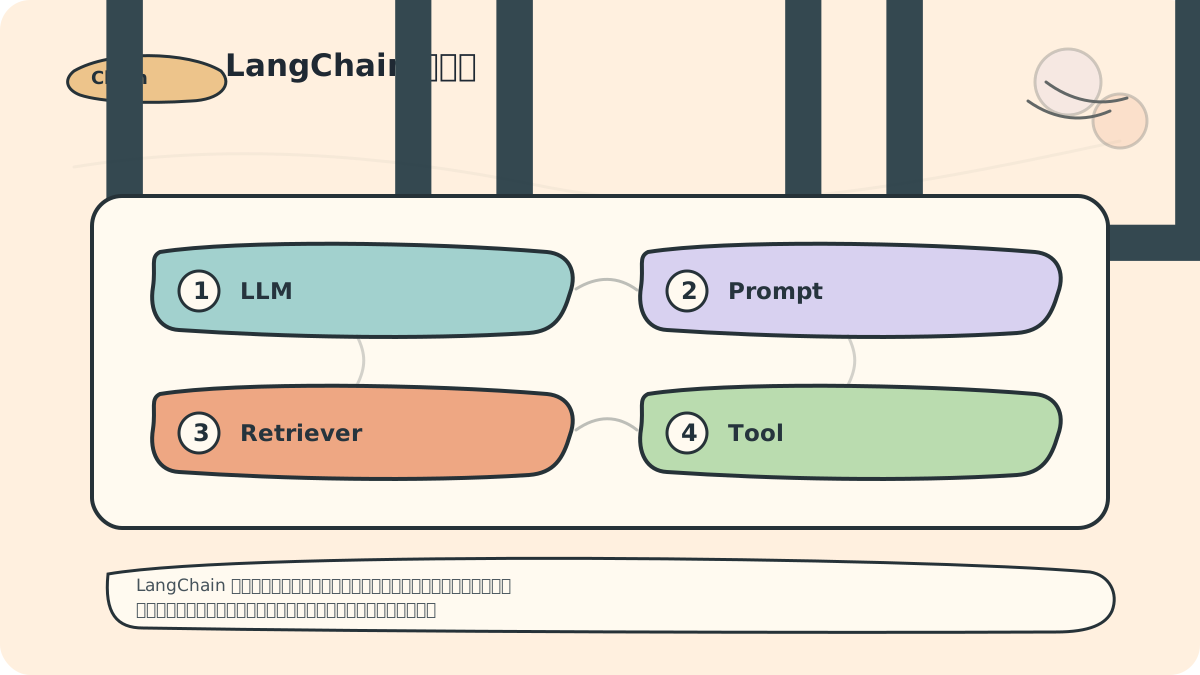
LangChain’s value lies in organizing models, prompts, retrieval, tools, and output parsing into composable code structures. Don’t mistake it for a new model—it’s more like an application-layer scaffolding framework.
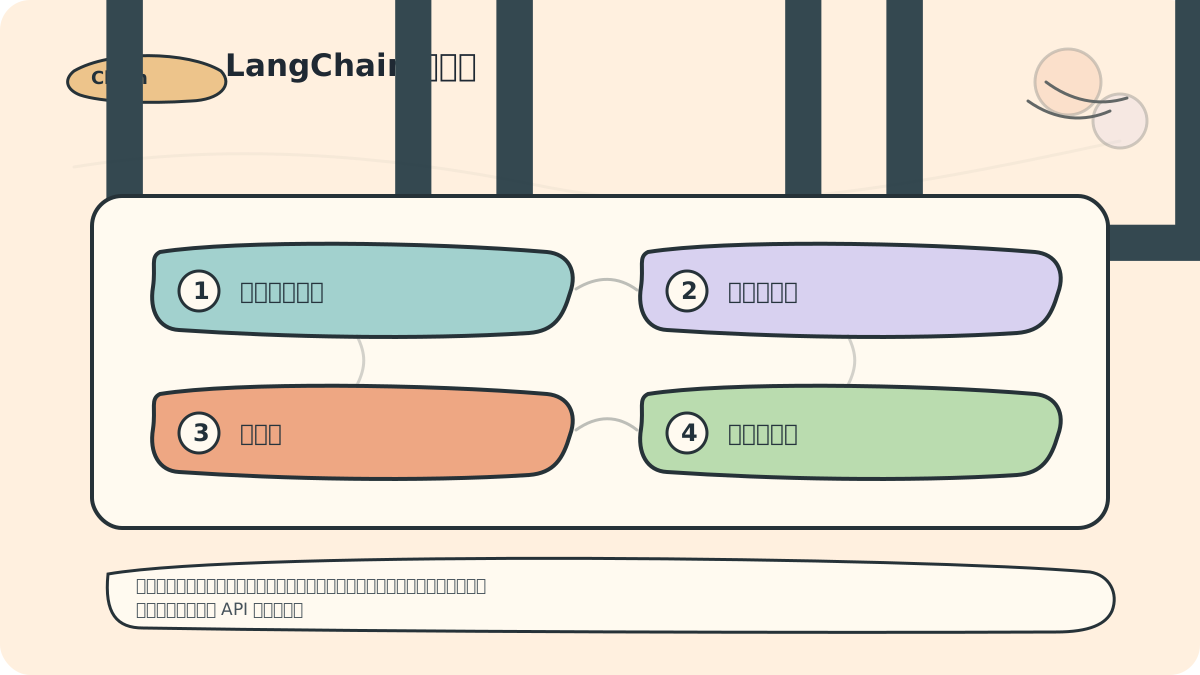
When learning, distill each component into a single sentence: What does it accept as input? What does it produce as output? And which step breaks if it fails? This approach is far more useful than memorizing API names.
In the previous article, we explored LangChain’s use cases—how it helps developers build interactive applications with language models. Now, we’ll dive deeper into LangChain itself: what it fundamentally is, and how it delivers on that vision.
What Is LangChain?
LangChain is a framework for building applications powered by language models, designed to simplify integration with large language models (LLMs) such as GPT-3 and other AI models. It provides a suite of tools and interfaces to help developers rapidly construct robust natural language processing (NLP) applications.
When revisiting “LangChain Overview: What Is LangChain?”, you don’t need to tackle a full-scale project right away. Start with a simple, working example to verify whether the core workflow is clear.
If “LangChain Overview: What Is LangChain?” hasn’t fully clicked yet, walk through the four actions on this card to reinforce your understanding.
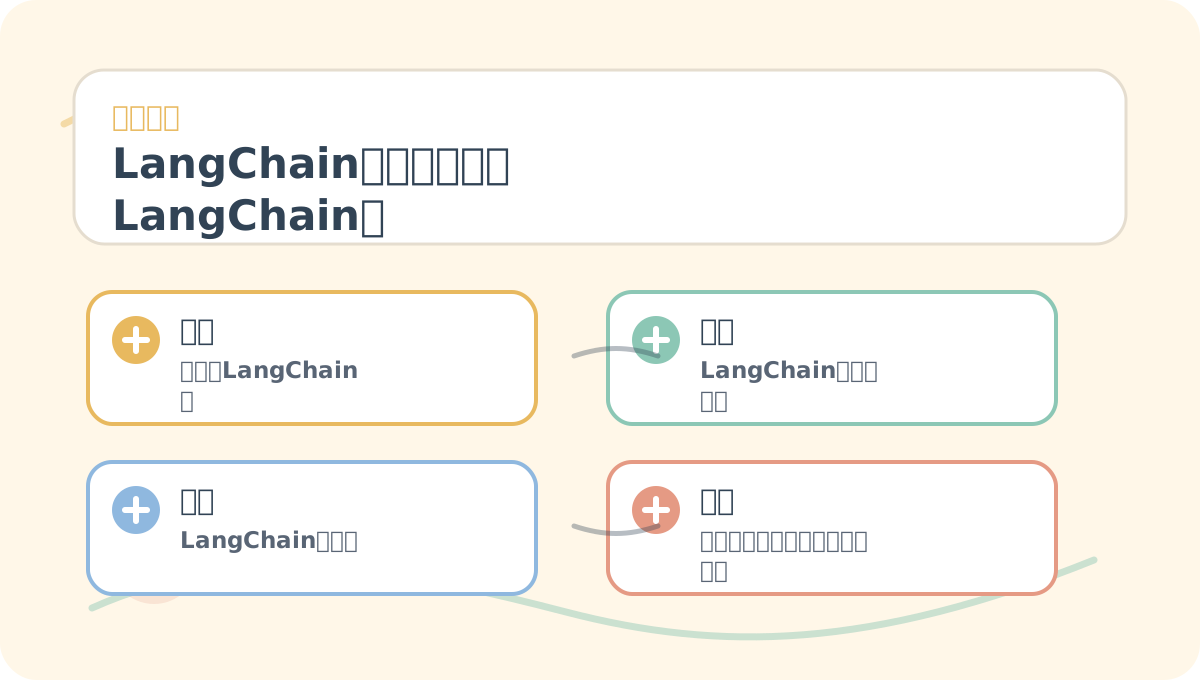
After reading “LangChain Overview: What Is LangChain?”, take one minute to reflect: — Are the key concepts clearly distinguished? — Can you reproduce the practice steps? — Can you restate the conclusions in your own words?
Key Features of LangChain
-
Modular Construction: LangChain enables developers to design applications using modular components—allowing flexible composition of functionality. For instance, you can use the
text-processing module,question-answering module, ormemory moduleindependently, then wire them together into a complete application. -
Diverse Model Integration: It supports integration with a wide range of language models—including OpenAI’s models, Hugging Face models, and custom models—making it easy to plug any LLM into your project.
-
Flexibility: LangChain lets users define custom workflows tailored to specific application needs. For example, if you’re building an intelligent assistant that adapts to user preferences over time, LangChain’s memory mechanisms become essential.
-
Ease of Debugging and Testing: The framework includes built-in debugging utilities, enabling developers to quickly test and optimize model behavior—a critical advantage for iterative development.
LangChain Architecture
LangChain’s architecture consists of several layered abstractions:
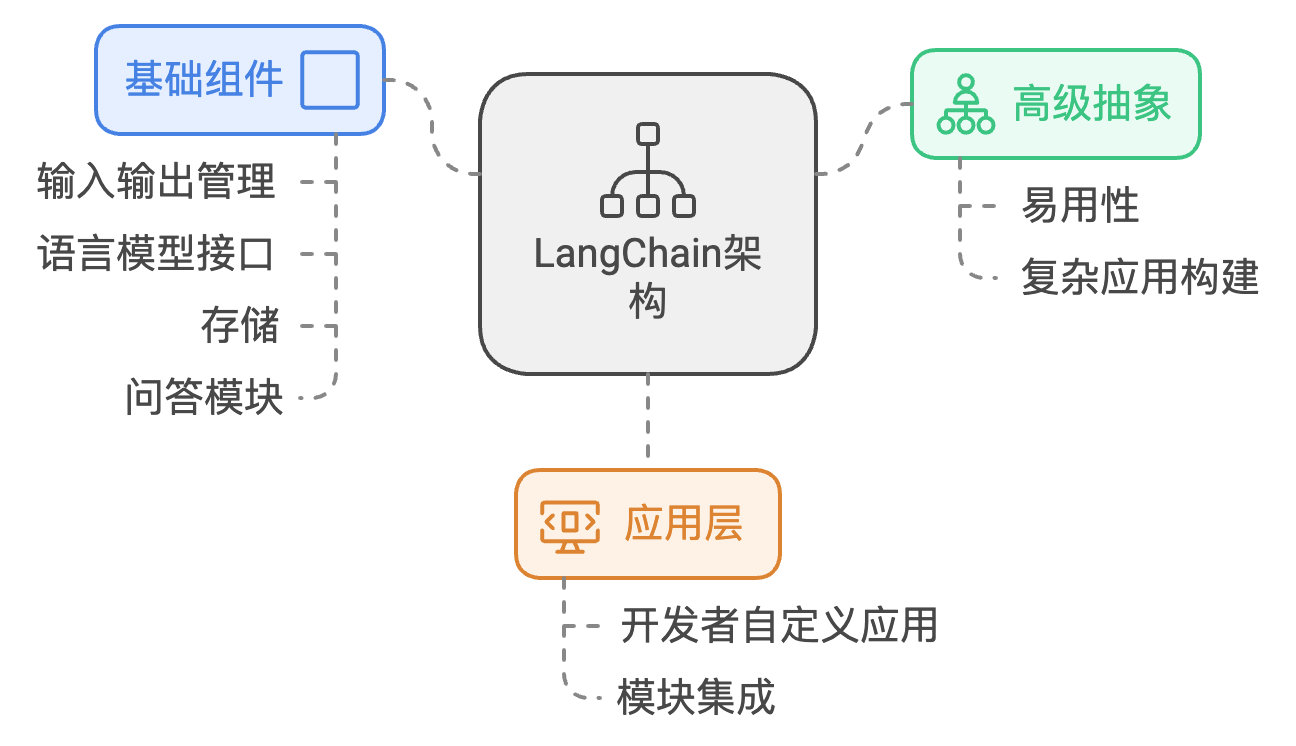
-
Core Components: These include input/output handling, language model interfaces, storage backends, and question-answering modules.
-
High-Level Abstractions: Built atop the core components, these abstractions simplify complex tasks—making it easier to assemble sophisticated applications without low-level boilerplate.
-
Application Layer: At this topmost level, developers build their own end-user applications, integrating various modules to deliver domain-specific functionality.
Example: Building a Simple Chatbot
To better understand LangChain in action, let’s walk through a minimal example: building a chatbot capable of answering basic questions.
from langchain import ConversationChain, OpenAI
from langchain.memory import ConversationBufferMemory

# Initialize the language model
llm = OpenAI(model_name="gpt-3.5-turbo")

# Create a memory buffer to track conversation history
memory = ConversationBufferMemory()

# Instantiate a conversation chain
conversation = ConversationChain(llm=llm, memory=memory)

# Begin interaction
response1 = conversation.predict(input="Hello! Can you tell me what LangChain is?")
print(response1)  # Prints the bot's response

response2 = conversation.predict(input="What is it used for?")
print(response2)  # Prints the bot's follow-up response
In this example, we use ConversationChain to build a basic chatbot that responds contextually. By leveraging ConversationBufferMemory, the bot retains prior exchanges—enabling more coherent, context-aware replies.
Summary
LangChain provides a powerful, developer-friendly environment for building language-model-driven applications—especially those requiring rich human-AI interaction. Its modular design and flexibility empower developers to rapidly prototype, iterate, and adapt applications to real-world needs.
In the next article, we’ll explore LangChain’s core concepts in depth—laying the groundwork for building more advanced, production-ready applications.
Apply This Lesson
Turn this article into AI software, model, API, and security decisions.
English Article FAQ
Use this article as evidence before choosing AI tools
How should I use this AI Tutorials article?
Use it as the implementation or learning layer, then connect the idea to AI software buyer guides, tool comparisons, benchmarks, API choices, and security checks before making a production decision.
Is this English article different from the Chinese original?
The English edition is localized for global AI readers while preserving the original diagrams, screenshots, prompts, code examples, and source context from the Chinese article.
What should I read after Initialize the language model?
Continue with AI Software Buyer Guides, AI Tools Workbench, Best AI Coding Agents, AI Model Benchmarks, OpenAI vs Anthropic API, or LLM Security Tools depending on the decision you need to make.
Can this article alone choose an AI product or model?
No. Treat the article as evidence and context, then validate fit with pricing, privacy requirements, integration effort, benchmark results, workflow tests, and fallback planning.
Continue