English translation
U-Net Architecture Explained
AI Article Decision Snapshot
Turn the lesson into workflow, model, budget, and security checks before choosing tools.
Use this quick snapshot before leaving the article. It keeps the next search tied to practical AI software, model/API, cost, privacy, and implementation questions.
Workflow fit
Identify the real job behind the article: coding, research, document review, support, analytics, content, or internal automation.
Model or tool decision
Decide whether the next step is a software shortlist, an AI tool comparison, an API platform choice, or a model benchmark.
Budget and usage signal
Estimate seats, API calls, prompt volume, retries, review time, and fallback work before assuming the workflow is cheap.
Security and privacy review
Check whether source code, customer data, private documents, prompts, logs, or embeddings will enter the AI workflow.
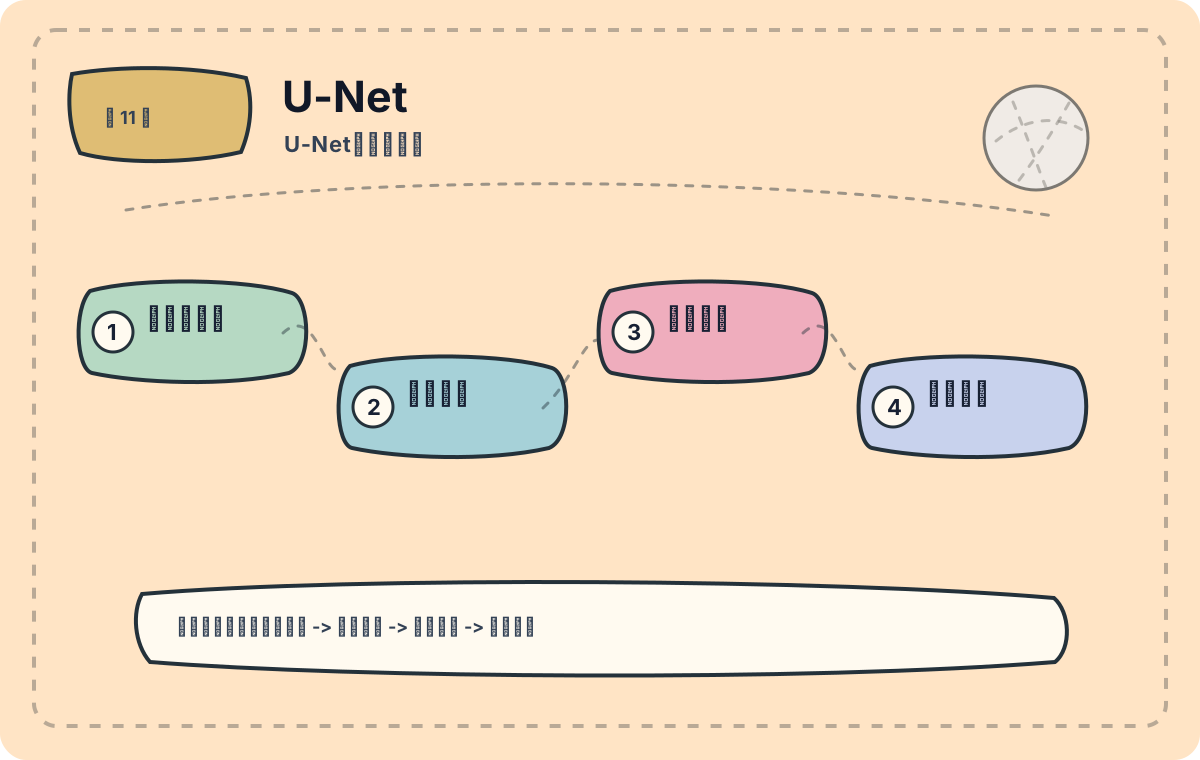
The value of U-Net lies in its dual capability: compressing semantic information while simultaneously feeding shallow, fine-grained details back into the decoder. In segmentation tasks, these skip connections typically determine whether object boundaries appear clean and precise. This article focuses specifically on architecture—first clarifying the data flow, key modules, and output layer, then revisiting formulas or code.
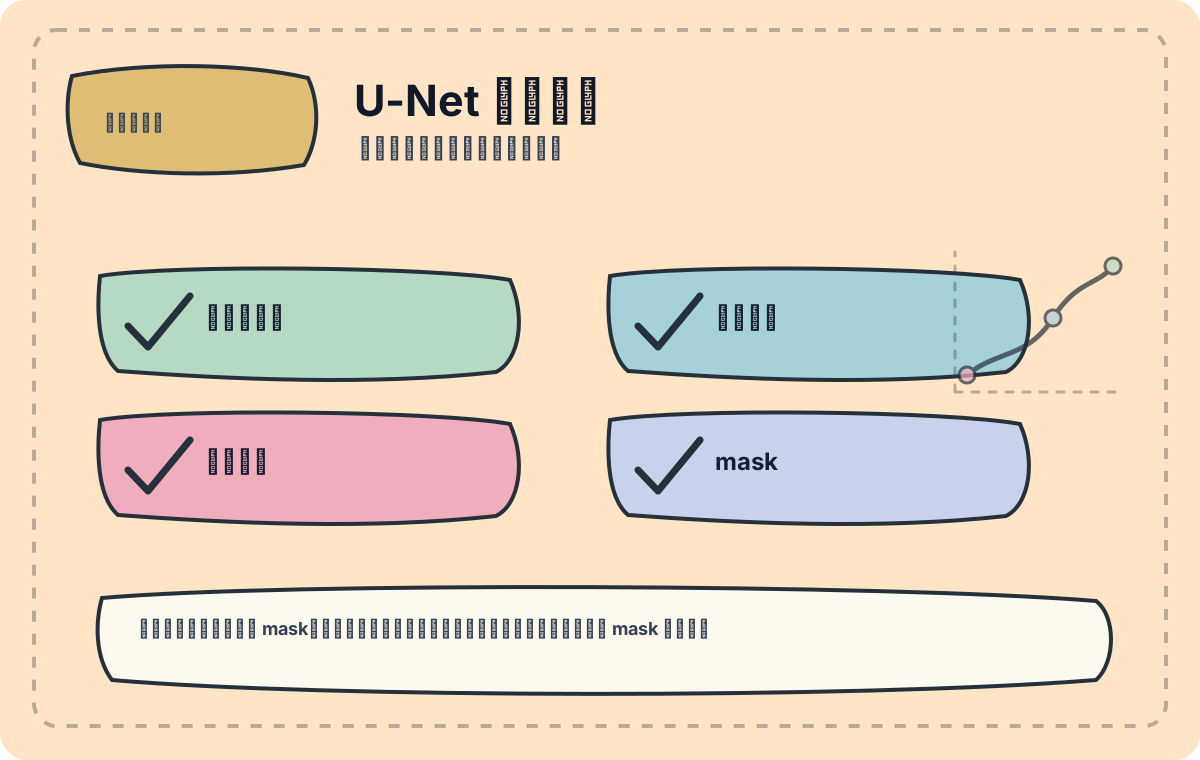
I verify alignment among input images, label masks, output dimensions, and loss functions. Misalignment between images and masks is the most common pitfall in segmentation tasks.
In the previous article, we conducted an in-depth analysis of VGG model evaluation, examining its performance, strengths, and limitations in image classification tasks. Next, we shift our focus to the U-Net deep learning architecture, dissecting its distinctive structure and design philosophy. U-Net is primarily used for image segmentation—especially excelling in biomedical image analysis.
Overview of U-Net Architecture
U-Net was proposed in 2015 by Olaf Ronneberger et al. to address biomedical image segmentation challenges. Its name derives from its architectural shape—a “U”-shaped topology. U-Net consists of two main components:
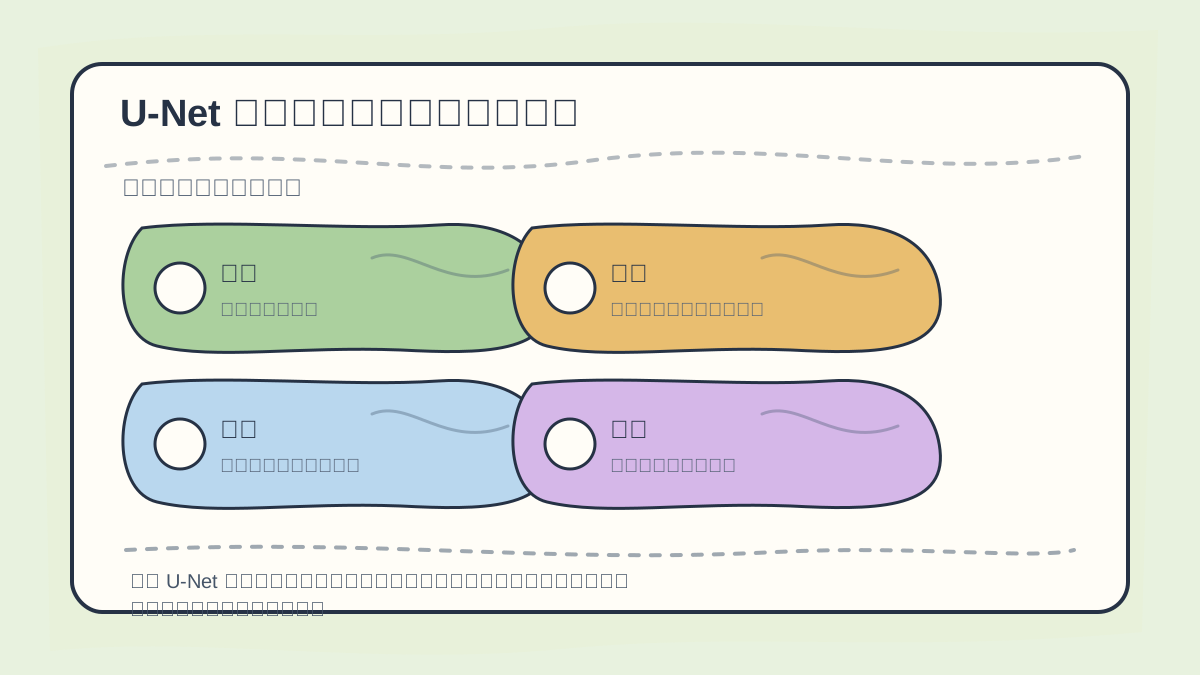
When understanding U-Net’s structure, first examine how downsampling extracts semantics, how upsampling restores spatial resolution, and how skip connections reintroduce boundary-level detail.
- Contracting Path (Encoder)
- Expansive Path (Decoder)
1. Contracting Path (Encoding Path)
Also known as the encoder, the contracting path comprises a series of convolutional layers interleaved with max pooling layers. Each convolutional block typically includes two convolutions, followed by ReLU activation and a max pooling layer. Each max pooling operation reduces the spatial dimensions of feature maps while increasing channel depth—enabling extraction of higher-level features and improving model robustness.
- Convolutional Layers: Use kernels for feature extraction.
- Pooling Layers: Apply max pooling to downsample feature maps.
2. Expansive Path (Decoding Path)
The expansive (or decoding) path progressively restores spatial resolution via upsampling. To mitigate information loss during upsampling, U-Net introduces skip connections, which concatenate feature maps from corresponding layers of the encoder and decoder. This mechanism preserves high-resolution spatial details critical for accurate segmentation.
- Upsampling Layers: Implemented using
conv_transpose(transposed convolution) or bilinear interpolation. - Concatenation Operation: Joins encoder and decoder feature maps at matching levels, ensuring effective propagation of fine-grained spatial information.
Example U-Net Architecture
Below is a simplified implementation of a U-Net model:
import tensorflow as tf
from tensorflow.keras import layers, Model

def unet_model(input_size=(256, 256, 1)):
    inputs = layers.Input(input_size)

    # Encoding path
    c1 = layers.Conv2D(64, (3, 3), activation='relu', padding='same')(inputs)
    c1 = layers.Conv2D(64, (3, 3), activation='relu', padding='same')(c1)
    p1 = layers.MaxPooling2D((2, 2))(c1)

    c2 = layers.Conv2D(128, (3, 3), activation='relu', padding='same')(p1)
    c2 = layers.Conv2D(128, (3, 3), activation='relu', padding='same')(c2)
    p2 = layers.MaxPooling2D((2, 2))(c2)

    c3 = layers.Conv2D(256, (3, 3), activation='relu', padding='same')(p2)
    c3 = layers.Conv2D(256, (3, 3), activation='relu', padding='same')(c3)
    p3 = layers.MaxPooling2D((2, 2))(c3)

    # Bottleneck
    c4 = layers.Conv2D(512, (3, 3), activation='relu', padding='same')(p3)
    c4 = layers.Conv2D(512, (3, 3), activation='relu', padding='same')(c4)

    # Decoding path
    u5 = layers.Conv2DTranspose(256, (2, 2), strides=(2, 2), padding='same')(c4)
    u5 = layers.concatenate([u5, c3])
    c5 = layers.Conv2D(256, (3, 3), activation='relu', padding='same')(u5)
    c5 = layers.Conv2D(256, (3, 3), activation='relu', padding='same')(c5)

    u6 = layers.Conv2DTranspose(128, (2, 2), strides=(2, 2), padding='same')(c5)
    u6 = layers.concatenate([u6, c2])
    c6 = layers.Conv2D(128, (3, 3), activation='relu', padding='same')(u6)
    c6 = layers.Conv2D(128, (3, 3), activation='relu', padding='same')(c6)

    u7 = layers.Conv2DTranspose(64, (2, 2), strides=(2, 2), padding='same')(c6)
    u7 = layers.concatenate([u7, c1])
    c7 = layers.Conv2D(64, (3, 3), activation='relu', padding='same')(u7)
    c7 = layers.Conv2D(64, (3, 3), activation='relu', padding='same')(c7)

    outputs = layers.Conv2D(1, (1, 1), activation='sigmoid')(c7)

    model = Model(inputs=inputs, outputs=outputs)
    return model

model = unet_model()
model.summary()
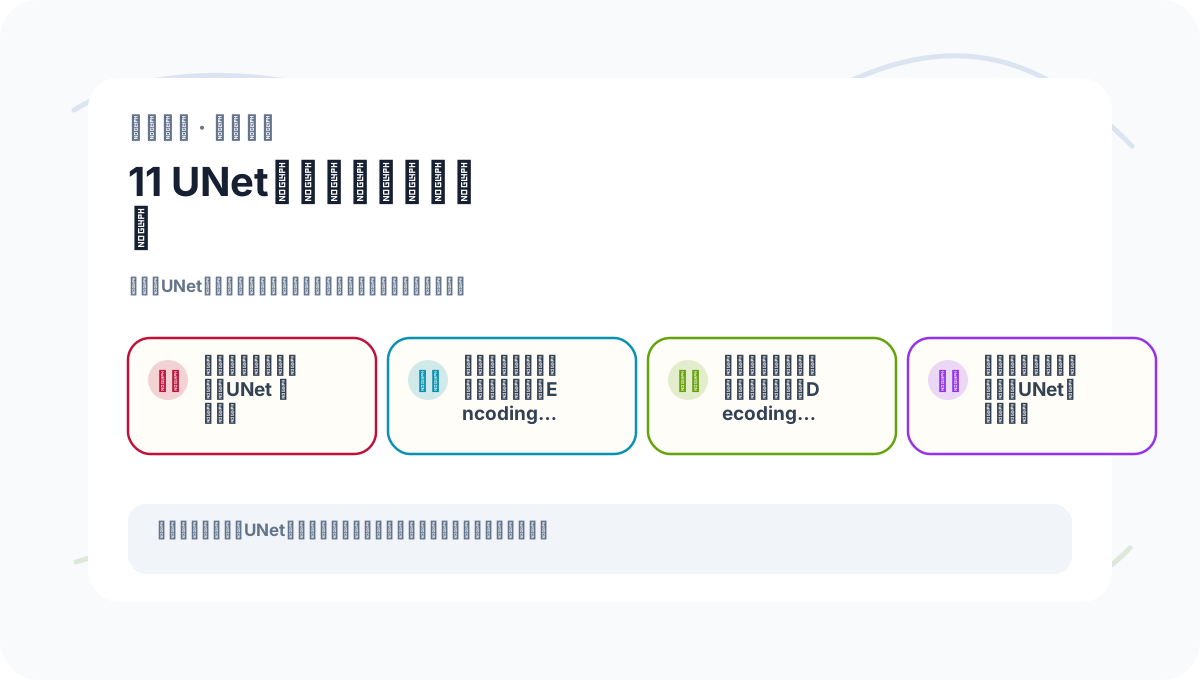
If you haven’t fully internalized U-Net Architecture Breakdown, revisit this card and walk through its four core actions step-by-step.
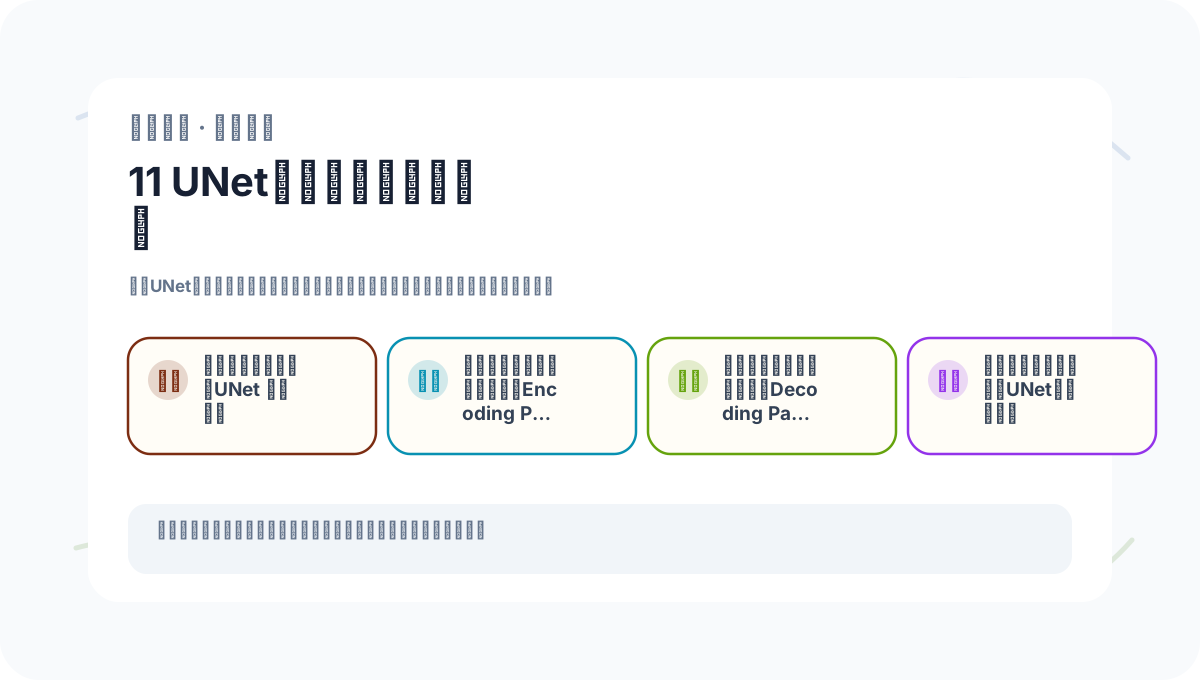
When reviewing U-Net Architecture Breakdown, avoid launching large-scale projects immediately. Instead, start with a single, simple example to confirm clarity on the core workflow.
Summary
U-Net achieves exceptional effectiveness in image segmentation by synergistically combining hierarchical semantic abstraction (via the encoder) with progressive spatial reconstruction (via the decoder). Its widespread adoption in medical imaging analysis solidifies its status as a foundational architecture in the field of image segmentation.
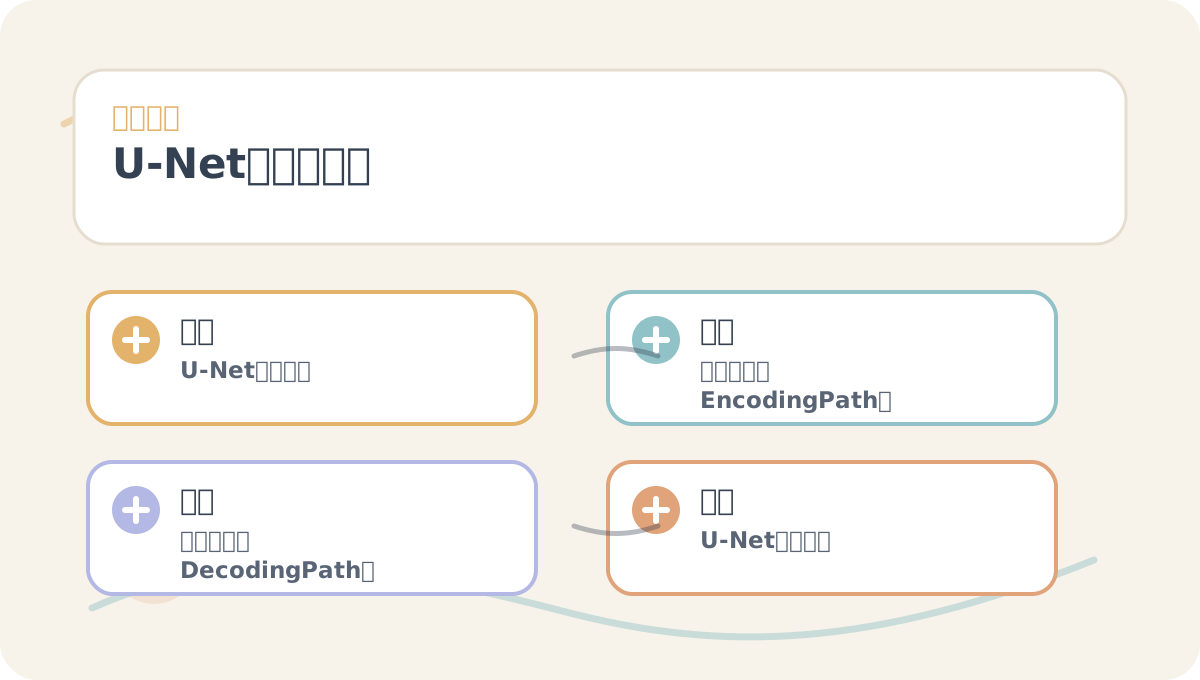
Content like U-Net Architecture Breakdown can easily derail readers with excessive detail. First grasp the central narrative illustrated in the diagrams; then return to the text to verify consistency across environment setup, inputs, outputs, and evaluation criteria.
In the next article, we will delve into practical applications of U-Net—including training and evaluation strategies on real-world datasets. Stay tuned!
Apply This Lesson
Turn this article into AI software, model, API, and security decisions.
English Article FAQ
Use this article as evidence before choosing AI tools
How should I use this AI Tutorials article?
Use it as the implementation or learning layer, then connect the idea to AI software buyer guides, tool comparisons, benchmarks, API choices, and security checks before making a production decision.
Is this English article different from the Chinese original?
The English edition is localized for global AI readers while preserving the original diagrams, screenshots, prompts, code examples, and source context from the Chinese article.
What should I read after U-Net Architecture Explained?
Continue with AI Software Buyer Guides, AI Tools Workbench, Best AI Coding Agents, AI Model Benchmarks, OpenAI vs Anthropic API, or LLM Security Tools depending on the decision you need to make.
Can this article alone choose an AI product or model?
No. Treat the article as evidence and context, then validate fit with pricing, privacy requirements, integration effort, benchmark results, workflow tests, and fallback planning.
Continue