English translation
Load dataset and initialize model
AI Article Decision Snapshot
Turn the lesson into workflow, model, budget, and security checks before choosing tools.
Use this quick snapshot before leaving the article. It keeps the next search tied to practical AI software, model/API, cost, privacy, and implementation questions.
Workflow fit
Identify the real job behind the article: coding, research, document review, support, analytics, content, or internal automation.
Model or tool decision
Decide whether the next step is a software shortlist, an AI tool comparison, an API platform choice, or a model benchmark.
Budget and usage signal
Estimate seats, API calls, prompt volume, retries, review time, and fallback work before assuming the workflow is cheap.
Security and privacy review
Check whether source code, customer data, private documents, prompts, logs, or embeddings will enter the AI workflow.
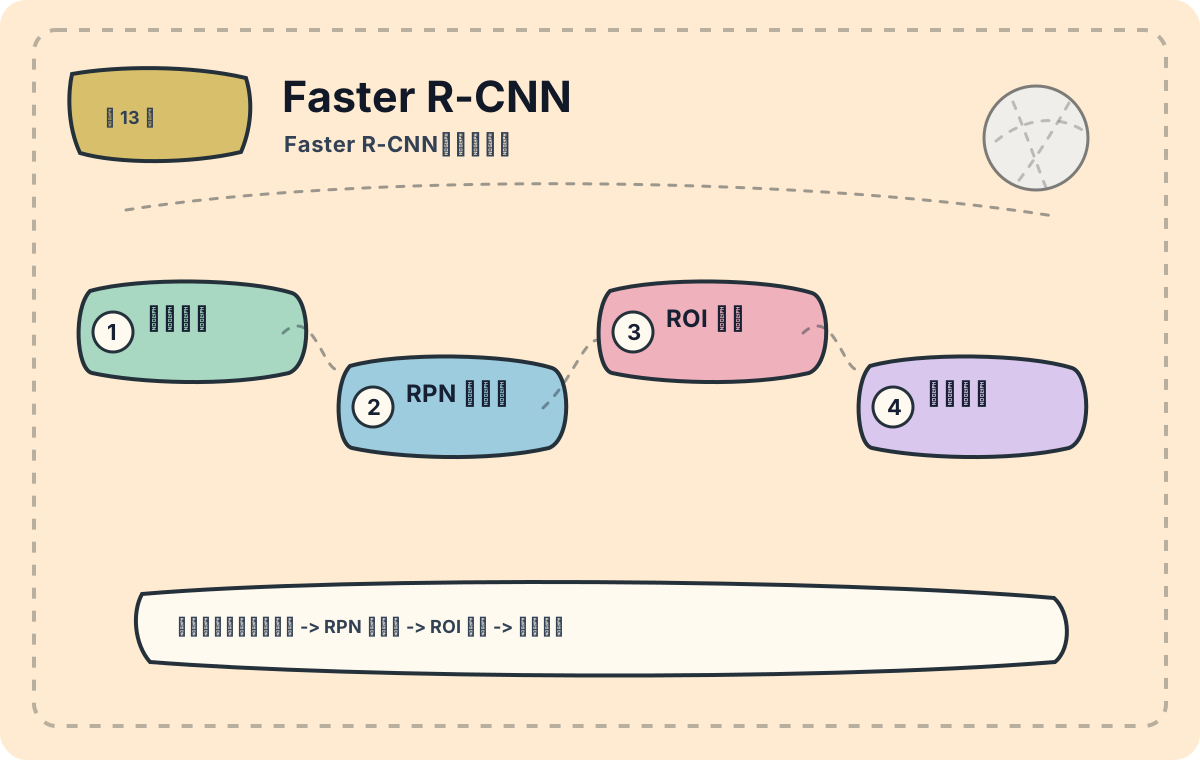
Faster R-CNN follows a two-stage detection paradigm: first proposing candidate regions likely to contain objects, then refining their class labels and bounding box coordinates. It excels in scenarios where detection accuracy is prioritized. This article focuses on its architectural design. We begin by clearly mapping the data flow, key modules, and output layers—only afterward do we revisit the underlying formulas or implementation code.
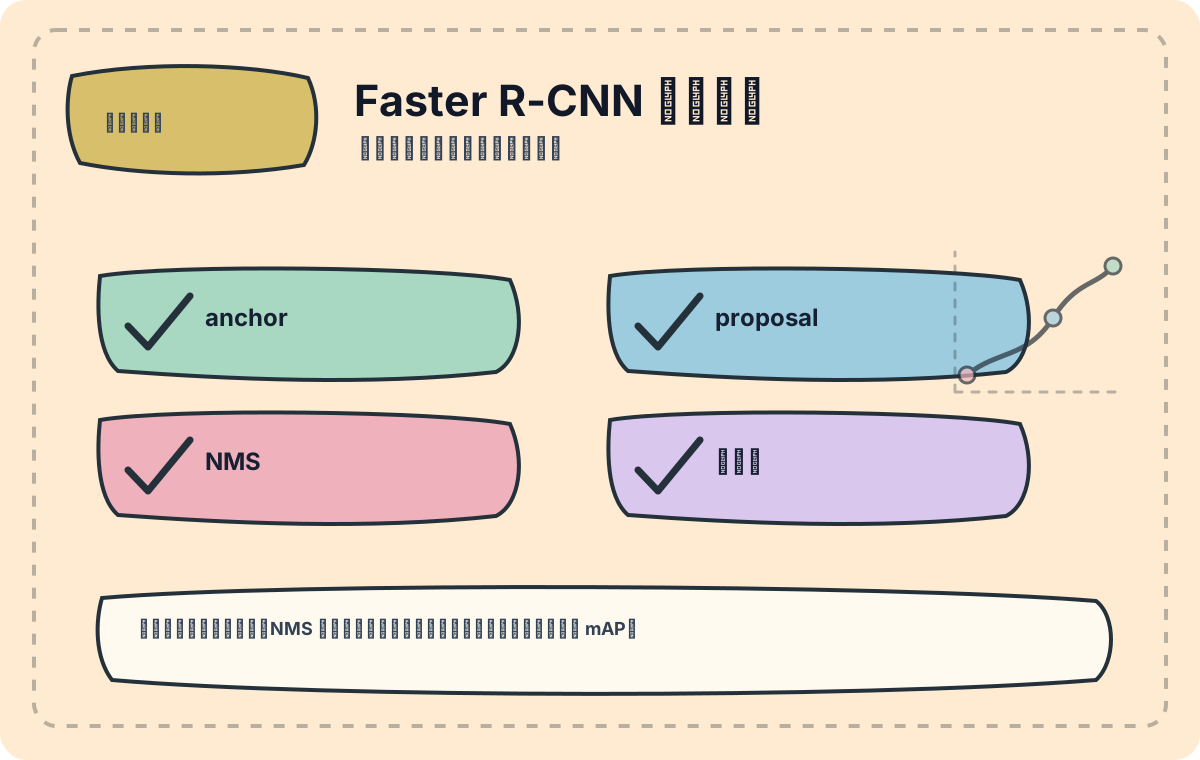
We will separately examine proposal quality, NMS thresholding, and the classification/regression head. When detection performance is suboptimal, focusing solely on the final mAP score is insufficient.
Faster R-CNN is a deep learning model for object detection that integrates a Region Proposal Network (RPN) with a standard convolutional neural network (CNN) to achieve efficient and accurate object localization and classification. Compared to its predecessors—R-CNN and Fast R-CNN—Faster R-CNN delivers significant improvements in both speed and accuracy.
1. Overall Architecture
The Faster R-CNN architecture consists of three primary components:
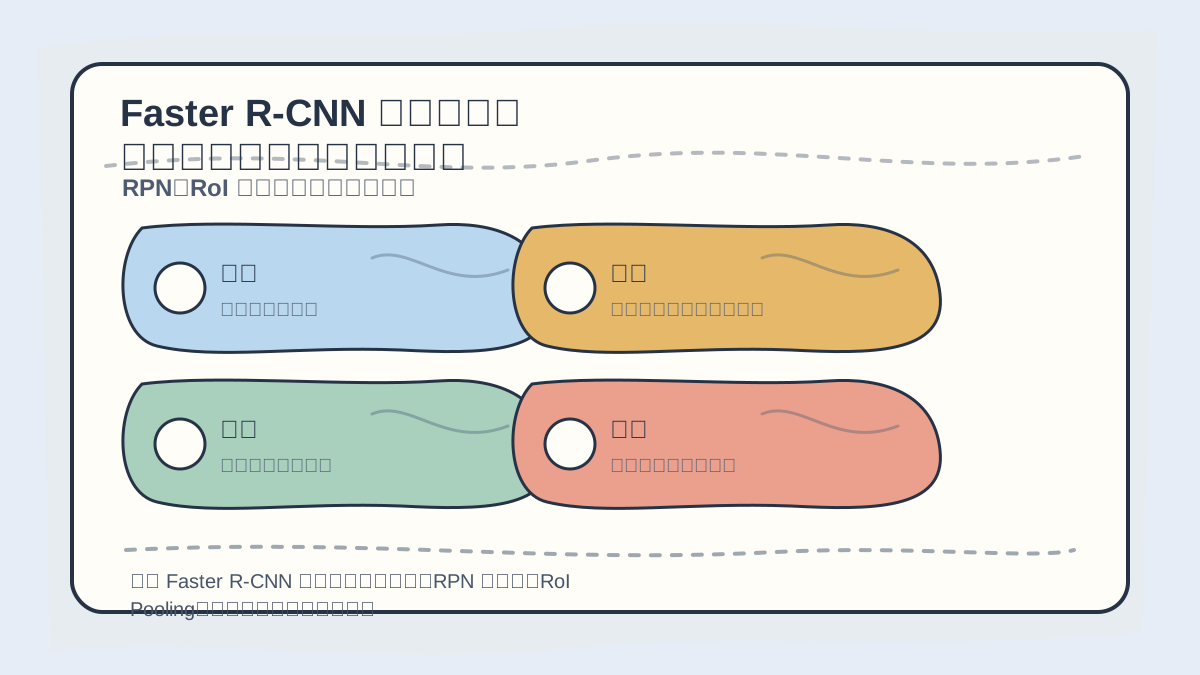
When learning Faster R-CNN, start by understanding: feature extraction, RPN-based region proposals, RoI Pooling, the classification branch, and bounding box regression.
- Feature Extraction Network: Typically employs a pre-trained CNN backbone (e.g., ResNet or VGG) to extract rich semantic features from the input image.
- Region Proposal Network (RPN): Operates on the extracted feature map to generate candidate bounding boxes (“anchors”) along with objectness scores—indicating the likelihood that each anchor contains an object.
- Detection Head: Takes the RPN-proposed regions and performs fine-grained classification and precise bounding box regression to produce final detections.
2. Detailed Workflow
2.1 Feature Extraction
By the end of reading “Fundamentals of Faster R-CNN”, treat the diagram’s workflow as a verification checklist: Is the problem well-defined? Are operations concretely implemented? Can evaluation criteria be reused across tasks?
Feature extraction transforms the input image into a high-dimensional feature map. Below is a pseudocode example:
def feature_extraction(image):
    # Extract features using a pre-trained CNN
    feature_map = pretrained_cnn(image)
    return feature_map
Commonly used backbones include VGG16 or ResNet models pre-trained on ImageNet.
2.2 Region Proposal Network (RPN)
The RPN is the core innovation of Faster R-CNN. Its purpose is to generate multiple candidate object regions (anchor boxes) directly from the feature map. The RPN outputs two predictions per anchor:
- A binary objectness score (foreground vs. background), and
- Refined bounding box coordinates (regression deltas).
The RPN operates as follows:
- At each spatial location on the feature map, it generates a fixed set of anchors with predefined scales and aspect ratios.
- For each anchor, it performs binary classification (object/background) and regresses the anchor’s coordinates toward the ground-truth box.
Pseudocode for anchor generation:
def generate_anchors(feature_map):
    anchors = []
    for i in range(feature_map_height):
        for j in range(feature_map_width):
            # Generate a fixed number of anchors per location
            anchors.extend(create_anchors_for_position(i, j))
    return anchors
2.3 Object Detection Refinement
From the RPN’s raw proposals, Non-Maximum Suppression (NMS) filters out highly overlapping candidates, retaining only the most confident ones. These refined proposals are then fed into the detection head for:
- Class-specific classification, and
- Precise bounding box regression.
The final output comprises class labels, confidence scores, and tightly fitted bounding boxes.
3. Loss Function
Faster R-CNN jointly optimizes two loss terms: classification loss and bounding box regression loss :
Here, is typically computed via cross-entropy loss, while commonly uses Smooth L1 loss. A simplified form is:
where denotes the ground-truth bounding box parameters and the predicted parameters.
(Note: In practice, balances the two losses; counts only positive (foreground) anchors.)
4. Case Study
Using the COCO dataset as an example, a trained Faster R-CNN model achieves robust detection across diverse object categories. Model training and inference can be implemented as follows:
# Load dataset and initialize model
model = FasterRCNN()
dataset = COCO_Dataset("path/to/coco")

# Train the model
model.train(dataset)

# Run inference
outputs = model.predict(test_image)
Following this pipeline yields an efficient, production-ready object detector capable of real-time inference.
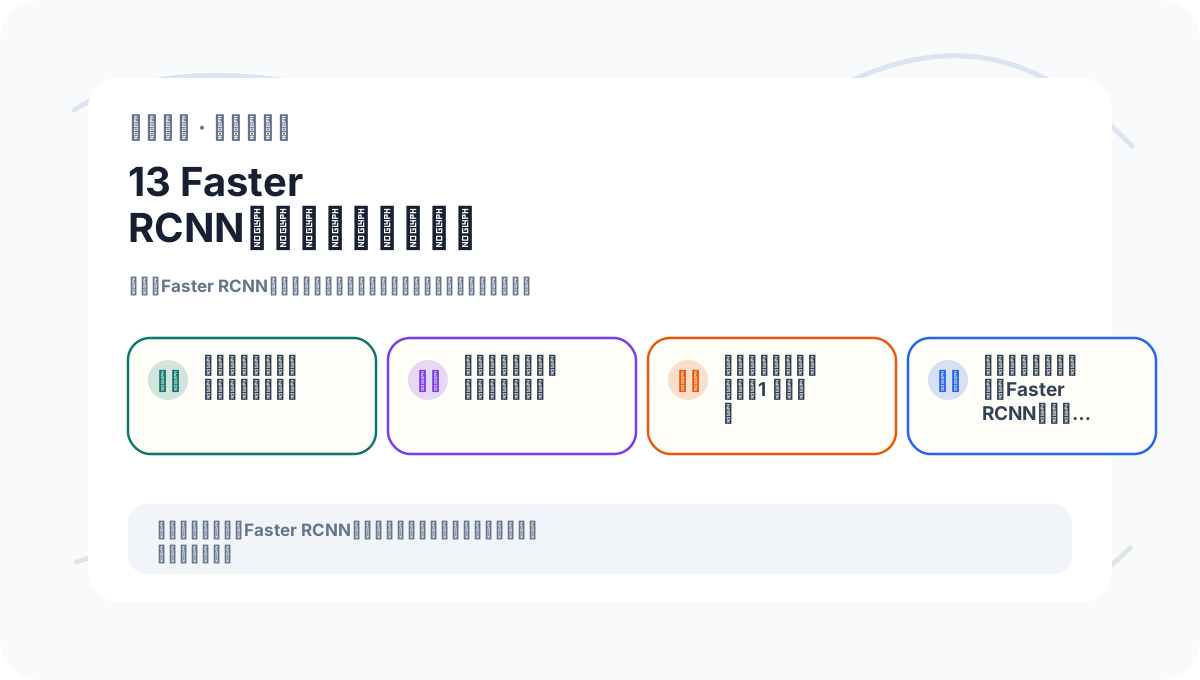
When reviewing “Fundamentals of Faster R-CNN”, consolidate key concepts, procedural steps, and observable outcomes onto a single page for rapid revision.
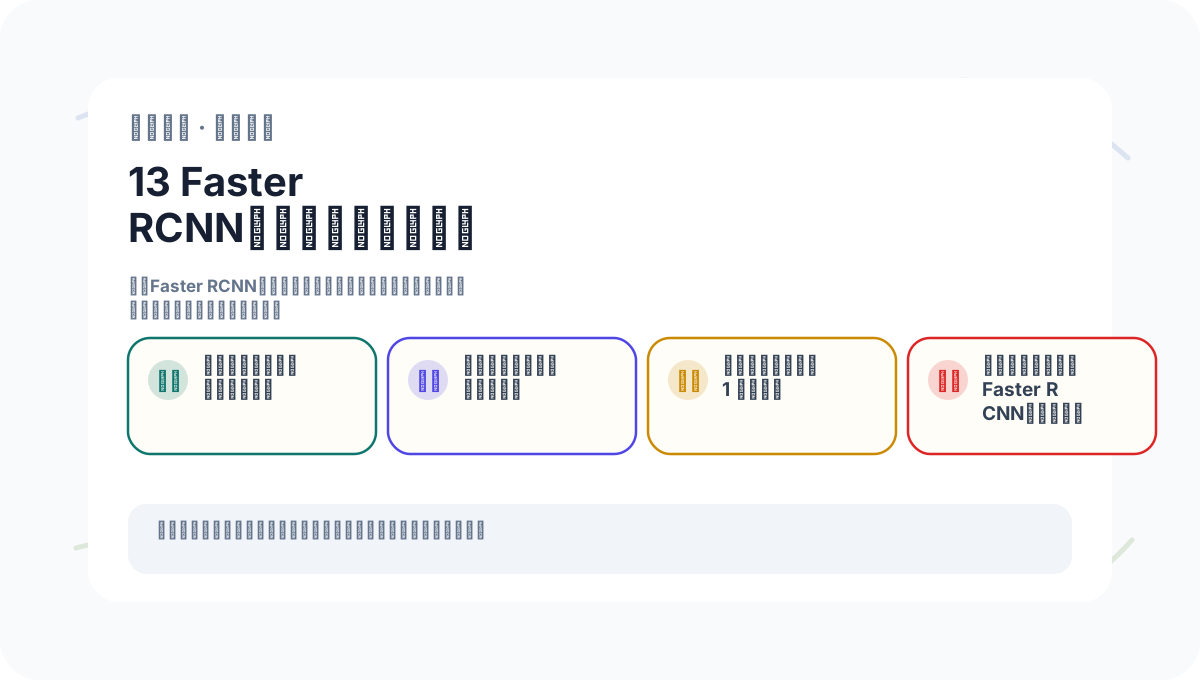
When practicing “Fundamentals of Faster R-CNN”, explicitly document input conditions, processing actions, and tangible outputs together—facilitating efficient future review.
Conclusion
Faster R-CNN addresses critical bottlenecks in traditional object detection pipelines by unifying region proposal and classification within a single, end-to-end trainable framework. By embedding the RPN directly into the CNN backbone, it achieves both high accuracy and computational efficiency.
In the next article, we will explore practical applications of Faster R-CNN—including real-time deployment strategies across diverse domains—and benchmark its performance against modern alternatives such as YOLO and RetinaNet. This will deepen our understanding of its adaptability, strengths, and real-world trade-offs.
Apply This Lesson
Turn this article into AI software, model, API, and security decisions.
English Article FAQ
Use this article as evidence before choosing AI tools
How should I use this AI Tutorials article?
Use it as the implementation or learning layer, then connect the idea to AI software buyer guides, tool comparisons, benchmarks, API choices, and security checks before making a production decision.
Is this English article different from the Chinese original?
The English edition is localized for global AI readers while preserving the original diagrams, screenshots, prompts, code examples, and source context from the Chinese article.
What should I read after Load dataset and initialize model?
Continue with AI Software Buyer Guides, AI Tools Workbench, Best AI Coding Agents, AI Model Benchmarks, OpenAI vs Anthropic API, or LLM Security Tools depending on the decision you need to make.
Can this article alone choose an AI product or model?
No. Treat the article as evidence and context, then validate fit with pricing, privacy requirements, integration effort, benchmark results, workflow tests, and fallback planning.
Continue