English translation
Load pre-trained model
AI Article Decision Snapshot
Turn the lesson into workflow, model, budget, and security checks before choosing tools.
Use this quick snapshot before leaving the article. It keeps the next search tied to practical AI software, model/API, cost, privacy, and implementation questions.
Workflow fit
Identify the real job behind the article: coding, research, document review, support, analytics, content, or internal automation.
Model or tool decision
Decide whether the next step is a software shortlist, an AI tool comparison, an API platform choice, or a model benchmark.
Budget and usage signal
Estimate seats, API calls, prompt volume, retries, review time, and fallback work before assuming the workflow is cheap.
Security and privacy review
Check whether source code, customer data, private documents, prompts, logs, or embeddings will enter the AI workflow.
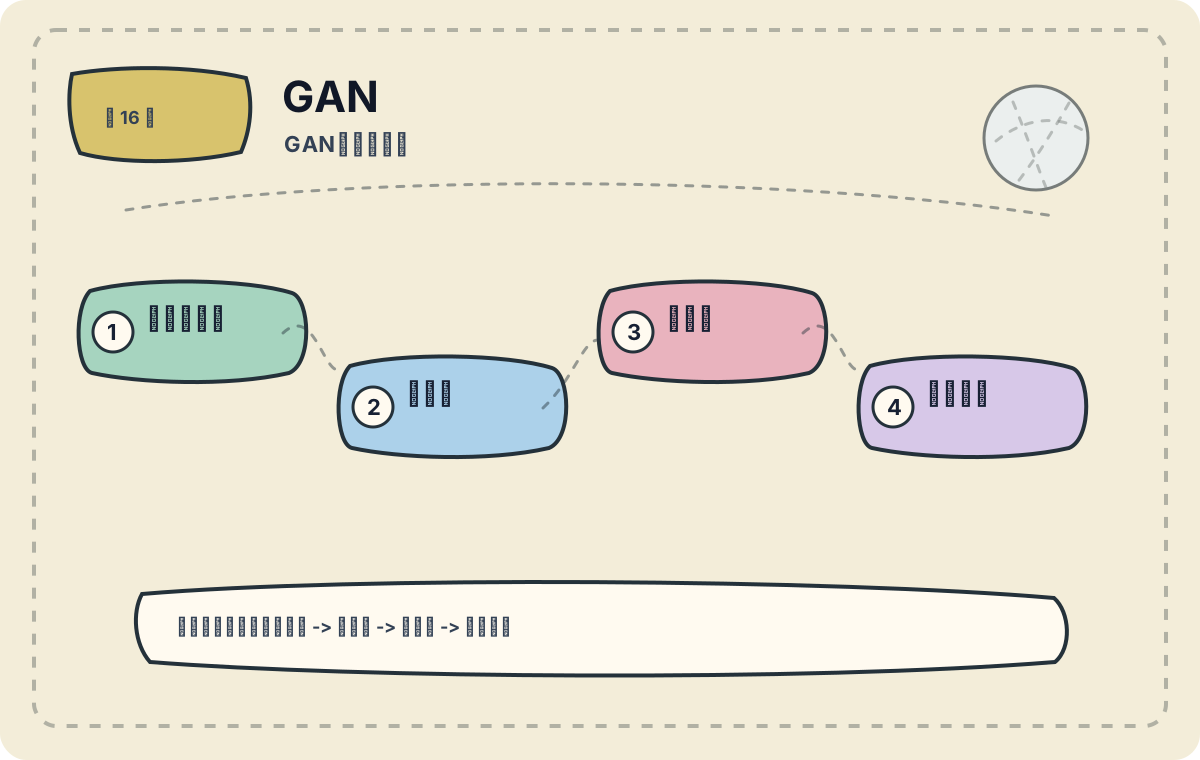
GANs involve two networks competing against each other: the generator aims to fool the discriminator, while the discriminator strives to detect flaws. The real challenge often lies in training stability. This article focuses on practical applications. First, assess whether the task truly suits this architecture; then consider data scale, deployment cost, and performance boundaries.
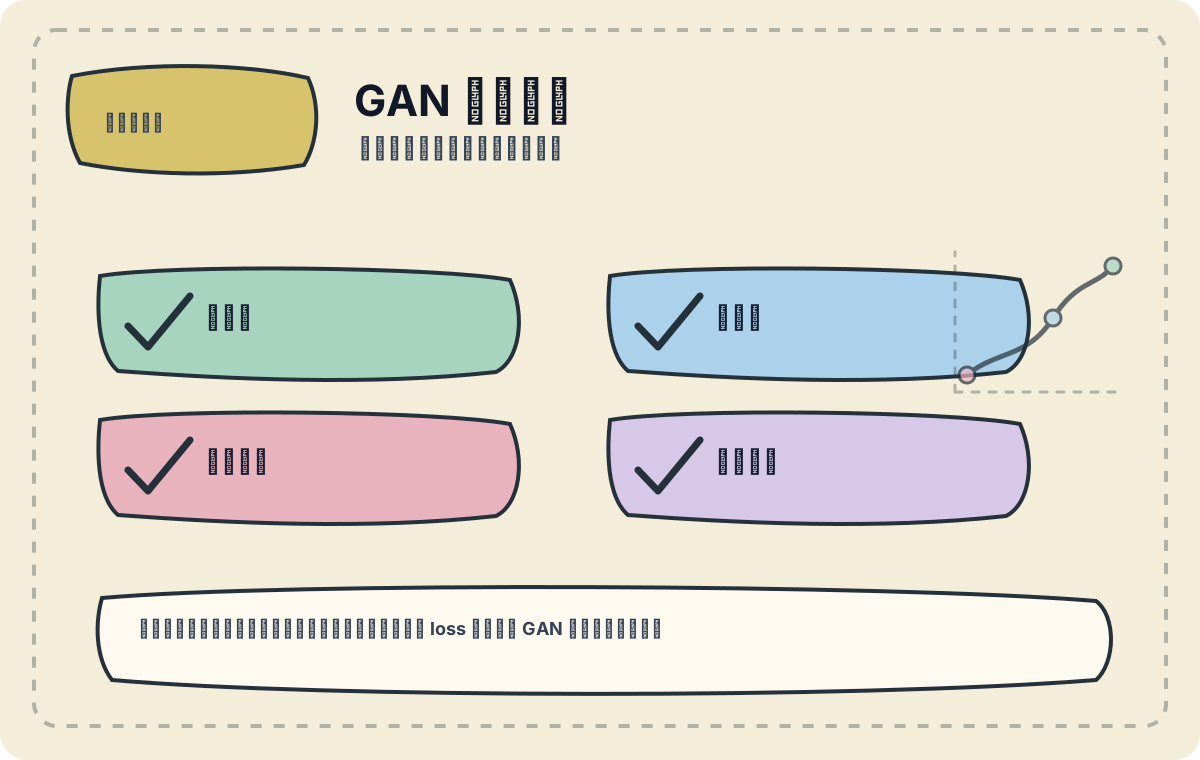
I monitor three key indicators simultaneously: generated samples, discriminator loss, and sample diversity. Relying solely on loss values can easily lead to misjudging whether a GAN has genuinely improved.
In the previous article, we thoroughly examined the architecture of Generative Adversarial Networks (GANs), understanding their foundational design and how they integrate with Convolutional Neural Networks (CNNs). This article dives into real-world application examples of GANs—demonstrating their powerful capabilities across multiple domains—and walks through implementation details using concrete cases and code.
Application Domains of GANs
1. Image Generation
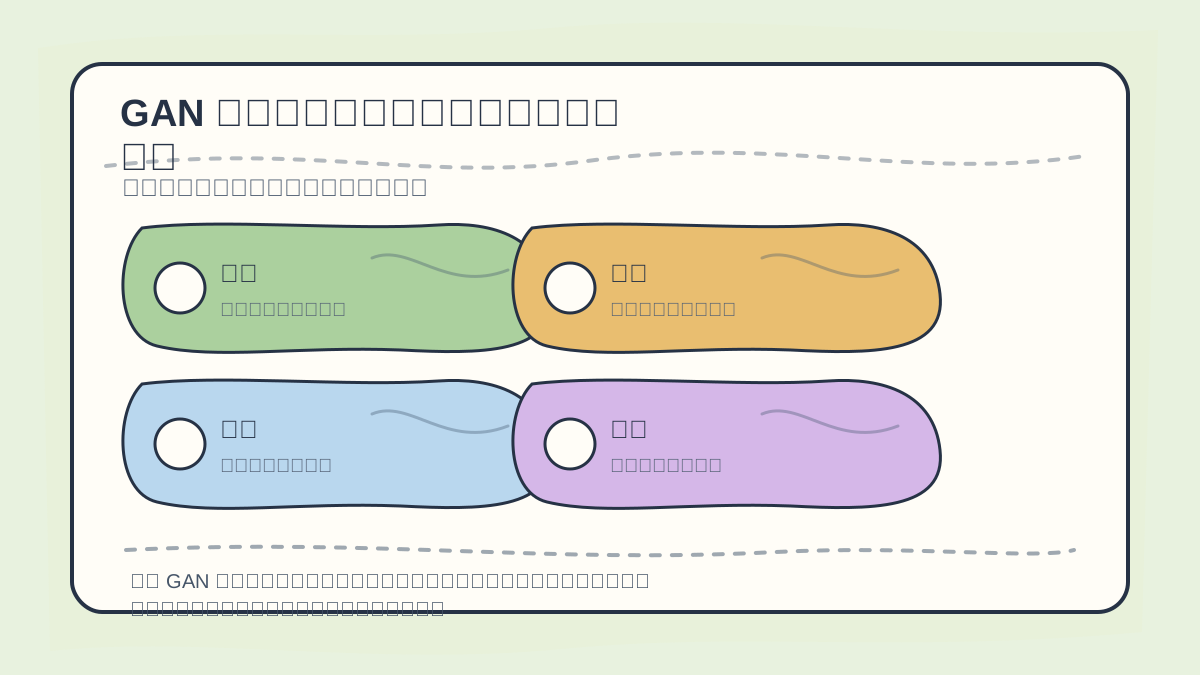
When analyzing a GAN application example, first verify whether the training data aligns with the task, how generated results are evaluated, whether failure cases are interpretable, and whether deployment costs are acceptable.
One of the most well-known applications of GANs is image generation. By training the generator, new images highly similar to the training data can be synthesized—for instance, generating high-resolution human face images. Notably, StyleGAN excels at producing high-resolution, photorealistic facial images.
Example Code:
import torch
from StyleGAN import StyleGAN  # Assume a StyleGAN class has been defined

# Load pre-trained model
model = StyleGAN.load_pretrained('path/to/pretrained_model')

# Generate image
with torch.no_grad():
    generated_image = model.generate(random_noise)

# Display image
import matplotlib.pyplot as plt
plt.imshow(generated_image.permute(1, 2, 0).numpy())
plt.axis('off')
plt.show()
2. Image Inpainting
GANs also perform exceptionally well in image inpainting tasks. By training the generator to synthesize missing or corrupted regions, GANs can efficiently restore image content.
Case Study: Context Encoder is a GAN-based approach to image inpainting. The generator is trained to fill in masked regions while preserving contextual coherence.
Example Code:
# In this example, assume we have an image with a masked region
input_image = load_image('path/to/image_with_masked_area.jpg')

# Feed into network
repaired_image = model.repair(input_image)

# Display repaired image
plt.imshow(repaired_image.permute(1, 2, 0).numpy())
plt.axis('off')
plt.show()
3. Style Transfer
GANs can also transfer the artistic style of one image onto another—for example, applying a painterly aesthetic to a standard photograph. CycleGAN is a highly influential model specifically designed for unpaired image-to-image translation.
Case Study: Converting photographs into artwork-style renderings.
Example Code:
# Load CycleGAN model
model = CycleGAN.load_pretrained('path/to/cyclegan_model')

# Input image
photo = load_image('path/to/photo.jpg')

# Apply style transfer
art_style_image = model.transform(photo)

# Display transformed image
plt.imshow(art_style_image.permute(1, 2, 0).numpy())
plt.axis('off')
plt.show()
4. Image Super-Resolution
Super-resolution reconstruction represents another major computer vision application of GANs. Using GANs for super-resolution enables synthesis of higher-resolution images with enhanced detail fidelity. SRGAN is a widely adopted GAN architecture for this purpose.
Example Code:
# Load SRGAN model
model = SRGAN.load_pretrained('path/to/srgan_model')

# Input low-resolution image
low_res_image = load_image('path/to/low_res_image.jpg')

# Perform super-resolution upscaling
high_res_image = model.upscale(low_res_image)

# Display super-resolved image
plt.imshow(high_res_image.permute(1, 2, 0).numpy())
plt.axis('off')
plt.show()
5. Semantic Segmentation
Another important application involves leveraging GANs for semantic segmentation. Conditional GANs (cGANs) enable more precise segmentation by incorporating label guidance. For instance, the Pix2Pix framework supports tasks such as converting sketches into photorealistic images or isolating semantically distinct regions within input images.
Example Code:
# Load Pix2Pix model
model = Pix2Pix.load_pretrained('path/to/pix2pix_model')

# Input real image for segmentation
input_image = load_image('path/to/image_to_segment.jpg')

# Perform semantic segmentation
segmented_image = model.segment(input_image)

# Display segmented image
plt.imshow(segmented_image.permute(1, 2, 0).numpy())
plt.axis('off')
plt.show()
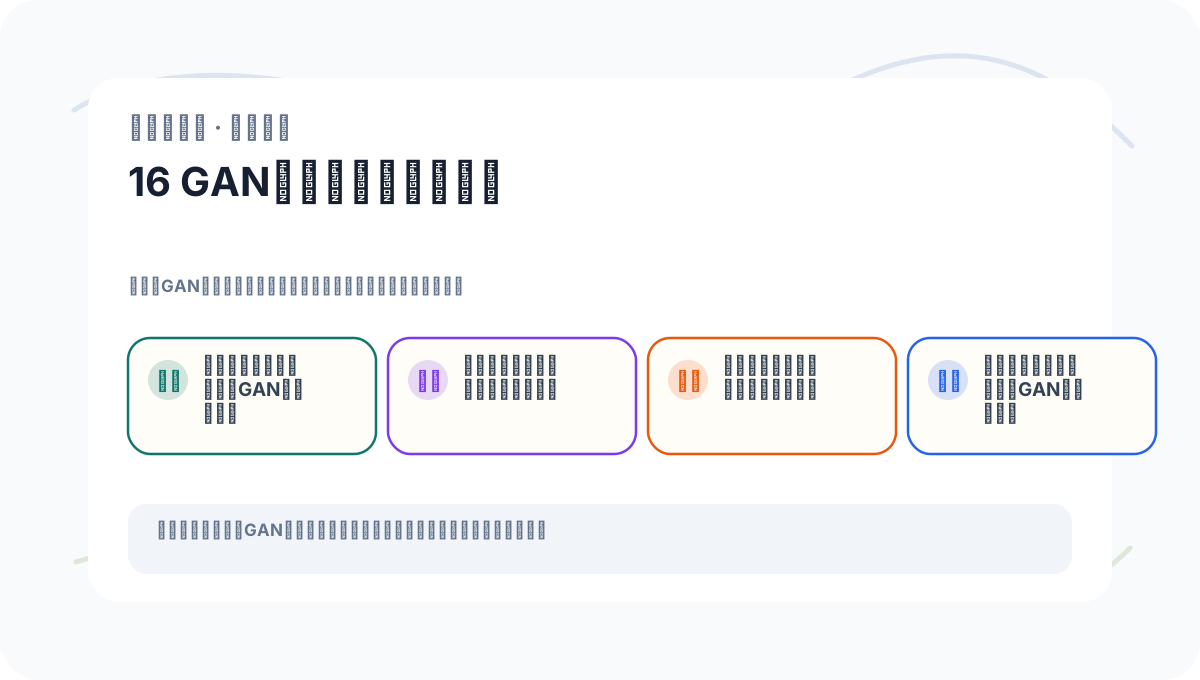
Having read this far, you can now consolidate “GAN Application Examples” into a structured retrospective table: first clarify the core narrative, then validate it using a small-scale task.
After finishing “GAN Application Examples”, try walking through a small representative example end-to-end, then assess which steps you can already execute independently.
Summary
In this article, we showcased practical applications of Generative Adversarial Networks (GANs) across diverse domains—from image generation and inpainting to style transfer, super-resolution, and semantic segmentation. GANs demonstrate remarkable capability, highlighting the immense potential of deep learning in image processing.
While reading “GAN Application Examples”, begin by identifying your target use case, then connect key concepts with hands-on practice actions. This approach helps anchor details meaningfully—rather than memorizing isolated terminology.
In the next article, we will explore hybrid architectures combining Convolutional Neural Networks (CNNs) with Recurrent Neural Networks (RNNs), helping readers gain a comprehensive understanding of their integration and real-world applications. Stay tuned!
Apply This Lesson
Turn this article into AI software, model, API, and security decisions.
English Article FAQ
Use this article as evidence before choosing AI tools
How should I use this AI Tutorials article?
Use it as the implementation or learning layer, then connect the idea to AI software buyer guides, tool comparisons, benchmarks, API choices, and security checks before making a production decision.
Is this English article different from the Chinese original?
The English edition is localized for global AI readers while preserving the original diagrams, screenshots, prompts, code examples, and source context from the Chinese article.
What should I read after Load pre-trained model?
Continue with AI Software Buyer Guides, AI Tools Workbench, Best AI Coding Agents, AI Model Benchmarks, OpenAI vs Anthropic API, or LLM Security Tools depending on the decision you need to make.
Can this article alone choose an AI product or model?
No. Treat the article as evidence and context, then validate fit with pricing, privacy requirements, integration effort, benchmark results, workflow tests, and fallback planning.
Continue