English translation
Build model
AI Article Decision Snapshot
Turn the lesson into workflow, model, budget, and security checks before choosing tools.
Use this quick snapshot before leaving the article. It keeps the next search tied to practical AI software, model/API, cost, privacy, and implementation questions.
Workflow fit
Identify the real job behind the article: coding, research, document review, support, analytics, content, or internal automation.
Model or tool decision
Decide whether the next step is a software shortlist, an AI tool comparison, an API platform choice, or a model benchmark.
Budget and usage signal
Estimate seats, API calls, prompt volume, retries, review time, and fallback work before assuming the workflow is cheap.
Security and privacy review
Check whether source code, customer data, private documents, prompts, logs, or embeddings will enter the AI workflow.
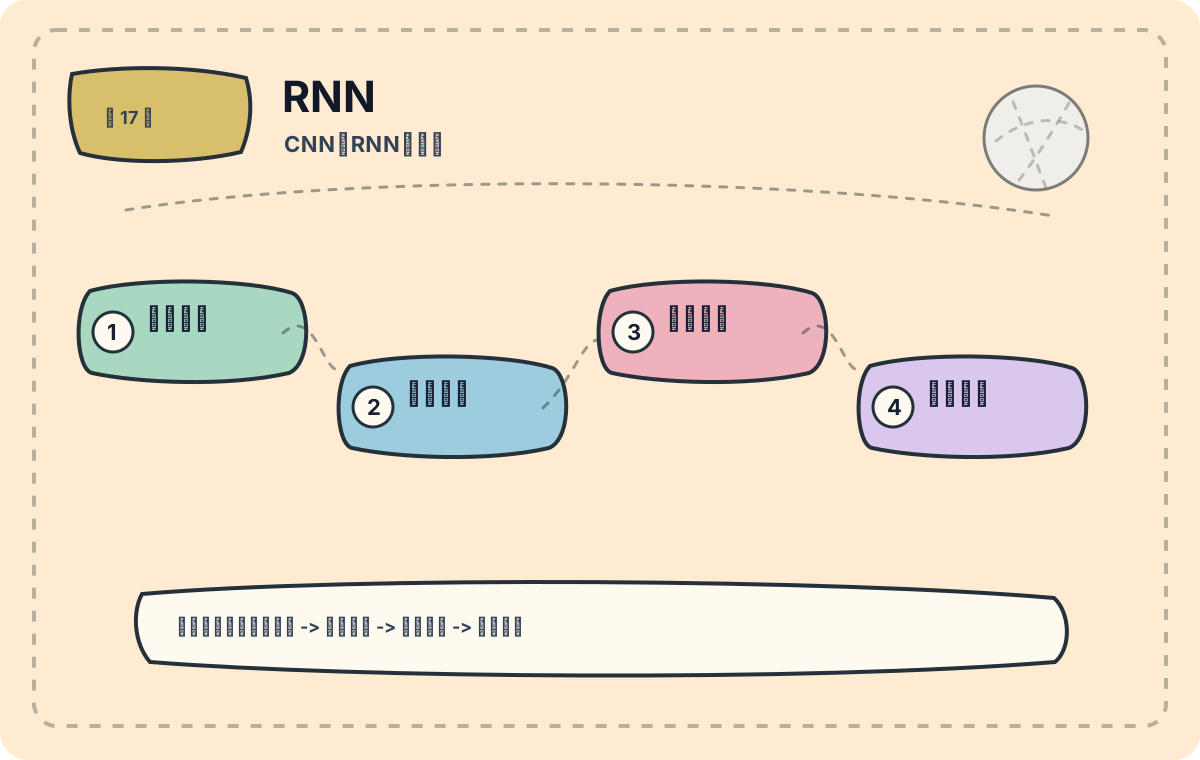
RNNs unroll sequences step-by-step over time, using hidden states to preserve contextual information. To understand them, first clearly map how data flows at each time step. This article focuses on architecture: start by sketching the data flow, key modules, and output layer—then revisit the formulas or code.
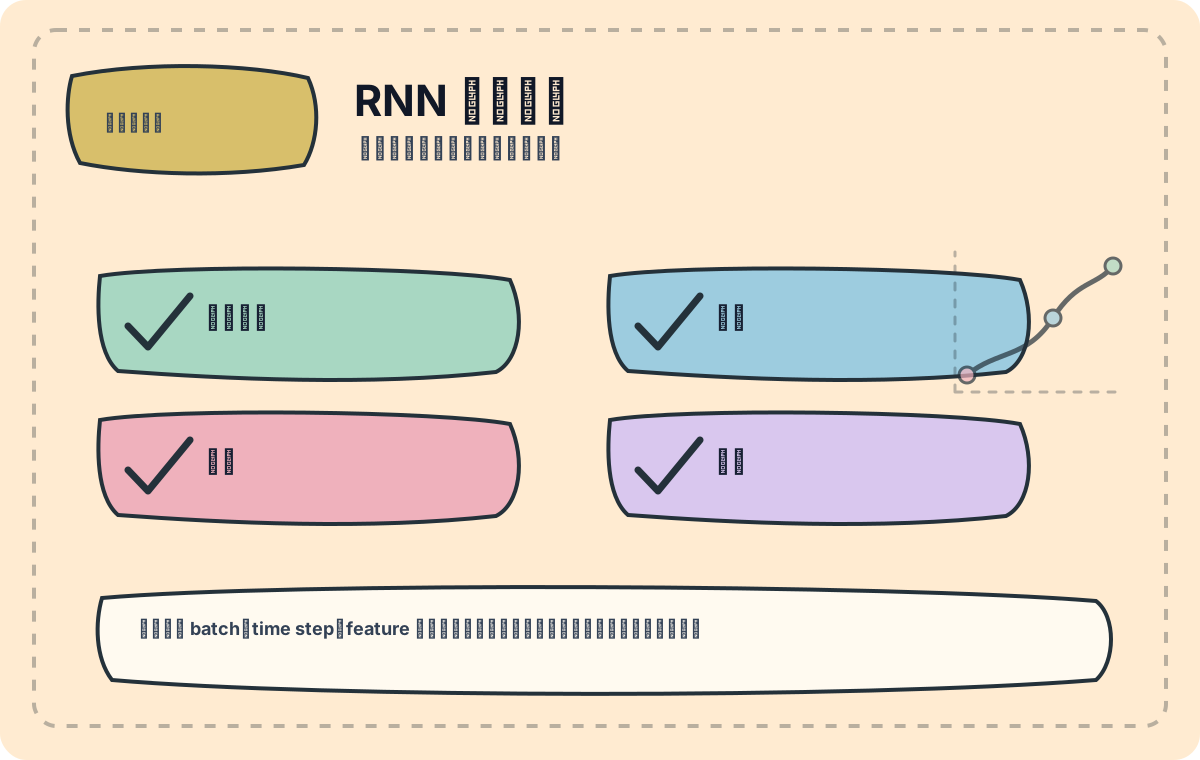
I’ll verify the ordering of three dimensions: batch, time step, and feature. Incorrect dimension ordering is a common pitfall in sequence modeling.
In the previous article, we explored practical applications of Generative Adversarial Networks (GANs), including image generation and style transfer. Today, we’ll focus on the distinguishing characteristics of Convolutional Neural Networks (CNNs) and Recurrent Neural Networks (RNNs), laying the groundwork for upcoming discussions of real-world CNN use cases.
1. What Is an RNN?
RNNs are typically used to process sequential data. Their core design principle is to propagate information across a sequence via hidden states. Unlike traditional feedforward neural networks, RNNs can handle input sequences of arbitrary length and maintain contextual information through iterative updates over time steps.
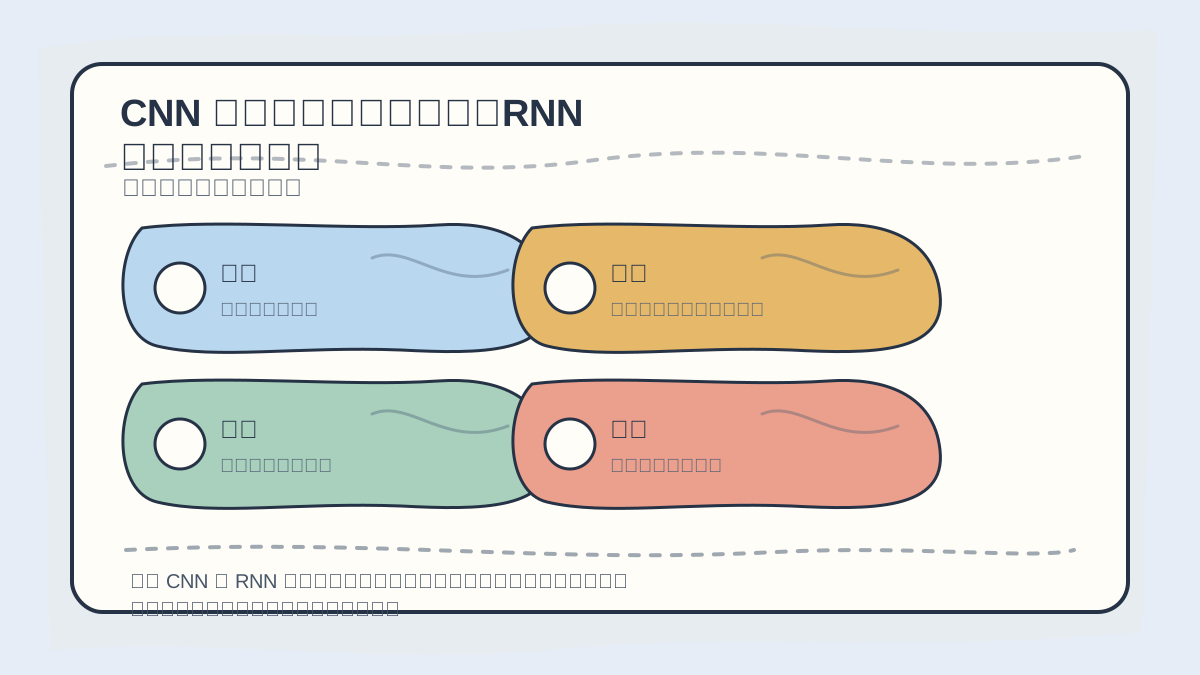
When comparing CNNs and RNNs, first determine whether your data is structured as a 2D grid (e.g., images) or a time series. Then evaluate based on local feature extraction, contextual memory, parallelization efficiency, and typical application domains.
Basic RNN Architecture
The fundamental RNN computation is defined as:
where denotes the hidden state at time step , is the input at that step, and are learnable weight matrices, and is a bias term.
Key Characteristics
- Memory Capability: RNNs retain and reuse information from prior inputs, enabling context-aware processing across subsequent steps.
- Variable-Length Sequence Handling: They naturally accommodate sequences of any length—ideal for text, speech, and other temporal data.
- Training Challenges: Standard RNNs often suffer from vanishing or exploding gradients when trained on long sequences. Variants such as Long Short-Term Memory (LSTM) or Gated Recurrent Units (GRU) are commonly adopted to mitigate these issues.
2. Practical RNN Applications
RNNs have found widespread adoption across many domains—particularly in Natural Language Processing (NLP) and time-series analysis.
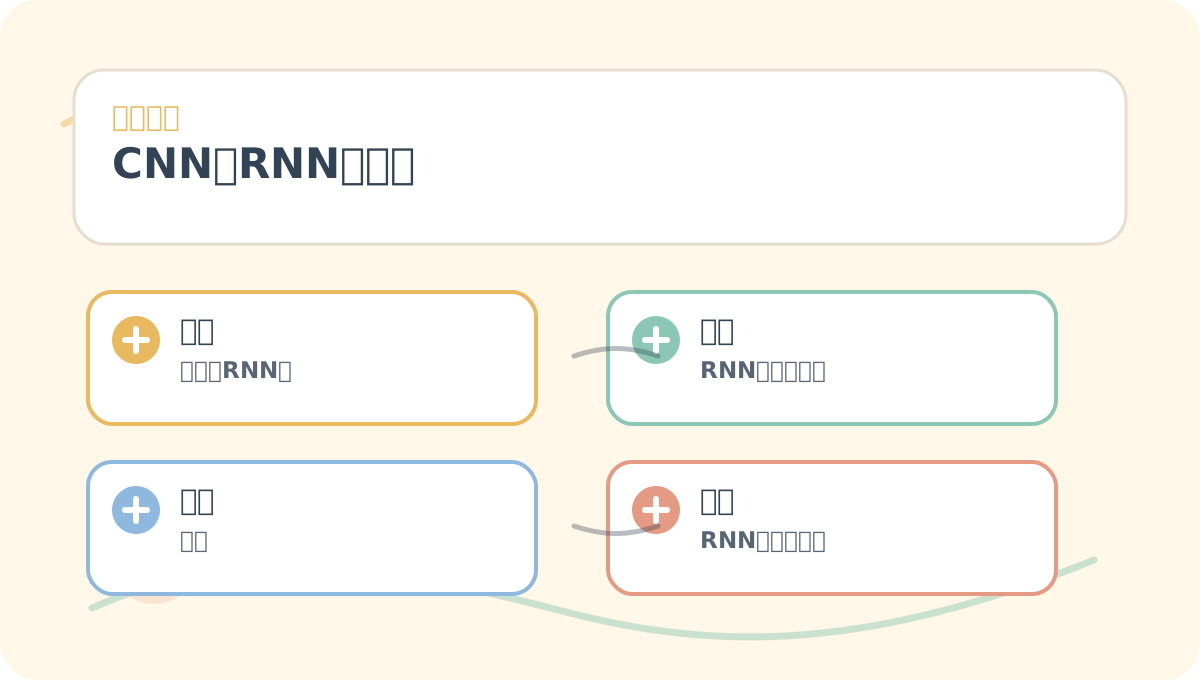
After reading Characteristics of CNNs and RNNs, don’t stop at “I understand.” Instead, pick one step and implement it hands-on. Note where you get stuck—this reflection will make future learning more robust.
2.1 Language Modeling
In language modeling, RNNs predict the next word given preceding words—a capability central to machine translation and text generation.
Example Code
The following snippet uses Keras to build a simple RNN for text generation:
from keras.models import Sequential
from keras.layers import SimpleRNN, Dense, Embedding

# Build model
model = Sequential()
model.add(Embedding(input_dim=vocab_size, output_dim=embedding_dim, input_length=max_length))
model.add(SimpleRNN(units=128))
model.add(Dense(vocab_size, activation='softmax'))

model.compile(loss='categorical_crossentropy', optimizer='adam', metrics=['accuracy'])
2.2 Time-Series Forecasting
RNNs are also widely applied to forecasting tasks—such as stock prices or weather patterns—by modeling historical trends to infer future behavior.
Example Code
Below is an example using LSTM for time-series prediction:
from keras.models import Sequential
from keras.layers import LSTM, Dense

# Build model
model = Sequential()
model.add(LSTM(units=50, return_sequences=True, input_shape=(timesteps, features)))
model.add(LSTM(units=50))
model.add(Dense(units=1))

model.compile(loss='mean_squared_error', optimizer='adam')
3. Comparing RNNs and CNNs
Within deep learning, CNNs and RNNs excel in distinct domains:
When practicing Characteristics of CNNs and RNNs, write down the input conditions, processing actions, and observable outcomes together—making future review more efficient.
When reviewing Characteristics of CNNs and RNNs, consolidate key concepts, procedural steps, and visible outcomes onto a single page for quick reference.
- Data Type: CNNs are primarily designed for image data and excel at extracting local spatial features; RNNs specialize in sequential (temporal) data and capture dependencies across time.
- Architectural Focus: CNNs rely on convolutional and pooling layers to process spatial structure; RNNs employ recursive connections to model temporal dynamics.
Next, we’ll delve into practical CNN applications—including image classification, object detection, and semantic segmentation—and explore how these tasks relate closely to the GAN concepts introduced earlier. This progression will deepen our understanding of how CNN-based techniques enable precise visual perception and manipulation.
Apply This Lesson
Turn this article into AI software, model, API, and security decisions.
English Article FAQ
Use this article as evidence before choosing AI tools
How should I use this AI Tutorials article?
Use it as the implementation or learning layer, then connect the idea to AI software buyer guides, tool comparisons, benchmarks, API choices, and security checks before making a production decision.
Is this English article different from the Chinese original?
The English edition is localized for global AI readers while preserving the original diagrams, screenshots, prompts, code examples, and source context from the Chinese article.
What should I read after Build model?
Continue with AI Software Buyer Guides, AI Tools Workbench, Best AI Coding Agents, AI Model Benchmarks, OpenAI vs Anthropic API, or LLM Security Tools depending on the decision you need to make.
Can this article alone choose an AI product or model?
No. Treat the article as evidence and context, then validate fit with pricing, privacy requirements, integration effort, benchmark results, workflow tests, and fallback planning.
Continue