English translation
20 Real-World Applications of Recurrent Neural Networks (RNNs)
AI Article Decision Snapshot
Turn the lesson into workflow, model, budget, and security checks before choosing tools.
Use this quick snapshot before leaving the article. It keeps the next search tied to practical AI software, model/API, cost, privacy, and implementation questions.
Workflow fit
Identify the real job behind the article: coding, research, document review, support, analytics, content, or internal automation.
Model or tool decision
Decide whether the next step is a software shortlist, an AI tool comparison, an API platform choice, or a model benchmark.
Budget and usage signal
Estimate seats, API calls, prompt volume, retries, review time, and fallback work before assuming the workflow is cheap.
Security and privacy review
Check whether source code, customer data, private documents, prompts, logs, or embeddings will enter the AI workflow.
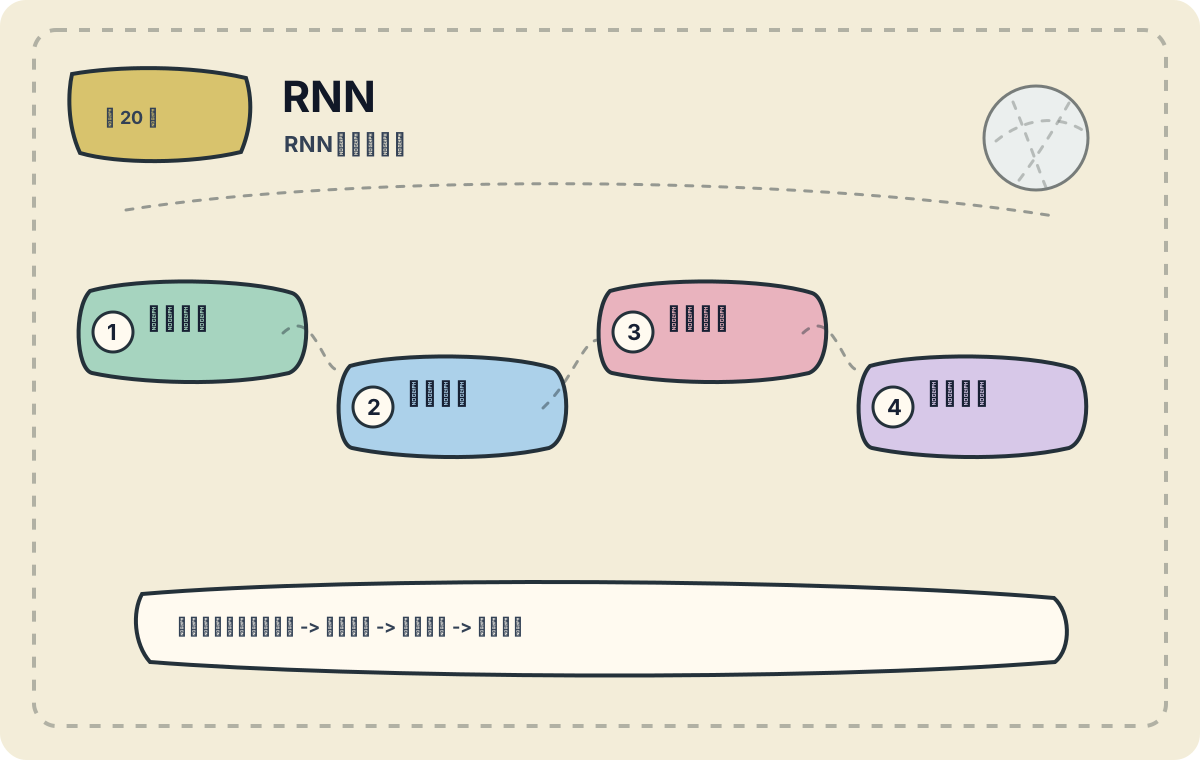
RNNs unroll sequences step-by-step in time and use hidden states to retain contextual information. To understand them, first clearly map how data flows at each time step. This article focuses on practical applications: before adopting an RNN, assess whether the task genuinely aligns with its capabilities—then evaluate data scale, deployment cost, and performance boundaries.
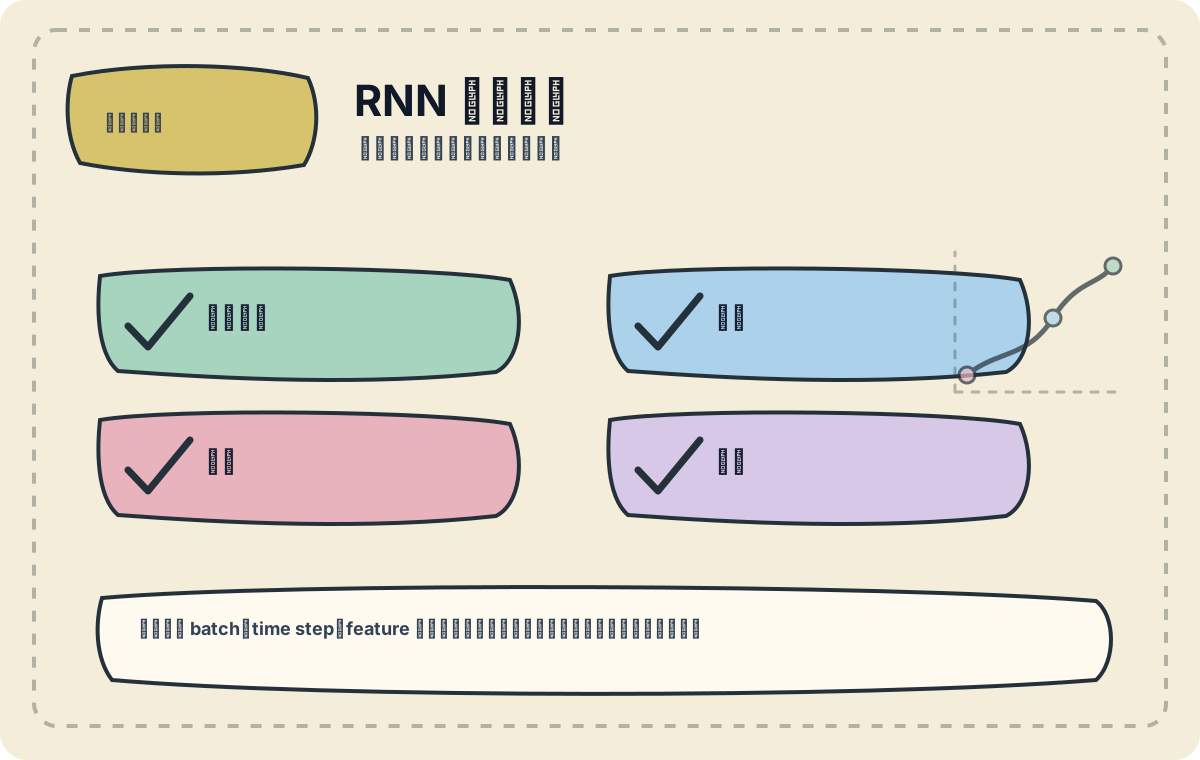
I verify the ordering across three dimensions: batch, time step, and feature. Incorrect dimension ordering is a common pitfall in sequence modeling.
In the previous article, we explored the transformation mechanics of Recurrent Neural Networks (RNNs), gaining insight into their behavior on sequential data and their training methodology. This article shifts focus to real-world RNN applications—illustrating concrete use cases across diverse domains to deepen our understanding of their value and appropriate scope.
Natural Language Processing (NLP)
RNNs are most widely applied in NLP. Because language is inherently sequential, RNNs effectively capture contextual dependencies in text. Below are key application examples:
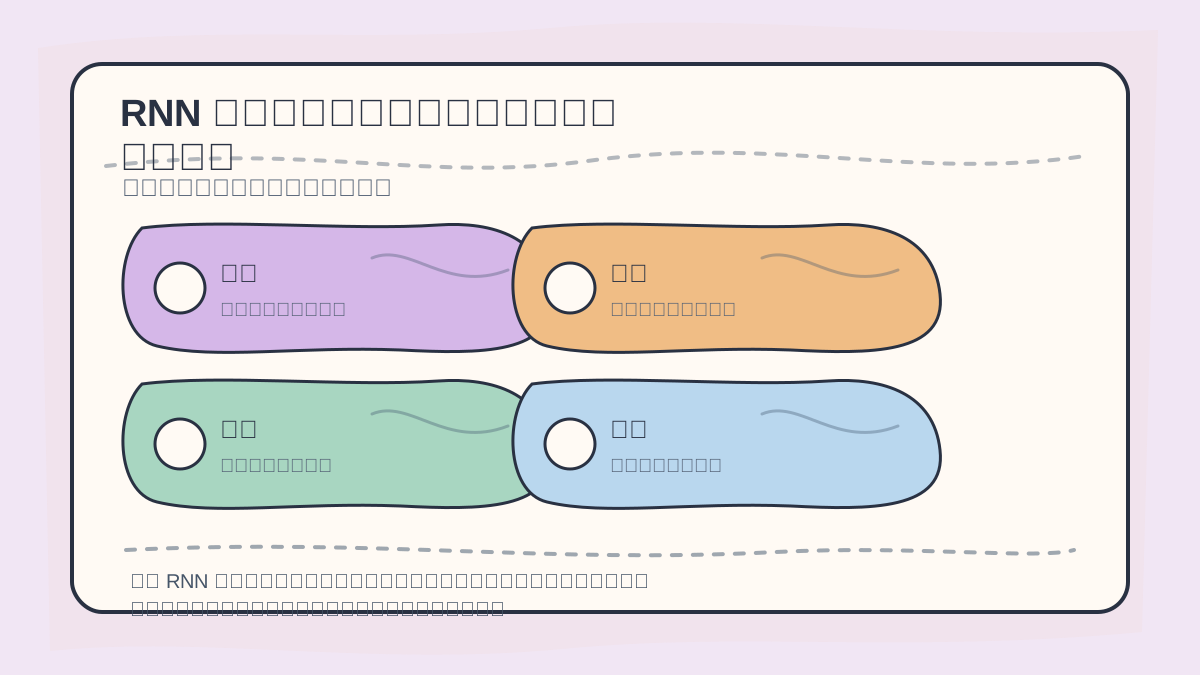
When analyzing practical RNN applications, first ask: Does the input exhibit inherent ordering? How long is the required context span? Is the output classification or generation? And should a stronger sequence model replace the RNN?
1. Language Modeling
RNNs can build language models that predict the most probable next word given preceding context. For example, given the phrase “The cat sat on the”, an RNN model may predict “mat” as the next word.
import torch
import torch.nn as nn

class RNNLanguageModel(nn.Module):
    def __init__(self, vocab_size, embedding_dim, hidden_dim):
        super(RNNLanguageModel, self).__init__()
        self.embedding = nn.Embedding(vocab_size, embedding_dim)
        self.rnn = nn.RNN(embedding_dim, hidden_dim)
        self.fc = nn.Linear(hidden_dim, vocab_size)

    def forward(self, x):
        x = self.embedding(x)
        out, _ = self.rnn(x)
        out = self.fc(out)
        return out
2. Machine Translation
RNNs achieve strong results in machine translation using an encoder–decoder architecture: one RNN encodes the source-language sentence, and another decodes it into the target language. For instance, translating English to French involves encoding the English sentence and generating the corresponding French sentence.
class EncoderRNN(nn.Module):
    def __init__(self, input_size, hidden_size):
        super(EncoderRNN, self).__init__()
        self.rnn = nn.RNN(input_size, hidden_size)

    def forward(self, x):
        output, hidden = self.rnn(x)
        return output, hidden

class DecoderRNN(nn.Module):
    def __init__(self, output_size, hidden_size):
        super(DecoderRNN, self).__init__()
        self.rnn = nn.RNN(output_size, hidden_size)
        self.fc = nn.Linear(hidden_size, output_size)

    def forward(self, x, hidden):
        output, hidden = self.rnn(x, hidden)
        output = self.fc(output)
        return output, hidden
3. Text Generation
RNNs can generate new text conditioned on an initial prompt, producing tokens sequentially until a stopping condition is met. For example, given the seed “Once upon a time”, the model might generate an entire story.
def generate_text(model, start_text, gen_length):
    model.eval()
    generated_text = start_text
    input = torch.tensor([word_to_index[start_text]])  # Convert seed text to index
    for _ in range(gen_length):
        output = model(input)
        _, top_index = torch.max(output, dim=1)
        next_word = index_to_word[top_index.item()]
        generated_text += ' ' + next_word
        input = torch.tensor([top_index.item()])  # Update input to index of newly generated word
    return generated_text
Time Series Forecasting
Beyond NLP, RNNs are extensively used for time series forecasting—leveraging historical observations to predict future values. This makes them well-suited for financial data, weather forecasting, and similar domains.
While studying “Practical RNN Applications”, begin with a small, reproducible scenario; then explore related concepts and practice steps. After reading, re-express the material using your own example.
1. Stock Price Prediction
RNNs model historical stock prices to forecast future trends. For improved long-sequence learning—especially critical for capturing long-term temporal dependencies—LSTMs (Long Short-Term Memory networks, a specialized RNN variant) are often preferred.
class LSTMPredictor(nn.Module):
    def __init__(self, input_size, hidden_size):
        super(LSTMPredictor, self).__init__()
        self.lstm = nn.LSTM(input_size, hidden_size)
        self.fc = nn.Linear(hidden_size, 1)

    def forward(self, x):
        lstm_out, _ = self.lstm(x)
        prediction = self.fc(lstm_out[-1])  # Predict using output from final time step
        return prediction
2. Load Forecasting
In energy systems, RNNs forecast electricity demand—predicting upward or downward load trends—to optimize power supply management and reduce energy waste. By analyzing historical consumption patterns, the model identifies recurring temporal load dynamics.
Audio Processing
RNNs are also commonly applied to audio signal processing and speech recognition, effectively modeling the temporal structure and acoustic features of waveform data.
1. Speech Recognition
In speech recognition, RNNs map raw or processed audio waveforms to textual transcriptions. Through training, the model learns to associate acoustic features with corresponding linguistic labels.
class SpeechRecognitionRNN(nn.Module):
    def __init__(self, input_size, hidden_size, output_size):
        super(SpeechRecognitionRNN, self).__init__()
        self.rnn = nn.RNN(input_size, hidden_size)
        self.fc = nn.Linear(hidden_size, output_size)

    def forward(self, x):
        output, _ = self.rnn(x)
        output = self.fc(output)
        return output
By this point, you can consolidate “Practical RNN Applications” into a retrospective summary: first articulate the core narrative, then validate it using a small-scale task.
After completing “Practical RNN Applications”, try executing a full workflow on a small example—and then identify which steps you can now perform independently.
Conclusion
This article surveyed practical RNN applications across multiple domains—including natural language processing, time series forecasting, and audio processing. By recognizing RNNs’ ability to model sequential data, we can more effectively apply them to solve real-world problems. In upcoming articles, we will delve into the Transformer architecture—examining its significance and usage in modern neural networks. Stay tuned—we’ll see you next time!
Apply This Lesson
Turn this article into AI software, model, API, and security decisions.
English Article FAQ
Use this article as evidence before choosing AI tools
How should I use this AI Tutorials article?
Use it as the implementation or learning layer, then connect the idea to AI software buyer guides, tool comparisons, benchmarks, API choices, and security checks before making a production decision.
Is this English article different from the Chinese original?
The English edition is localized for global AI readers while preserving the original diagrams, screenshots, prompts, code examples, and source context from the Chinese article.
What should I read after 20 Real-World Applications of Recurrent Neural Networks (RNNs)?
Continue with AI Software Buyer Guides, AI Tools Workbench, Best AI Coding Agents, AI Model Benchmarks, OpenAI vs Anthropic API, or LLM Security Tools depending on the decision you need to make.
Can this article alone choose an AI product or model?
No. Treat the article as evidence and context, then validate fit with pricing, privacy requirements, integration effort, benchmark results, workflow tests, and fallback planning.
Continue