English translation
Transformer Architecture Explained
AI Article Decision Snapshot
Turn the lesson into workflow, model, budget, and security checks before choosing tools.
Use this quick snapshot before leaving the article. It keeps the next search tied to practical AI software, model/API, cost, privacy, and implementation questions.
Workflow fit
Identify the real job behind the article: coding, research, document review, support, analytics, content, or internal automation.
Model or tool decision
Decide whether the next step is a software shortlist, an AI tool comparison, an API platform choice, or a model benchmark.
Budget and usage signal
Estimate seats, API calls, prompt volume, retries, review time, and fallback work before assuming the workflow is cheap.
Security and privacy review
Check whether source code, customer data, private documents, prompts, logs, or embeddings will enter the AI workflow.
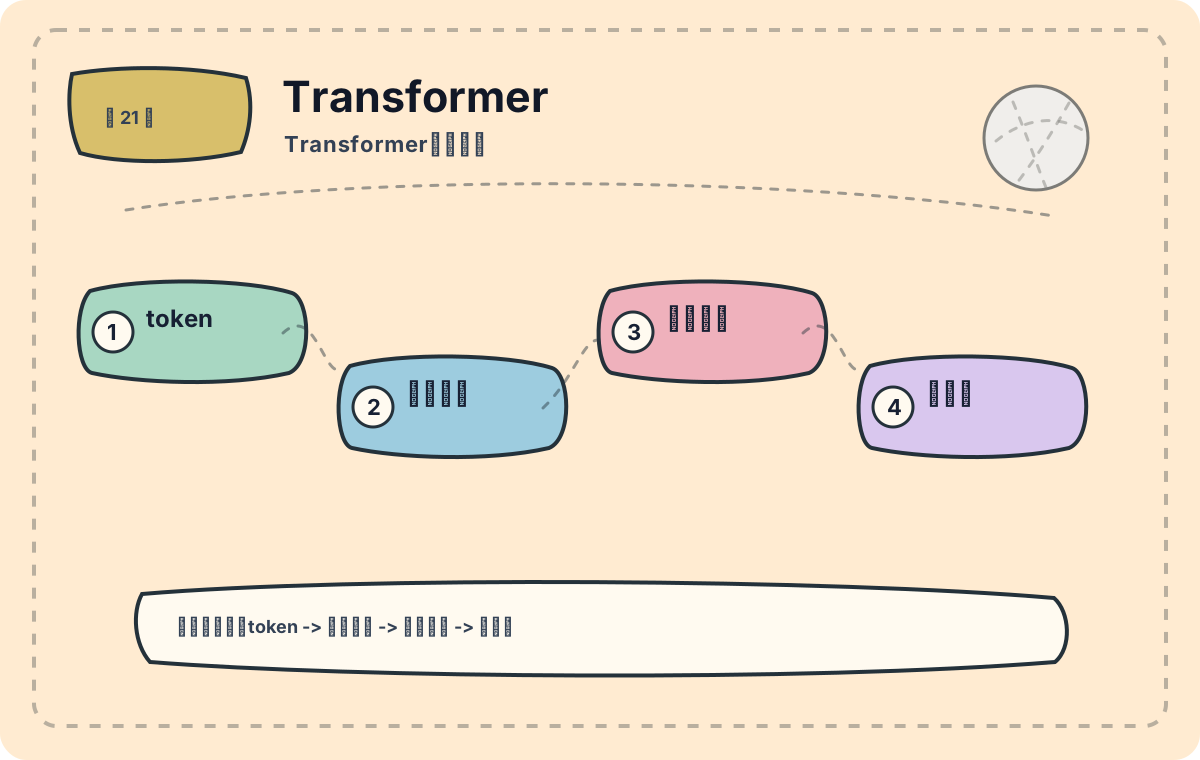
The Transformer shifts sequence modeling from step-by-step recurrence to simultaneously perceiving relationships among all tokens. To understand it, begin by examining how the attention matrix distributes information. This article focuses on evaluation: speed, accuracy, GPU memory usage, and reproducible configuration must all be recorded together—no single metric tells the full story.
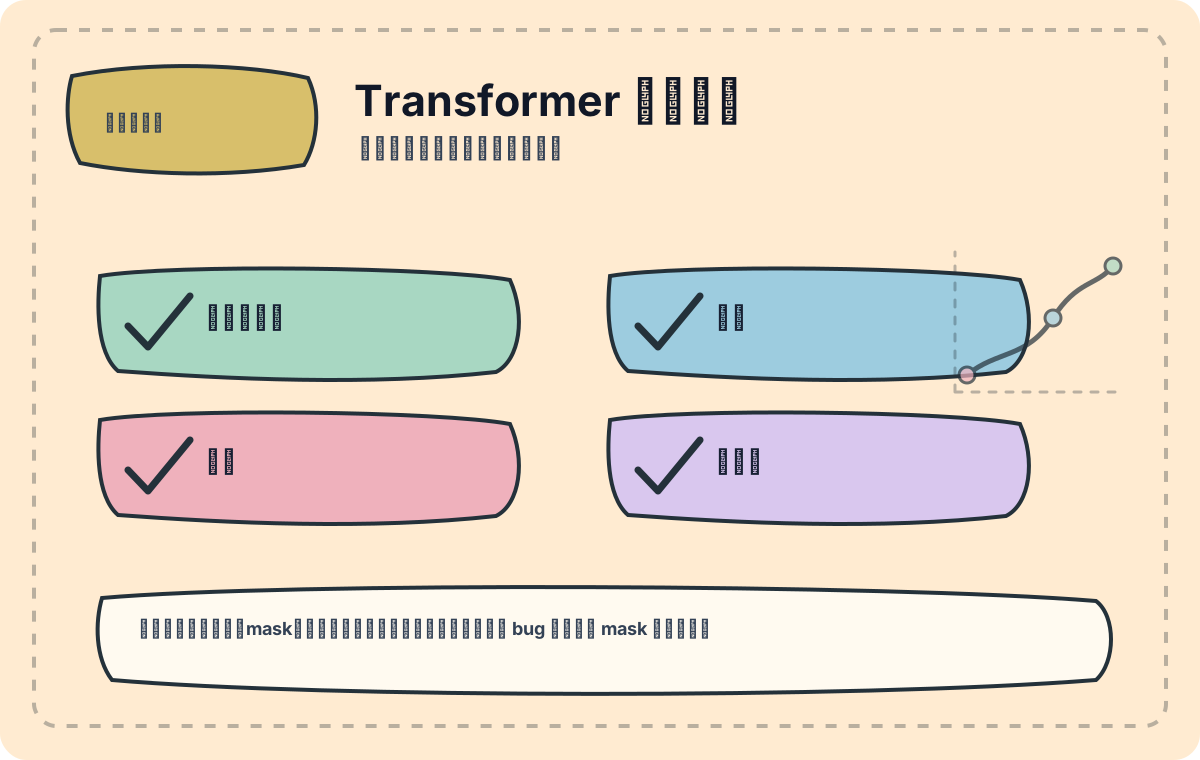
I will verify sequence length, attention masks, positional encodings, and the shapes of multi-head outputs. Attention-related bugs often hide in mask logic and tensor dimensions.
Building upon RNNs’ strong performance on sequential data, the Transformer introduces a fundamentally new architectural paradigm. In the previous article, we explored practical RNN applications in natural language processing (NLP); here, we delve into the Transformer’s architecture and its core components—laying the groundwork for the next article, which will examine the Transformer’s key advantages.
Core Architecture of the Transformer
The Transformer follows an encoder-decoder design and is widely used in NLP tasks such as machine translation and text generation. Its central innovation is the complete elimination of recurrent structures—replacing them with self-attention mechanisms to capture relationships among elements in a sequence.
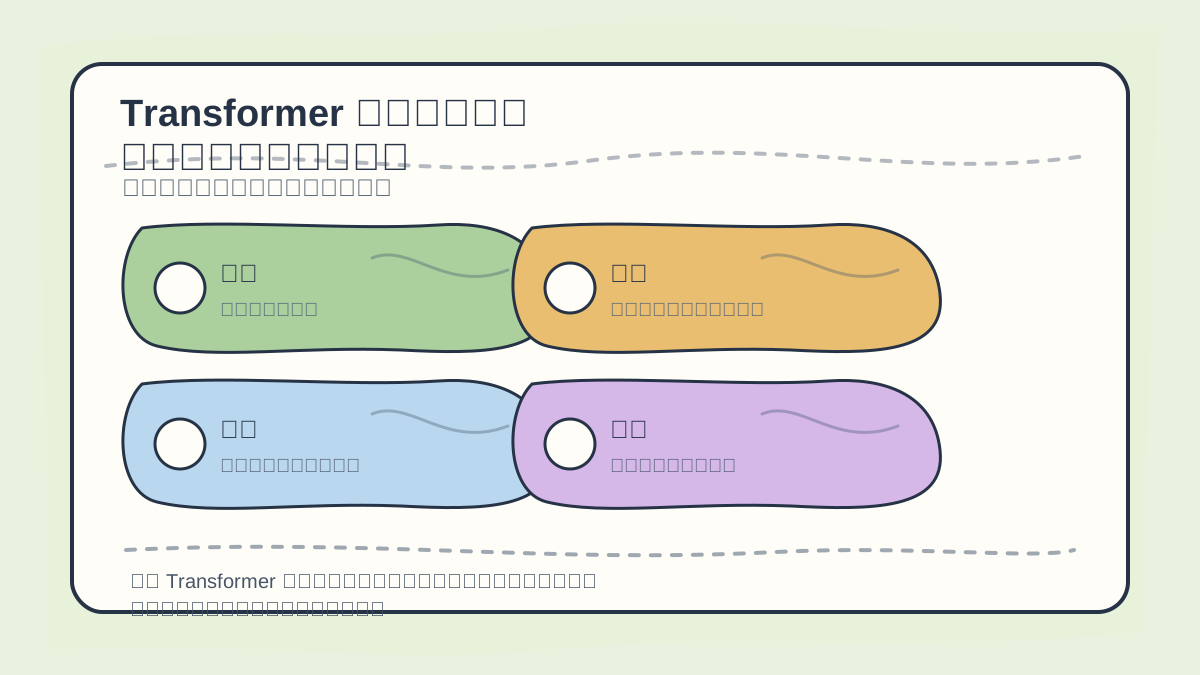
When analyzing the Transformer architecture, first inspect: input embeddings, positional encodings, multi-head attention, feed-forward networks, residual connections with layer normalization, and output task heads.
Encoder and Decoder
The Transformer consists of two main components: the encoder and the decoder.
-
Encoder: Composed of a stack of identical layers. Each layer contains two sub-layers:
- Self-Attention Layer: Computes the relative importance among all positions in the current input sequence. Its core operation computes scaled dot-products of query (Q), key (K), and value (V) matrices:
Here, is the dimensionality of the keys, and
softmaxnormalizes the attention scores into weights.- Feed-Forward Neural Network: Applies two linear transformations with a non-linear activation function—typically ReLU—in between.
-
Decoder: Also composed of stacked layers. In addition to self-attention and feed-forward sub-layers, each decoder layer includes a third sub-layer: encoder-decoder attention, which allows the decoder to attend to relevant information from the encoder’s output.
Residual Connections and Layer Normalization
Each sub-layer employs a residual connection, ensuring stable signal propagation during backpropagation. This is followed by layer normalization, which accelerates convergence and mitigates gradient vanishing during training.
Positional Encoding
Because the Transformer lacks inherent sequential order, positional encoding is introduced as a critical mechanism to convey token position information. These encodings are added directly to the input embeddings. The standard sinusoidal formulation is:
After reading “Transformer Architecture Analysis”, revisit three questions:
What problem does it solve?
Which step is most error-prone?
Can I run a small working example end-to-end?
Here, is the position index, is the dimension index, and is the embedding dimension.
Case Study: Machine Translation
In machine translation, the Transformer demonstrates exceptional real-world performance. Traditional RNNs often suffer from information loss when translating long sentences; the Transformer overcomes this via self-attention, effectively capturing long-range dependencies—and thereby significantly improving translation quality.
A partial TensorFlow implementation of the Transformer’s positional encoding looks like this:
import tensorflow as tf

def get_positional_encoding(maximum_position_encoding, d_model):
    angle_rads = tf.keras.backend.arange(maximum_position_encoding, dtype=tf.float32)[:, tf.newaxis] / tf.pow(10000, (2 * (tf.keras.backend.arange(d_model, dtype=tf.float32) // 2)) / d_model)
    angle_rads[0:, 0::2] = tf.sin(angle_rads[0:, 0::2])  # dim 2i
    angle_rads[0:, 1::2] = tf.cos(angle_rads[0:, 1::2])  # dim 2i+1
    return angle_rads
This code generates sinusoidal positional encodings and adds them to input embeddings—enabling the model to infer token positions within a sentence and make more accurate predictions.
When reviewing “Transformer Architecture Analysis”, place key concepts, procedural steps, and observable outcomes on the same page for efficient revision.
When practicing “Transformer Architecture Analysis”, write input conditions, processing actions, and observable results side-by-side—making future review faster and more reliable.
Summary
Through innovations including self-attention, residual connections, and positional encoding, the Transformer dramatically improves both the efficiency and effectiveness of sequence modeling. Compared to traditional RNNs, it offers unmatched advantages in capturing long-range dependencies and enabling full parallelization. In the next article, we will explore the Transformer’s concrete advantages in depth—and reveal its broad applicability across modern NLP tasks.
Apply This Lesson
Turn this article into AI software, model, API, and security decisions.
English Article FAQ
Use this article as evidence before choosing AI tools
How should I use this AI Tutorials article?
Use it as the implementation or learning layer, then connect the idea to AI software buyer guides, tool comparisons, benchmarks, API choices, and security checks before making a production decision.
Is this English article different from the Chinese original?
The English edition is localized for global AI readers while preserving the original diagrams, screenshots, prompts, code examples, and source context from the Chinese article.
What should I read after Transformer Architecture Explained?
Continue with AI Software Buyer Guides, AI Tools Workbench, Best AI Coding Agents, AI Model Benchmarks, OpenAI vs Anthropic API, or LLM Security Tools depending on the decision you need to make.
Can this article alone choose an AI product or model?
No. Treat the article as evidence and context, then validate fit with pricing, privacy requirements, integration effort, benchmark results, workflow tests, and fallback planning.
Continue