English translation
Assume we have a pre-built character vocabulary and training data
AI Article Decision Snapshot
Turn the lesson into workflow, model, budget, and security checks before choosing tools.
Use this quick snapshot before leaving the article. It keeps the next search tied to practical AI software, model/API, cost, privacy, and implementation questions.
Workflow fit
Identify the real job behind the article: coding, research, document review, support, analytics, content, or internal automation.
Model or tool decision
Decide whether the next step is a software shortlist, an AI tool comparison, an API platform choice, or a model benchmark.
Budget and usage signal
Estimate seats, API calls, prompt volume, retries, review time, and fallback work before assuming the workflow is cheap.
Security and privacy review
Check whether source code, customer data, private documents, prompts, logs, or embeddings will enter the AI workflow.
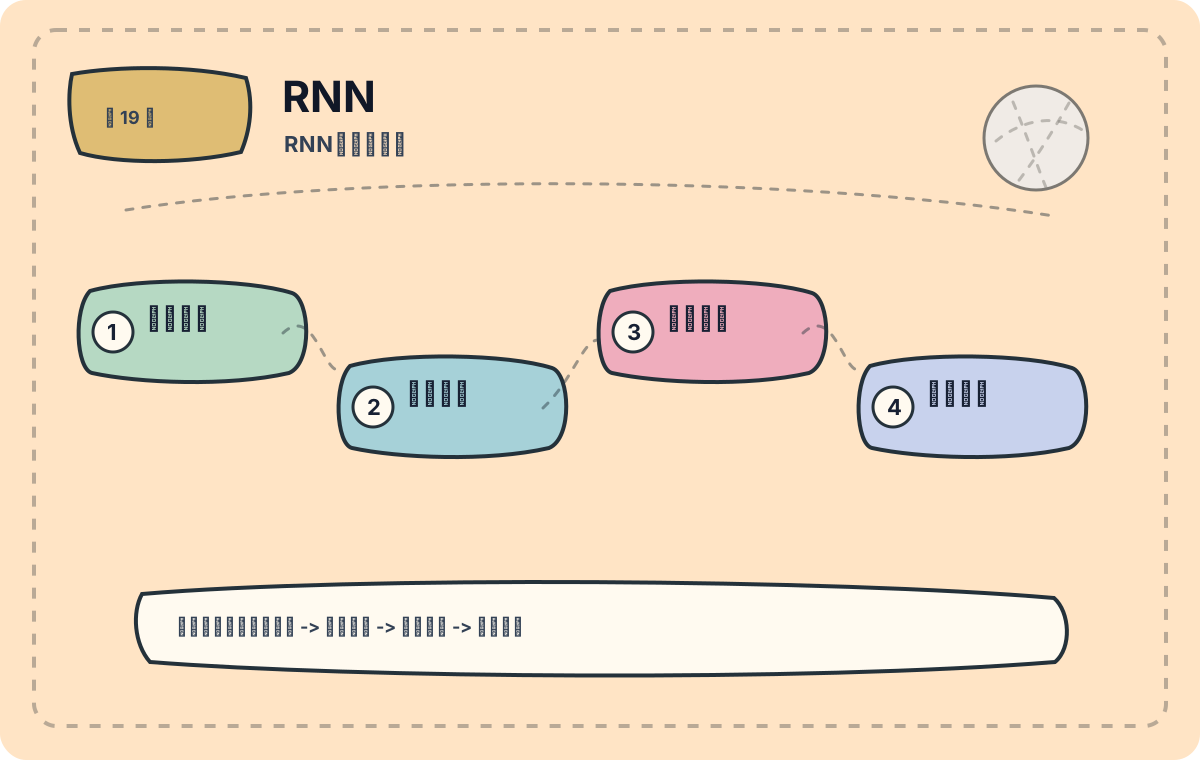
RNNs unroll sequences step-by-step over time and maintain contextual information via hidden states. To understand them, first clearly map how data flows at each time step. This article focuses on structure: begin by sketching the data flow, key modules, and output layer—then revisit formulas or code.

I’ll verify the ordering of three dimensions: batch, time step, and feature. Incorrect dimension ordering is common in sequence modeling.
In the previous article, we thoroughly explored practical applications of Convolutional Neural Networks (CNNs), covering implementation workflows for tasks such as image classification and object detection. In this section, we shift focus to the transformation mechanism of Recurrent Neural Networks (RNNs) and examine how they process sequential data.
Fundamental Principles of RNNs
A Recurrent Neural Network (RNN) is a neural network architecture specifically designed for sequential data. Unlike traditional feedforward networks, RNNs possess hidden states that retain and leverage information from prior time steps, enabling dynamic state updates. This property makes RNNs particularly effective for time-series data—including text, speech, and video.
At any given time step , the hidden state depends not only on the current input , but also on the previous hidden state . The core recurrence relation is expressed as:
where and are weight matrices for the hidden state and input respectively, and denotes an activation function—commonly tanh or ReLU.
The Transformation Mechanism of RNNs
In the RNN transformation mechanism, an input sequence is fed into the network incrementally. At each step, the hidden state update incorporates both the current input and accumulated historical information. This enables RNNs to “remember” and “forget” information across the temporal dimension. However, standard RNNs suffer from vanishing or exploding gradients when learning long sequences.
To address this limitation, Long Short-Term Memory (LSTM) and Gated Recurrent Unit (GRU) architectures were introduced. Both employ gating mechanisms to selectively control information storage and forgetting—effectively resolving long-range dependency challenges.
The Gating Mechanism in LSTMs
LSTMs refine memory flow using three distinct gates: the forget gate, input gate, and output gate. Their core state-update equations are as follows:
- Forget gate: determines which information to discard from the cell state
- Input gate: determines which new information to store in the cell state
- Output gate: determines which part of the cell state to output
- Candidate cell state update: computes a candidate value for the cell state
- Final cell state and hidden state update:
Through these equations, LSTMs effectively handle long-range dependencies while selectively preserving relevant information at each time step.
Application of the Transformation Mechanism in Practice
The RNN transformation mechanism finds broad application across domains. Below is a concrete example: text generation using LSTM.
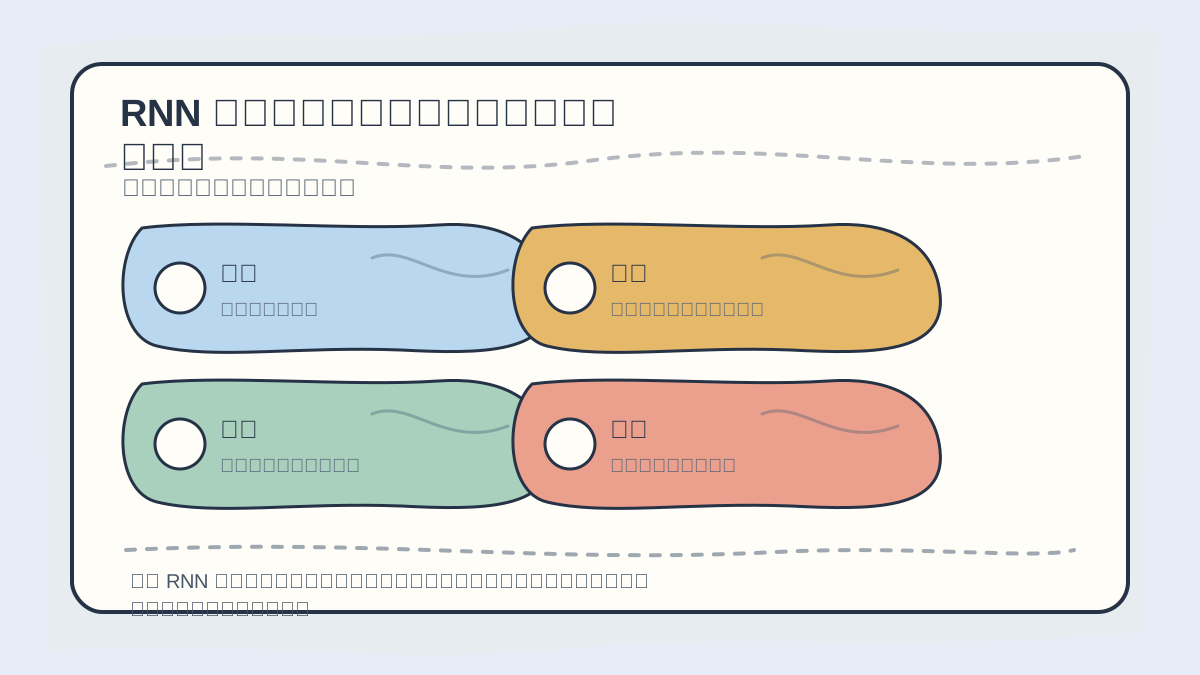
When grasping the RNN transformation mechanism, first consider: input sequence, hidden state, weight sharing, time-step updates, gradient propagation, and the long-term dependency problem.
Text Generation Example
Suppose we have a short text string and wish to train an LSTM model to generate new text.
import numpy as np
import tensorflow as tf

# Assume we have a pre-built character vocabulary and training data
char_to_idx = {'a': 0, 'b': 1, 'c': 2}  # Example vocabulary mapping
idx_to_char = {i: char for char, i in char_to_idx.items()}
text = "abcabcabc"

# Hyperparameters
seq_length = 3
vocab_size = len(char_to_idx)
embedding_dim = 256
hidden_units = 128

# Data preprocessing
inputs = []
targets = []

for i in range(len(text) - seq_length):
    inputs.append([char_to_idx[char] for char in text[i:i + seq_length]])
    targets.append(char_to_idx[text[i + seq_length]])

# Convert to TensorFlow tensors
inputs = tf.convert_to_tensor(inputs)
targets = tf.convert_to_tensor(targets)

# Define LSTM model
model = tf.keras.models.Sequential([
    tf.keras.layers.Embedding(vocab_size, embedding_dim, batch_input_shape=[None, None]),
    tf.keras.layers.LSTM(hidden_units,
                          return_sequences=False,
                          recurrent_initializer='glorot_uniform'),
    tf.keras.layers.Dense(vocab_size)
])

model.compile(loss=tf.keras.losses.SparseCategoricalCrossentropy(from_logits=True), optimizer='adam')

# Train the model
model.fit(inputs, targets, epochs=100)

# Text generation function
def generate_text(model, start_string, num_generate=10):
    input_eval = [char_to_idx[s] for s in start_string]
    input_eval = tf.expand_dims(input_eval, 0)

    text_generated = []

    # Low-temperature sampling for more deterministic output
    temperature = 1.0
    model.reset_states()

    for i in range(num_generate):
        predictions = model(input_eval)
        predictions = tf.squeeze(predictions, 0) / temperature
        predicted_id = tf.random.categorical(predictions, num_samples=1)[-1, 0].numpy()

        input_eval = tf.expand_dims([predicted_id], 0)
        text_generated.append(idx_to_char[predicted_id])

    return start_string + ''.join(text_generated)

# Generate text
print(generate_text(model, start_string="ab", num_generate=10))
In this simplified example, the learned LSTM transformation mechanism enables the model to generate plausible continuations—starting from the prefix "ab".
If you haven’t fully internalized “RNN Transformation Mechanism”, revisit the four actions outlined on this card to reinforce understanding.
When reviewing “RNN Transformation Mechanism”, avoid jumping straight into large-scale projects. Instead, first validate your conceptual grasp using a minimal, working example.
Summary
This article provided an in-depth analysis of RNNs and their transformation mechanisms—with particular emphasis on LSTM architecture and usage. RNNs’ unique ability to process sequential information underpins their strong performance in tasks like sequence generation and sentiment analysis. In the next article, we will explore concrete real-world applications of RNNs, further illuminating their pivotal role in modern deep learning.
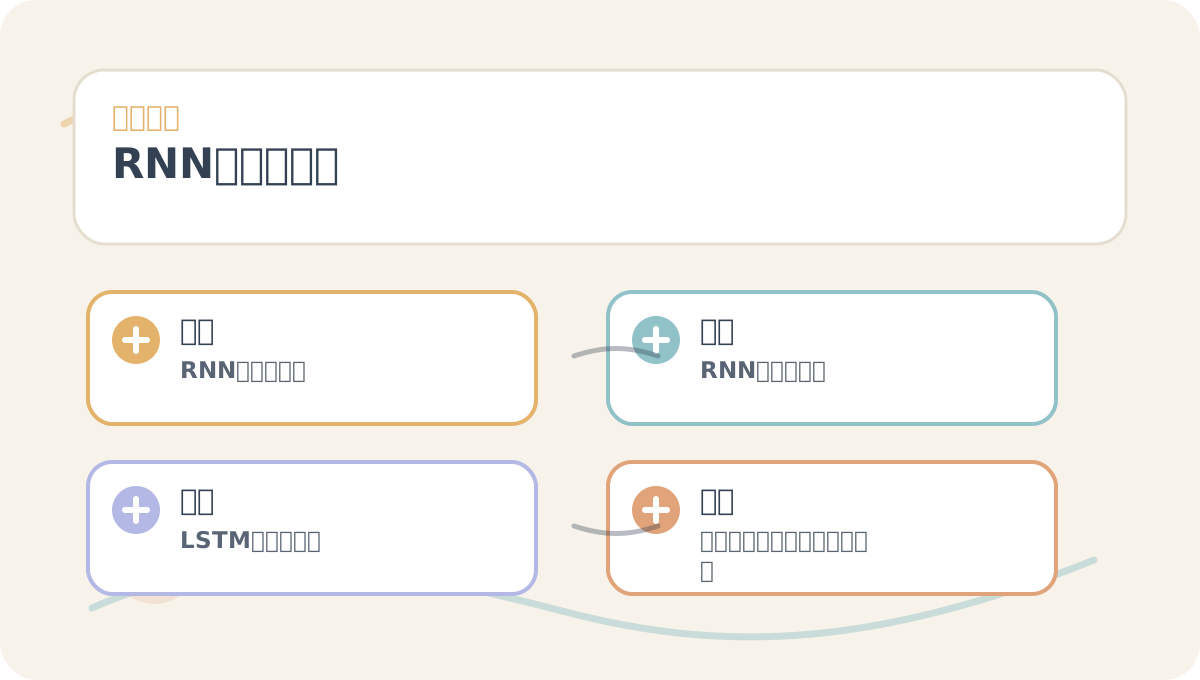
Before reading “RNN Transformation Mechanism”, use the accompanying diagram to confirm your understanding of the central narrative. After reading, reflect: which steps can you implement directly? Which concepts still require supplemental study?
Apply This Lesson
Turn this article into AI software, model, API, and security decisions.
English Article FAQ
Use this article as evidence before choosing AI tools
How should I use this AI Tutorials article?
Use it as the implementation or learning layer, then connect the idea to AI software buyer guides, tool comparisons, benchmarks, API choices, and security checks before making a production decision.
Is this English article different from the Chinese original?
The English edition is localized for global AI readers while preserving the original diagrams, screenshots, prompts, code examples, and source context from the Chinese article.
What should I read after Assume we have a pre-built character vocabulary and training data?
Continue with AI Software Buyer Guides, AI Tools Workbench, Best AI Coding Agents, AI Model Benchmarks, OpenAI vs Anthropic API, or LLM Security Tools depending on the decision you need to make.
Can this article alone choose an AI product or model?
No. Treat the article as evidence and context, then validate fit with pricing, privacy requirements, integration effort, benchmark results, workflow tests, and fallback planning.
Continue