English translation
MobileNet Feature Fusion Explained
AI Article Decision Snapshot
Turn the lesson into workflow, model, budget, and security checks before choosing tools.
Use this quick snapshot before leaving the article. It keeps the next search tied to practical AI software, model/API, cost, privacy, and implementation questions.
Workflow fit
Identify the real job behind the article: coding, research, document review, support, analytics, content, or internal automation.
Model or tool decision
Decide whether the next step is a software shortlist, an AI tool comparison, an API platform choice, or a model benchmark.
Budget and usage signal
Estimate seats, API calls, prompt volume, retries, review time, and fallback work before assuming the workflow is cheap.
Security and privacy review
Check whether source code, customer data, private documents, prompts, logs, or embeddings will enter the AI workflow.
At its core, MobileNet decomposes standard convolutions into two lighter-weight operations. Its primary design goal is stable performance on compute-constrained devices. This article begins by establishing a holistic mental map: what problem it solves, what its core modules are, and which types of tasks it best suits.
I will simultaneously track model size, latency, input resolution, and accuracy. For mobile models, accuracy alone is insufficient.
In the previous article, we explored optimization strategies for the Inception model and gained deep appreciation for the critical role of feature extraction in deep learning. This article continues that exploration—focusing specifically on feature fusion techniques within MobileNet—to better understand how to efficiently extract and leverage features in lightweight neural networks. Feature fusion is pivotal for boosting model performance, especially in edge-device and real-time applications.
Overview of MobileNet
MobileNet is a lightweight convolutional neural network (CNN) architecture explicitly designed for mobile and resource-constrained devices. Compared with traditional CNNs, MobileNet employs depthwise separable convolutions to drastically reduce both model size and computational cost. By factorizing convolution operations, MobileNet achieves high accuracy while significantly lowering computational complexity.
Why Feature Fusion Is Necessary
Feature fusion refers to the process of combining features from multiple layers or multiple networks to improve overall model performance. For MobileNet, effective feature fusion enhances the network’s ability to learn across different feature scales—leading to improved classification accuracy and stronger generalization capability.
Common Feature Fusion Strategies
Below are several widely adopted feature fusion strategies in mobile networks:
- Feature Concatenation: Stacking feature maps from different convolutional layers along the channel dimension.
- Weighted Summation: Applying learnable or fixed weights to feature maps from different layers, then performing element-wise addition.
- Attention Mechanisms: Introducing attention modules to dynamically reweight features—emphasizing more informative ones and suppressing less relevant ones.
Feature Fusion Examples in MobileNet
1. Feature Concatenation Example
We can implement feature fusion via simple concatenation. Here's a PyTorch example demonstrating how to concatenate feature maps from two distinct layers:
import torch
import torch.nn as nn

class FeatureFusion(nn.Module):
    def __init__(self):
        super(FeatureFusion, self).__init__()
        self.conv1 = nn.Conv2d(32, 64, kernel_size=3, stride=1, padding=1)  # First layer
        self.conv2 = nn.Conv2d(64, 128, kernel_size=3, stride=1, padding=1) # Second layer

    def forward(self, x):
        x1 = self.conv1(x)  # Extract features from first layer
        x2 = self.conv2(x)  # Extract features from second layer
        fused = torch.cat((x1, x2), dim=1)  # Concatenate along channel dimension
        return fused

model = FeatureFusion()
input_tensor = torch.randn(1, 32, 224, 224)
output = model(input_tensor)
print(f"Output feature map shape: {output.shape}")
In this example, features are extracted via conv1 and conv2, then concatenated using torch.cat() along the channel dimension. This approach effectively combines multi-level features while increasing channel depth—benefiting subsequent high-level representation learning.
2. Weighted Summation Example
Weighted summation offers greater flexibility, enabling the model to learn the relative importance of features from different layers. Below is a simple implementation:
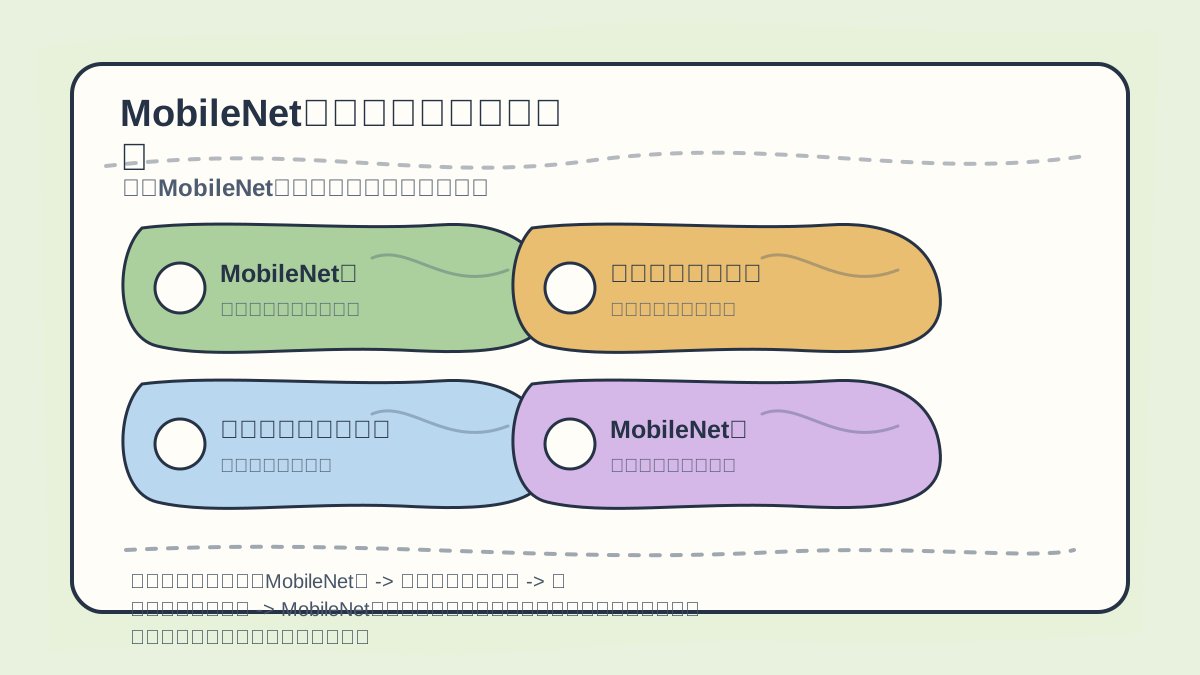
While reading this article, treat the sequence “MobileNet Overview → Necessity of Feature Fusion → Common Fusion Methods → MobileNet Implementation” as a verification checklist: first identify the object, path, and supporting evidence; then revisit concrete examples, code snippets, or metrics for validation.
class WeightedSumFusion(nn.Module):
    def __init__(self):
        super(WeightedSumFusion, self).__init__()
        self.conv1 = nn.Conv2d(32, 64, kernel_size=3, stride=1, padding=1)
        self.conv2 = nn.Conv2d(32, 64, kernel_size=3, stride=1, padding=1)
        self.alpha = 0.5  # Weighting factor

    def forward(self, x):
        x1 = self.conv1(x)
        x2 = self.conv2(x)
        fused = self.alpha * x1 + (1 - self.alpha) * x2  # Weighted element-wise sum
        return fused

model = WeightedSumFusion()
output = model(input_tensor)
print(f"Output feature map shape: {output.shape}")
Here, a fixed weighting factor alpha controls the contribution of each feature map. This method allows fine-grained control over feature influence, enhancing model adaptability.
3. Attention-Based Fusion
Integrating attention mechanisms into feature fusion enables the model to focus selectively on the most salient features. As an illustrative example, we adopt a bottleneck attention design:
After finishing “MobileNet Feature Fusion”, reflect on three questions: What problem does it solve? At which step is error most likely to occur? Can you reproduce it end-to-end with a minimal working example?
class AttentionFusion(nn.Module):
    def __init__(self):
        super(AttentionFusion, self).__init__()
        self.conv1 = nn.Conv2d(32, 64, kernel_size=3, stride=1, padding=1)
        self.conv2 = nn.Conv2d(32, 64, kernel_size=3, stride=1, padding=1)
        self.fc = nn.Linear(64 * 2, 2)  # Compress concatenated features to attention logits

    def forward(self, x):
        x1 = self.conv1(x)
        x2 = self.conv2(x)
        # Flatten concatenated features and compute attention weights
        concat_flat = torch.flatten(torch.cat((x1, x2), dim=1), start_dim=1)
        attention_weights = torch.softmax(self.fc(concat_flat), dim=1)
        # Broadcast weights and apply to feature maps
        fused = (attention_weights[:, 0].view(-1, 64, 1, 1) * x1
               + attention_weights[:, 1].view(-1, 64, 1, 1) * x2)
        return fused

model = AttentionFusion()
output = model(input_tensor)
print(f"Output feature map shape: {output.shape}")
In this implementation, a fully connected layer computes attention logits from flattened concatenated features. After applying softmax, the resulting weights are broadcast and used to linearly combine the two feature maps—allowing the model to emphasize the most discriminative features.
When reviewing “MobileNet Feature Fusion”, place key concepts, procedural steps, and observable outcomes side-by-side on a single page for efficient revision.
When practicing “MobileNet Feature Fusion”, write down input conditions, processing actions, and visible outputs together—making future review and debugging straightforward.
Summary
This article examined feature fusion techniques in MobileNet—including feature concatenation, weighted summation, and attention-based fusion—with practical PyTorch implementations. Well-designed feature fusion not only improves MobileNet’s task performance but also delivers practical benefits for deployment on edge devices. In the next article, we will conduct a comparative analysis of MobileNet against other network architectures—highlighting performance differences across concrete application scenarios.
Apply This Lesson
Turn this article into AI software, model, API, and security decisions.
English Article FAQ
Use this article as evidence before choosing AI tools
How should I use this AI Tutorials article?
Use it as the implementation or learning layer, then connect the idea to AI software buyer guides, tool comparisons, benchmarks, API choices, and security checks before making a production decision.
Is this English article different from the Chinese original?
The English edition is localized for global AI readers while preserving the original diagrams, screenshots, prompts, code examples, and source context from the Chinese article.
What should I read after MobileNet Feature Fusion Explained?
Continue with AI Software Buyer Guides, AI Tools Workbench, Best AI Coding Agents, AI Model Benchmarks, OpenAI vs Anthropic API, or LLM Security Tools depending on the decision you need to make.
Can this article alone choose an AI product or model?
No. Treat the article as evidence and context, then validate fit with pricing, privacy requirements, integration effort, benchmark results, workflow tests, and fallback planning.
Continue