English translation
Load pre-trained MobileNet model
AI Article Decision Snapshot
Turn the lesson into workflow, model, budget, and security checks before choosing tools.
Use this quick snapshot before leaving the article. It keeps the next search tied to practical AI software, model/API, cost, privacy, and implementation questions.
Workflow fit
Identify the real job behind the article: coding, research, document review, support, analytics, content, or internal automation.
Model or tool decision
Decide whether the next step is a software shortlist, an AI tool comparison, an API platform choice, or a model benchmark.
Budget and usage signal
Estimate seats, API calls, prompt volume, retries, review time, and fallback work before assuming the workflow is cheap.
Security and privacy review
Check whether source code, customer data, private documents, prompts, logs, or embeddings will enter the AI workflow.
At its core, MobileNet decomposes standard convolutions into two lighter, sequential operations. Its primary design goal is stable performance on devices with limited computational resources. This article focuses on evaluation: speed, accuracy, memory footprint, and reproducible experimental settings must all be recorded together—no single metric tells the full story.
I will record model size, inference latency, input resolution, and accuracy simultaneously. For mobile models, accuracy alone is insufficient.
In prior discussions, we explored how MobileNet improves performance and efficiency through feature fusion. The following sections focus on comparing MobileNet against other mainstream architectures—particularly in terms of efficiency versus accuracy—to lay the groundwork for subsequent exploration of DenseNet in real-time detection tasks.
Introduction to MobileNet
The MobileNet family is a series of lightweight neural networks developed by Google, specifically designed for efficient execution on mobile and resource-constrained devices. It employs depthwise separable convolutions, dramatically reducing both parameter count and computational cost while retaining relatively high accuracy. As a result, MobileNet achieves significant optimization in FLOPs.
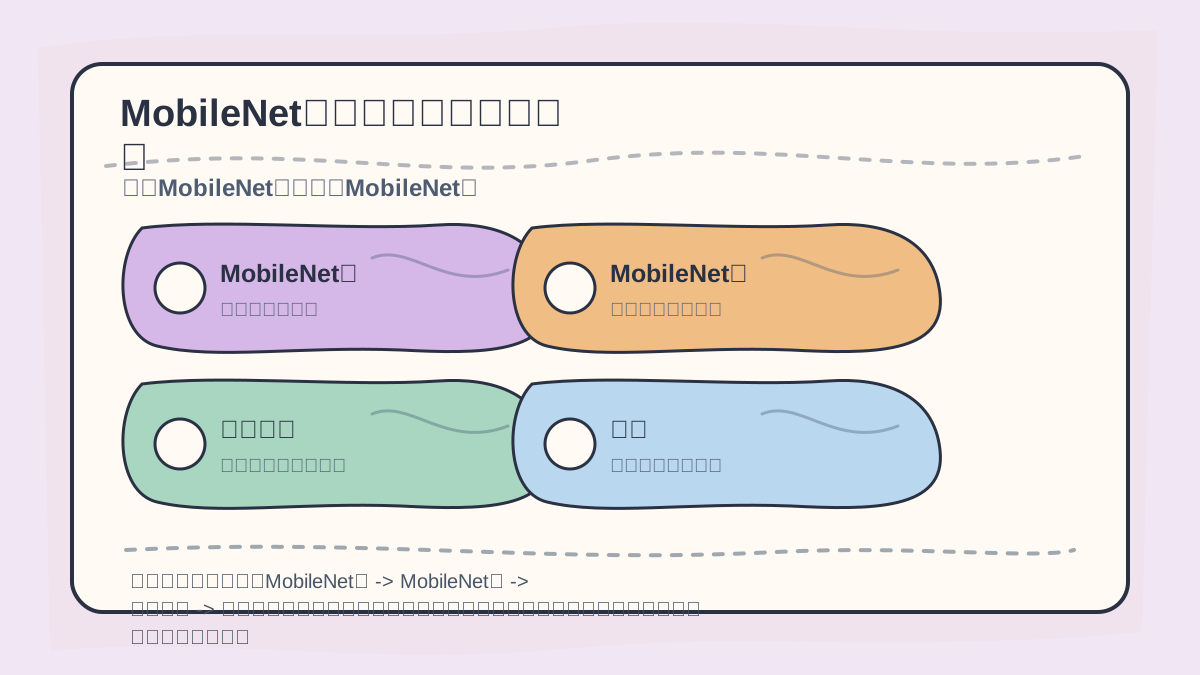
While reading this article, treat “MobileNet Intro → MobileNet vs. Others → Case Study → Review” as a verification checklist: first clarify the topic, learning path, and validation criteria; then revisit code, examples, or metrics to verify understanding.
MobileNet vs. Other Architectures
Selecting a neural network architecture requires balancing multiple factors—including model size, inference speed, and accuracy. Table 1 compares MobileNet against several mainstream networks (e.g., VGG, ResNet, DenseNet, and EfficientNet) across these dimensions.
Before diving into the main text of “MobileNet Architecture Comparison,” align the questions, keywords, actions, and acceptance criteria shown in the diagram—this makes reading more efficient. After finishing, try re-explaining the content using your own project context.
| Architecture | Parameters (M) | FLOPs (B) | Top-1 Accuracy | Typical Use Cases |
|---|---|---|---|---|
| MobileNet | 4.2 | 0.575 | 70.6% | Mobile & embedded devices |
| VGG | 138 | 15.5 | 71.6% | General image classification |
| ResNet | 25.6 | 4.1 | 76.0% | Deep learning benchmarks |
| DenseNet | 8.0 | 4.0 | 74.9% | Image classification |
| EfficientNet | 5.3 | 0.39 | 84.3% | Mobile & computer vision |
As shown in the table, MobileNet excels in parameter efficiency and computational complexity—making it especially well-suited for resource-constrained environments.
Case Study
Let’s deepen our understanding of MobileNet’s effectiveness through a concrete example: real-time face recognition. Using MobileNet, we can achieve efficient face detection with minimal latency:
import cv2
import numpy as np
from keras.models import load_model

# Load pre-trained MobileNet model
model = load_model('mobilenet_face_recognition.h5')

# Initialize video capture
video_capture = cv2.VideoCapture(0)

while True:
    # Capture frame-by-frame
    ret, frame = video_capture.read()

    # Preprocess the frame
    input_frame = cv2.resize(frame, (224, 224))
    input_frame = np.expand_dims(input_frame, axis=0) / 255.0

    # Run inference
    predictions = model.predict(input_frame)
    # Assume index 1 corresponds to "face detected"
    if predictions[0][1] > 0.5:
        print("Face detected!")

    # Display the result
    cv2.imshow('Video', frame)

    # Press 'q' to exit
    if cv2.waitKey(1) & 0xFF == ord('q'):
        break

video_capture.release()
cv2.destroyAllWindows()
In this example, MobileNet enables a simple yet functional real-time face recognition pipeline. Its ability to meet strict latency requirements on modern mobile hardware clearly demonstrates its efficiency.
After studying “MobileNet Architecture Comparison,” try adapting it to your own use case—pay close attention to whether inputs, processing steps, and outputs align coherently.
To apply “MobileNet Architecture Comparison” to your own task, start small: isolate and validate just one critical decision point.
Summary
The above comparison highlights MobileNet’s strengths under resource constraints—especially where low computational demand must coexist with acceptable accuracy. Compared to standard architectures like VGG and ResNet, MobileNet delivers outstanding performance as a lightweight model.
In the next article, we’ll explore DenseNet’s application in real-time detection—analyzing its advantages in feature reuse and gradient flow, and how it further improves upon MobileNet’s efficiency.
Apply This Lesson
Turn this article into AI software, model, API, and security decisions.
English Article FAQ
Use this article as evidence before choosing AI tools
How should I use this AI Tutorials article?
Use it as the implementation or learning layer, then connect the idea to AI software buyer guides, tool comparisons, benchmarks, API choices, and security checks before making a production decision.
Is this English article different from the Chinese original?
The English edition is localized for global AI readers while preserving the original diagrams, screenshots, prompts, code examples, and source context from the Chinese article.
What should I read after Load pre-trained MobileNet model?
Continue with AI Software Buyer Guides, AI Tools Workbench, Best AI Coding Agents, AI Model Benchmarks, OpenAI vs Anthropic API, or LLM Security Tools depending on the decision you need to make.
Can this article alone choose an AI product or model?
No. Treat the article as evidence and context, then validate fit with pricing, privacy requirements, integration effort, benchmark results, workflow tests, and fallback planning.
Continue