English translation
Example usage
AI Article Decision Snapshot
Turn the lesson into workflow, model, budget, and security checks before choosing tools.
Use this quick snapshot before leaving the article. It keeps the next search tied to practical AI software, model/API, cost, privacy, and implementation questions.
Workflow fit
Identify the real job behind the article: coding, research, document review, support, analytics, content, or internal automation.
Model or tool decision
Decide whether the next step is a software shortlist, an AI tool comparison, an API platform choice, or a model benchmark.
Budget and usage signal
Estimate seats, API calls, prompt volume, retries, review time, and fallback work before assuming the workflow is cheap.
Security and privacy review
Check whether source code, customer data, private documents, prompts, logs, or embeddings will enter the AI workflow.
SegNet focuses on the encoder-decoder process in semantic segmentation—particularly how compressed semantic information is reconstructed into pixel-level outputs. This article centers on architecture. We’ll first clarify the data flow, key modules, and output layer; only then will we revisit formulas or code.
I will compare the dimensions of the input image, ground-truth label map, and predicted segmentation map—and verify whether class-to-color mappings remain consistent.
In the previous article, we conducted a detailed walkthrough of YOLO’s source code to understand the fundamental structure and implementation of this object detection framework. Now, we shift our focus to an important model in the image segmentation domain: SegNet—specifically, its generative model.
Introduction to SegNet
SegNet is a deep learning model designed for image semantic segmentation, known for its strong performance and relatively low computational requirements. Its core idea is to achieve high-quality segmentation via an encoder-decoder architecture. SegNet consists primarily of an encoder and a decoder: the encoder extracts hierarchical features from the input image, while the decoder reconstructs a segmentation map at the original image resolution.
The SegNet encoder resembles the VGG network architecture, but its decoder—designed specifically for efficient upsampling—is SegNet’s defining innovation.
The SegNet Generative Model
1. Model Architecture
SegNet’s overall architecture is illustrated below:
Input Image → Encoder → Bottleneck → Decoder → Output Segmentation Map
- Encoder: Applies successive convolutional layers and pooling operations to extract increasingly abstract features.
- Bottleneck: Captures the most salient, compressed feature representations.
- Decoder: Reconstructs spatial resolution using transposed convolutions (deconvolutions) and upsampling, ultimately producing a dense pixel-wise segmentation map.
2. Key Formulas
In SegNet’s encoder, the convolution operation at layer is expressed as:
where denotes the output feature map at layer , is the convolutional kernel, is the bias term, and is a nonlinear activation function—typically ReLU.
The subsequent pooling operation yields:
In the decoder, upsampling (via transposed convolution) is formulated as:
3. Concrete Example
Suppose we aim to apply SegNet to a semantic segmentation task—for instance, segmenting vehicles, pedestrians, and buildings in street-scene images. We would prepare a labeled dataset such as Cityscapes and construct the SegNet model as follows:
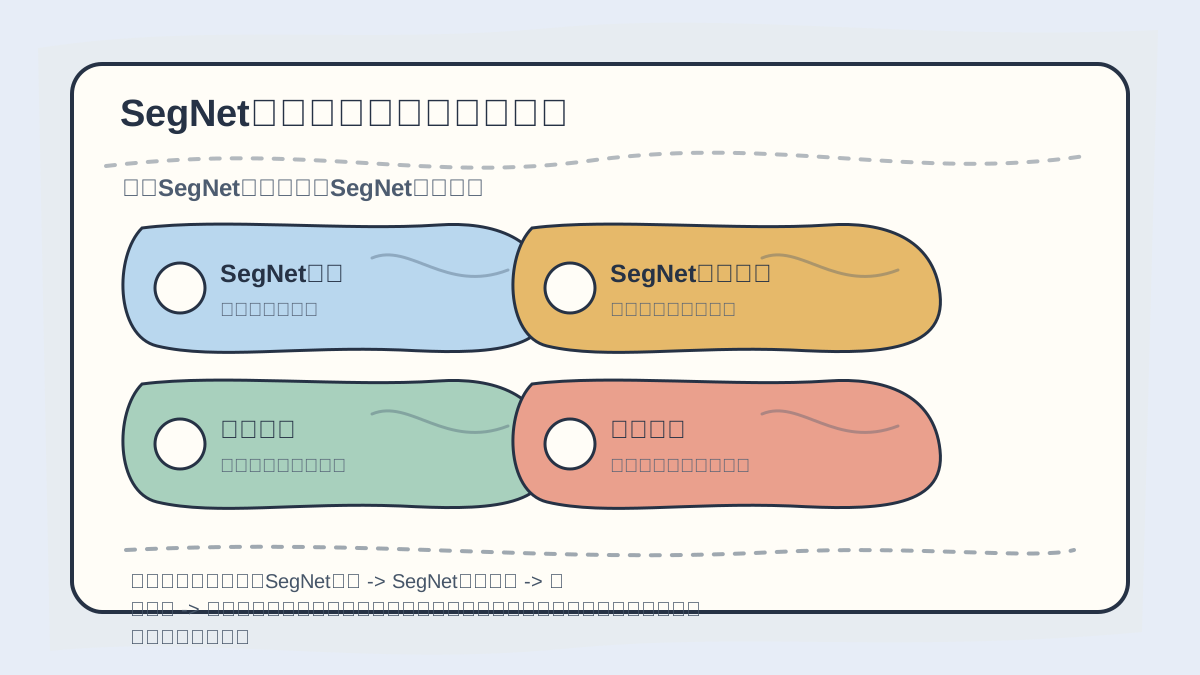
While reading this article, treat the sequence “SegNet Introduction → SegNet Generative Model → Model Architecture → Key Formulas” as a verification checklist: first identify the target object, processing path, and supporting evidence; then return to concrete examples, code, or evaluation metrics for cross-checking.
import tensorflow as tf
from tensorflow.keras import layers, models

def build_segnet(input_shape):
    inputs = layers.Input(shape=input_shape)

    # Encoder
    encoder = layers.Conv2D(64, (3, 3), activation='relu', padding='same')(inputs)
    encoder = layers.MaxPooling2D((2, 2))(encoder)
    encoder = layers.Conv2D(128, (3, 3), activation='relu', padding='same')(encoder)
    encoder = layers.MaxPooling2D((2, 2))(encoder)

    # Bottleneck
    bottleneck = layers.Conv2D(256, (3, 3), activation='relu', padding='same')(encoder)

    # Decoder
    decoder = layers.Conv2DTranspose(128, (3, 3), activation='relu', padding='same')(bottleneck)
    decoder = layers.UpSampling2D((2, 2))(decoder)
    decoder = layers.Conv2DTranspose(64, (3, 3), activation='relu', padding='same')(decoder)
    decoder = layers.UpSampling2D((2, 2))(decoder)

    outputs = layers.Conv2D(1, (1, 1), activation='sigmoid')(decoder)  # Assume binary segmentation

    model = models.Model(inputs, outputs)
    return model

# Example usage
model = build_segnet((128, 128, 3))
model.compile(optimizer='adam', loss='binary_crossentropy', metrics=['accuracy'])
model.summary()
This code demonstrates a basic SegNet implementation. It defines a model accepting RGB input images of size 128×128, with explicit construction of both encoder and decoder blocks.
If you haven’t fully internalized “SegNet Generative Model Deep Dive”, use the four actions on this card to retrace your understanding step by step.
When revisiting “SegNet Generative Model Deep Dive”, avoid launching large-scale projects upfront. Instead, start with one simple example to confirm whether the core workflow is clear.
Summary
This article provides a comprehensive overview of SegNet’s generative model—from architectural design principles to practical implementation details. Thanks to its efficiency and accuracy, SegNet has found widespread application in domains including autonomous driving and medical image analysis. In the next article, we will conduct a comparative analysis of SegNet against other segmentation models—highlighting their similarities, differences, and respective strengths.
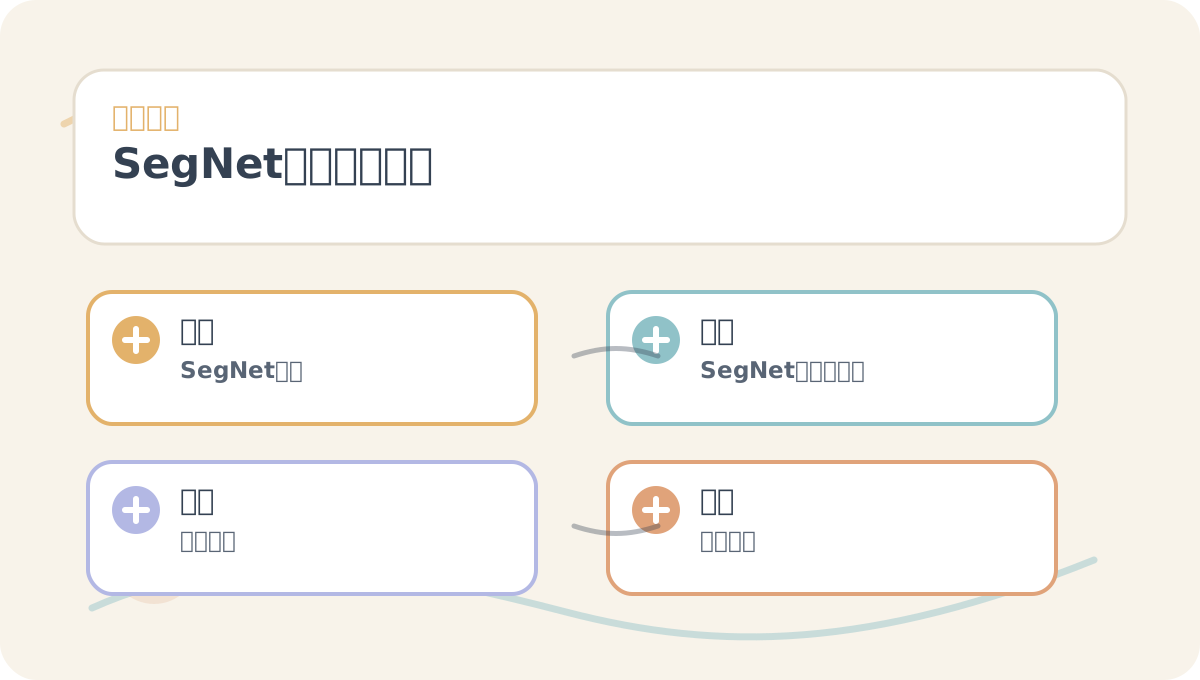
While reading “SegNet Generative Model Deep Dive”, treat the accompanying diagrams as navigational aids: first grasp the overall pipeline order; then examine the rationale behind each step; finally, verify boundary conditions and constraints.
We hope this article helps readers gain deeper insight into SegNet’s design philosophy and implementation strategy.
Apply This Lesson
Turn this article into AI software, model, API, and security decisions.
English Article FAQ
Use this article as evidence before choosing AI tools
How should I use this AI Tutorials article?
Use it as the implementation or learning layer, then connect the idea to AI software buyer guides, tool comparisons, benchmarks, API choices, and security checks before making a production decision.
Is this English article different from the Chinese original?
The English edition is localized for global AI readers while preserving the original diagrams, screenshots, prompts, code examples, and source context from the Chinese article.
What should I read after Example usage?
Continue with AI Software Buyer Guides, AI Tools Workbench, Best AI Coding Agents, AI Model Benchmarks, OpenAI vs Anthropic API, or LLM Security Tools depending on the decision you need to make.
Can this article alone choose an AI product or model?
No. Treat the article as evidence and context, then validate fit with pricing, privacy requirements, integration effort, benchmark results, workflow tests, and fallback planning.
Continue