English translation
YOLO Source Code Deep Dive
AI Article Decision Snapshot
Turn the lesson into workflow, model, budget, and security checks before choosing tools.
Use this quick snapshot before leaving the article. It keeps the next search tied to practical AI software, model/API, cost, privacy, and implementation questions.
Workflow fit
Identify the real job behind the article: coding, research, document review, support, analytics, content, or internal automation.
Model or tool decision
Decide whether the next step is a software shortlist, an AI tool comparison, an API platform choice, or a model benchmark.
Budget and usage signal
Estimate seats, API calls, prompt volume, retries, review time, and fallback work before assuming the workflow is cheap.
Security and privacy review
Check whether source code, customer data, private documents, prompts, logs, or embeddings will enter the AI workflow.
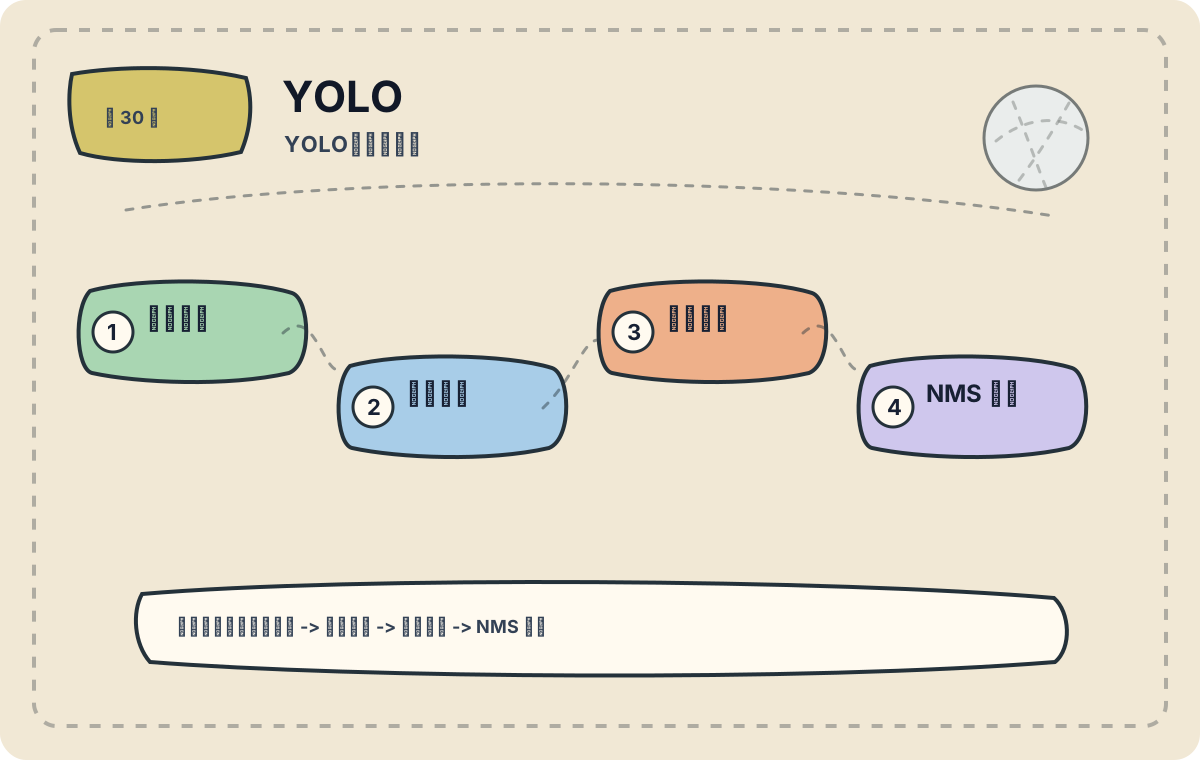
YOLO performs object detection in a single forward pass—making it ideal for real-time applications. To understand it effectively, visualize bounding boxes, class predictions, confidence scores, and Non-Maximum Suppression (NMS) together on the same diagram. This article focuses on implementation: do not merely copy code—systematically verify the environment setup, input tensor dimensions, model invocation, and output interpretation.
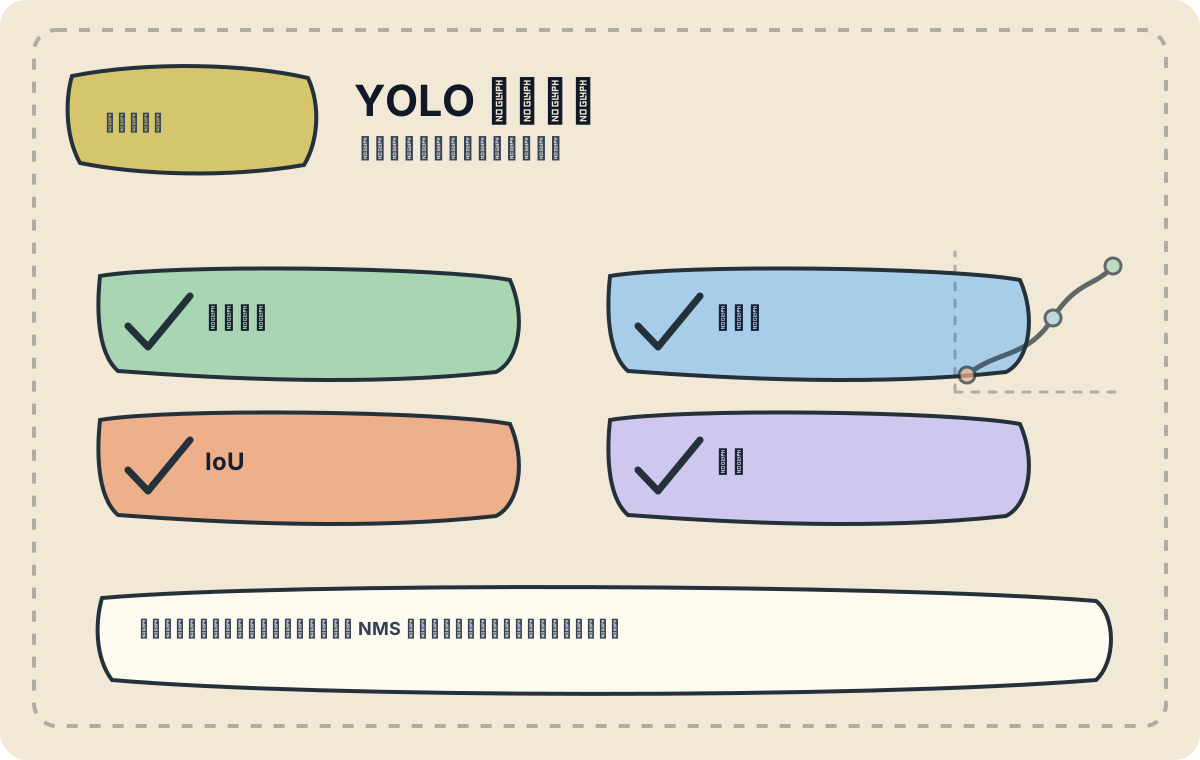
I begin by fixing the input image size, then explicitly set confidence and NMS thresholds. Without recording these threshold values, detection results become irreproducible.
In the previous article, we discussed YOLO’s segmentation-capable architecture and demonstrated how to adapt YOLO models for image segmentation tasks. This article dives deep into YOLO’s source code to provide a more granular understanding of its internal mechanics. We also ensure conceptual continuity across articles to help readers build a coherent mental model of the topic.
Overview of YOLO
YOLO (You Only Look Once) is a deep learning–based object detection algorithm. Its core design philosophy frames object detection as a regression problem—using a single neural network to jointly predict bounding box coordinates and class probabilities in one pass. YOLO’s primary advantages are high inference speed and strong accuracy—especially well-suited for real-time detection scenarios.
YOLO Source Code Structure
YOLO implementations are widely available in open-source frameworks such as Darknet, TensorFlow, and PyTorch. In this article, we use Darknet as our reference implementation to analyze the core YOLO codebase.
1. Environment Setup
First, ensure the Darknet framework is installed. Installation instructions are available on the project’s GitHub page.
git clone https://github.com/AlexeyAB/darknet
cd darknet
make
2. Data Preparation
To perform object detection with YOLO, you must prepare a labeled dataset. YOLO natively supports standard benchmarks like COCO and Pascal VOC. Below is a minimal data configuration example:
classes = 20
train = data/train.txt
valid = data/valid.txt
names = data/coco.names
backup = backup/
3. Network Architecture
YOLO’s network architecture consists primarily of convolutional layers, activation functions (commonly Leaky ReLU), and residual connections. For instance, in cfg/yolov3.cfg, layer definitions appear as follows:
[convolutional]
filters=255
size=1
stride=1
pad=1
activation=linear
4. Model Training
Once your dataset and network configuration are ready, training can begin. A typical training command looks like this:
./darknet detector train data/obj.data cfg/yolov3.cfg yolov3.weights
This command trains the YOLO model using the specified dataset and configuration file.
Code Walkthrough
The core YOLO logic resides primarily in src/yolo.c and src/network.c. Below are analyses of key functions.
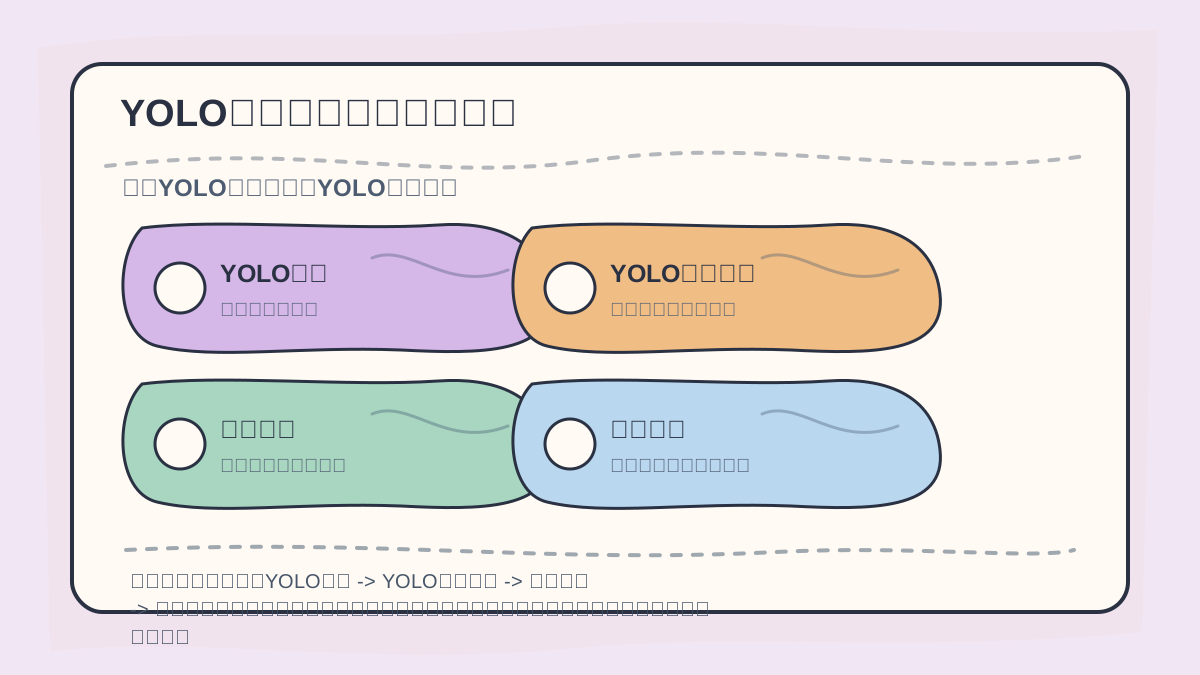
While reading this article, treat the sequence “YOLO Overview → YOLO Source Code Structure → Environment Setup → Data Preparation” as a verification checklist: first identify the objects, actions, and decision criteria, then revisit concrete examples, code snippets, or evaluation metrics to cross-check.
1. Forward Pass (Inference)
The inference pipeline is implemented in forward_network within network.c. This function propagates input images through successive convolutional and pooling layers to compute final outputs.
void forward_network(Layer *l) {
    for (int i = 0; i < l->n; ++i) {
        layer *current = &l[i];
        forward_layer(current);
    }
}
2. Loss Computation
YOLO employs a custom loss function composed of three main components: coordinate loss, confidence loss, and classification loss. Its implementation appears in the calculate_loss function inside detector.c.
float calculate_loss(network net, int index) {
    float total_loss = 0;
    // Calculate various components of the loss
    return total_loss;
}
3. NMS Postprocessing
YOLO applies Non-Maximum Suppression (NMS) to eliminate redundant bounding box predictions. The do_nms function in detector.c implements this step.
When reading “YOLO Source Code Deep Dive”, start by reviewing the task, concepts, exercises, and judgment points illustrated in the accompanying figures—then return to the main text to fill in technical details. This approach helps you quickly assess which real-world scenarios this content maps onto.
void do_nms(box *boxes, float **probs, int total, int classes, float nms_thresh) {
    // NMS implementation
}
4. Practical Example
Let’s walk through a simple end-to-end example: using a pre-trained YOLO model to detect objects in an image (test.jpg).
./darknet detector test data/obj.data cfg/yolov3.cfg backup/yolov3_final.weights test.jpg
This command produces an annotated output image highlighting all detected objects.
After completing “YOLO Source Code Deep Dive”, try adapting it to your own use case—pay close attention to whether inputs, internal processing steps, and outputs align coherently.
To apply “YOLO Source Code Deep Dive” to your own task, start small: isolate and validate just one critical decision point first.
Summary
This article thoroughly dissected YOLO’s source code structure and key functional components—laying a solid foundation for understanding the inner workings of modern object detection systems. We covered YOLO’s network architecture, training workflow, and essential code modules—extending earlier discussions about segmentation-aware networks.
In the next article, we’ll shift focus to another pivotal architecture: SegNet’s generative modeling approach—exploring its strengths and implementation specifics for semantic segmentation tasks.
We hope this deep dive equips you with both conceptual clarity and practical insight into how YOLO works—and how to implement and adapt it effectively!
Apply This Lesson
Turn this article into AI software, model, API, and security decisions.
English Article FAQ
Use this article as evidence before choosing AI tools
How should I use this AI Tutorials article?
Use it as the implementation or learning layer, then connect the idea to AI software buyer guides, tool comparisons, benchmarks, API choices, and security checks before making a production decision.
Is this English article different from the Chinese original?
The English edition is localized for global AI readers while preserving the original diagrams, screenshots, prompts, code examples, and source context from the Chinese article.
What should I read after YOLO Source Code Deep Dive?
Continue with AI Software Buyer Guides, AI Tools Workbench, Best AI Coding Agents, AI Model Benchmarks, OpenAI vs Anthropic API, or LLM Security Tools depending on the decision you need to make.
Can this article alone choose an AI product or model?
No. Treat the article as evidence and context, then validate fit with pricing, privacy requirements, integration effort, benchmark results, workflow tests, and fallback planning.
Continue