English translation
SegNet: Architecture Comparison and Discussion
AI Article Decision Snapshot
Turn the lesson into workflow, model, budget, and security checks before choosing tools.
Use this quick snapshot before leaving the article. It keeps the next search tied to practical AI software, model/API, cost, privacy, and implementation questions.
Workflow fit
Identify the real job behind the article: coding, research, document review, support, analytics, content, or internal automation.
Model or tool decision
Decide whether the next step is a software shortlist, an AI tool comparison, an API platform choice, or a model benchmark.
Budget and usage signal
Estimate seats, API calls, prompt volume, retries, review time, and fallback work before assuming the workflow is cheap.
Security and privacy review
Check whether source code, customer data, private documents, prompts, logs, or embeddings will enter the AI workflow.
SegNet focuses on the encoder-decoder process in semantic segmentation—particularly how compressed semantic information is reconstructed into pixel-level outputs. This article emphasizes evaluation. Speed, accuracy, GPU memory usage, and reproducible experimental settings must all be recorded together; no single metric alone suffices to characterize overall performance.
I will compare the dimensions of input images, ground-truth label maps, and predicted segmentation maps—and verify consistency in class-to-color mappings.
In the previous article, we explored the generative modeling principles and applications of SegNet in depth. In this article, we conduct a more thorough comparative analysis and discussion of SegNet—especially against other popular segmentation architectures—examining its strengths and limitations. This lays essential groundwork for our upcoming discussion of improved architectures based on Variational Autoencoders (VAEs).
Introduction to SegNet
SegNet is a convolutional neural network (CNN) designed specifically for image segmentation. It adopts an encoder-decoder architecture: the encoder extracts hierarchical feature representations from the input image, while the decoder reconstructs a pixel-wise segmentation map via transposed convolutions (often called “deconvolutions”). SegNet achieves strong segmentation accuracy with relatively low memory footprint—making it especially effective for tasks such as urban scene parsing.
Comparison of SegNet with Other Segmentation Models
1. SegNet vs. U-Net
U-Net, originally developed for biomedical image segmentation, is a canonical segmentation architecture. Compared to SegNet, U-Net features stronger skip connections that directly route high-resolution feature maps from the encoder to corresponding layers in the decoder. This enables more precise recovery of object boundaries during upsampling.
- Advantages:
- U-Net typically delivers superior performance on medical imaging tasks, particularly in fine-detail reconstruction.
- Disadvantages:
- U-Net has significantly more parameters, resulting in slower training and higher GPU memory consumption.
2. SegNet vs. FCN (Fully Convolutional Network)
FCN was the first CNN architecture capable of producing pixel-level predictions. It replaces fully connected layers in traditional CNNs with convolutional layers, enabling end-to-end training on arbitrary-sized inputs. While SegNet and FCN share conceptual similarities, SegNet introduces explicit feature propagation mechanisms in the decoder—helping preserve spatial precision in the final segmentation output.
- Advantages:
- SegNet achieves high segmentation accuracy while maintaining a relatively lightweight and interpretable architecture.
- Disadvantages:
- FCN can achieve faster inference speeds—especially on large-resolution images—due to its simpler upsampling strategy.
3. SegNet vs. DeepLab
The DeepLab series (e.g., DeepLabv3) incorporates dilated (atrous) convolutions to expand the receptive field without sacrificing spatial resolution. Additionally, DeepLab integrates multi-scale context aggregation (e.g., via ASPP—Atrous Spatial Pyramid Pooling), making it highly robust in complex, cluttered scenes.
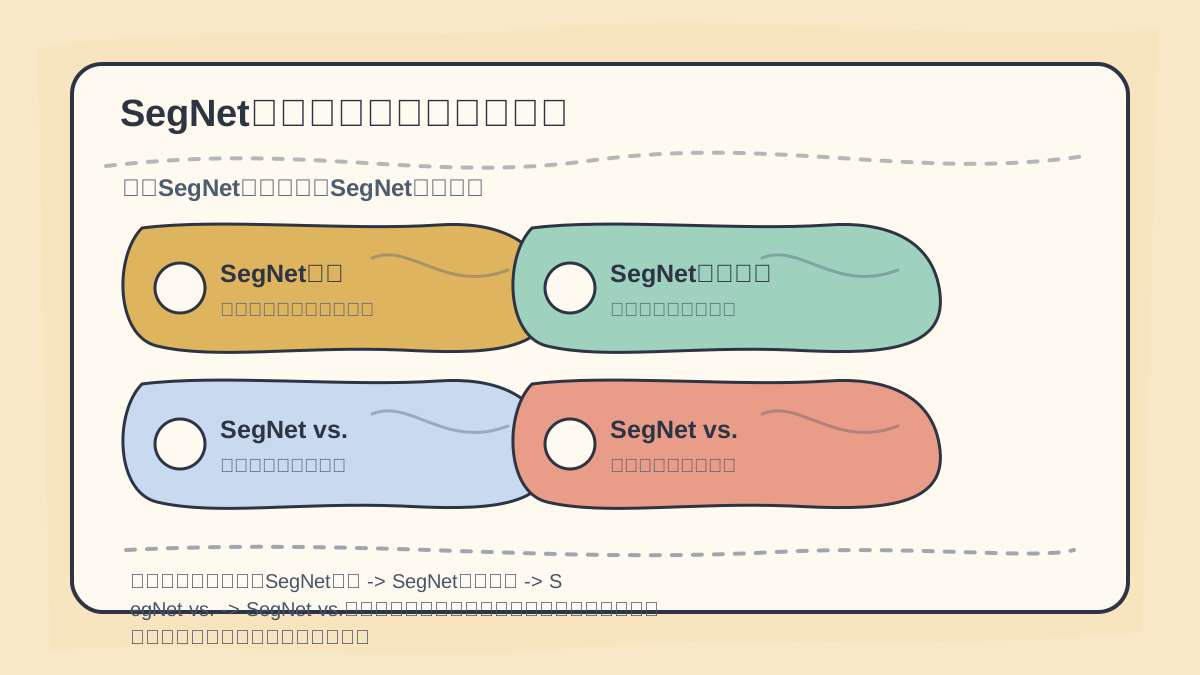
While reading this article, treat the sequence “SegNet Introduction → SegNet vs. Others → SegNet vs. … → SegNet vs. …” as a verification checklist: first identify the objects, pathways, and supporting evidence; then return to concrete examples, code snippets, or quantitative metrics to cross-check.
- Advantages:
- DeepLab excels at segmenting scenes with multiple overlapping or densely packed objects.
- Disadvantages:
- Its incorporation of multiple sophisticated modules increases both training time and inference latency.
Practical Performance of SegNet
Case Study
In urban traffic scene understanding, SegNet demonstrates strong segmentation capability. For instance, when applied to aerial imagery of cities, it reliably distinguishes roads, vehicles, pedestrians, and other classes. In real-world traffic monitoring systems, SegNet’s design supports near-real-time processing—highlighting its practical deployment value.
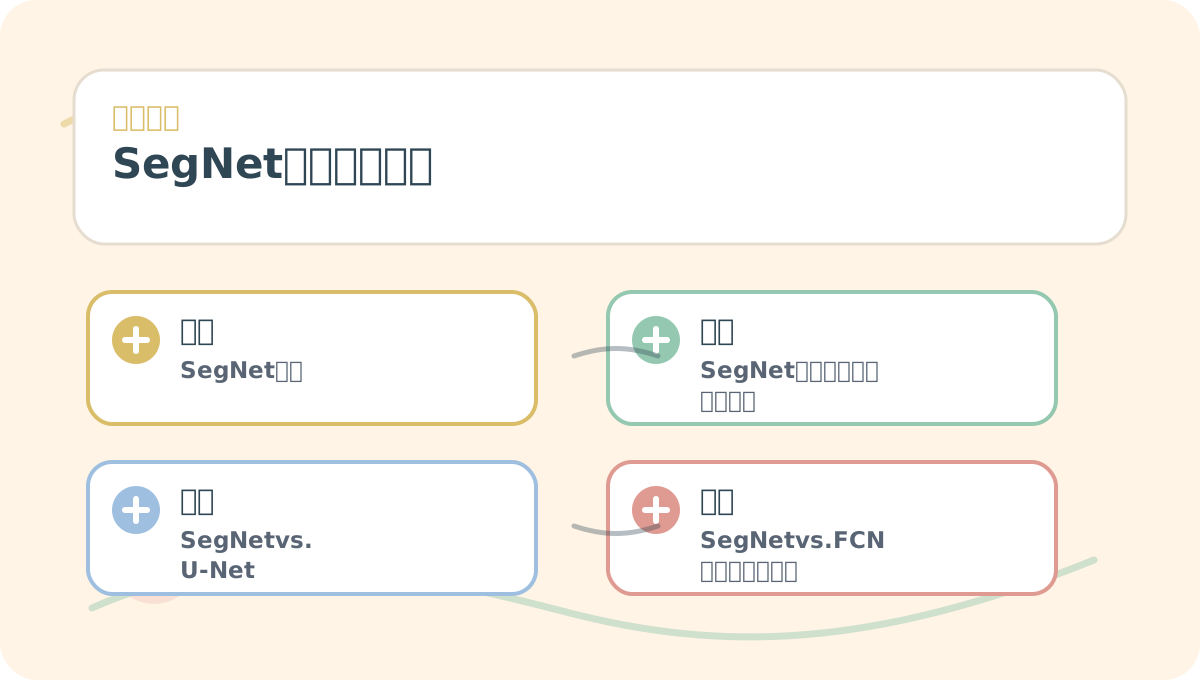
When studying “Comparison and Discussion of SegNet”, begin with a small, reproducible scenario you can implement yourself. Then explore related concepts and step-by-step exercises. After reading, try restating the core ideas using your own example.
Below is a minimal Keras implementation of SegNet for image segmentation:
from keras.models import Model
from keras.layers import Input, Conv2D, MaxPooling2D, UpSampling2D

def build_segnet(input_shape):
    inputs = Input(shape=input_shape)
    # Encoder
    conv1 = Conv2D(64, (3, 3), activation='relu', padding='same')(inputs)
    pool1 = MaxPooling2D(pool_size=(2, 2))(conv1)

    conv2 = Conv2D(128, (3, 3), activation='relu', padding='same')(pool1)
    pool2 = MaxPooling2D(pool_size=(2, 2))(conv2)

    # Bottleneck
    conv3 = Conv2D(256, (3, 3), activation='relu', padding='same')(pool2)

    # Decoder
    up1 = UpSampling2D(size=(2, 2))(conv3)
    conv4 = Conv2D(128, (3, 3), activation='relu', padding='same')(up1)

    up2 = UpSampling2D(size=(2, 2))(conv4)
    conv5 = Conv2D(64, (3, 3), activation='relu', padding='same')(up2)

    outputs = Conv2D(1, (1, 1), activation='sigmoid')(conv5)

    model = Model(inputs=inputs, outputs=outputs)
    return model

segnet_model = build_segnet((256, 256, 3))
segnet_model.compile(optimizer='adam', loss='binary_crossentropy', metrics=['accuracy'])
This code constructs a simplified SegNet model comprising encoder and decoder stages. By adjusting filter counts and pooling sizes per layer, the architecture can be customized to suit specific application requirements.
By this point, summarize “Comparison and Discussion of SegNet” into a retrospective table: first clarify the central narrative, then validate it using a small-scale task.
After finishing “Comparison and Discussion of SegNet”, select a small working example and walk through the full pipeline end-to-end—then assess which steps you can now execute independently.
Summary
In this article, we compared and discussed SegNet’s performance in image segmentation against several widely adopted alternatives. Although SegNet delivers competitive results in certain well-defined scenarios—especially where memory efficiency and moderate accuracy are prioritized—architectures like U-Net and DeepLab often outperform it in highly diverse or structurally complex environments. Understanding these trade-offs provides foundational insight and practical experience critical for our next topic: improved architectures built upon Variational Autoencoders (VAEs).
In the following article, we will shift focus to VAE-based architectural enhancements—exploring how generative modeling can be further advanced.
Apply This Lesson
Turn this article into AI software, model, API, and security decisions.
English Article FAQ
Use this article as evidence before choosing AI tools
How should I use this AI Tutorials article?
Use it as the implementation or learning layer, then connect the idea to AI software buyer guides, tool comparisons, benchmarks, API choices, and security checks before making a production decision.
Is this English article different from the Chinese original?
The English edition is localized for global AI readers while preserving the original diagrams, screenshots, prompts, code examples, and source context from the Chinese article.
What should I read after SegNet: Architecture Comparison and Discussion?
Continue with AI Software Buyer Guides, AI Tools Workbench, Best AI Coding Agents, AI Model Benchmarks, OpenAI vs Anthropic API, or LLM Security Tools depending on the decision you need to make.
Can this article alone choose an AI product or model?
No. Treat the article as evidence and context, then validate fit with pricing, privacy requirements, integration effort, benchmark results, workflow tests, and fallback planning.
Continue